--
Why Should You Use a Concrete Vault?
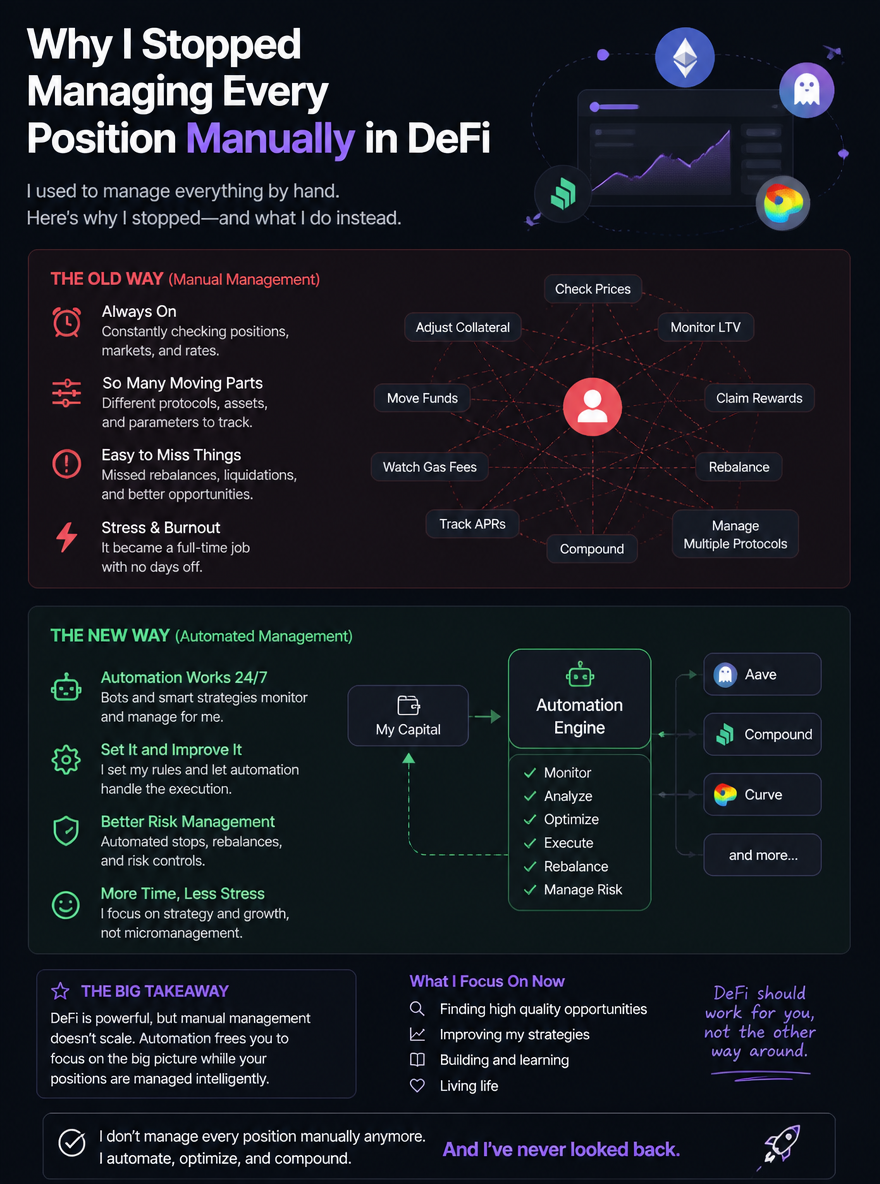
DeFi is supposed to feel like financial freedom — but for most users, it feels like a second job.
If you want to stay competitive, you’re stuck doing the same exhausting cycle every day:
checking APYs, hopping across protocols, claiming rewards, compounding by hand, tracking risk, and praying you didn’t miss an exploit announcement at 2 a.m.
It works… until it doesn’t.
Manual management simply doesn’t scale.
And the more complex DeFi becomes, the more this manual grind punishes the average user.
This is exactly where Concrete Vaults step in.
1️⃣ The Reality of Today’s DeFi Experience
Let’s be blunt — most users are basically unpaid full-time yield managers.
To stay ahead, people feel forced to:
chase APYs before they decay
constantly reallocate liquidity
claim and re-stake rewards
rebalance strategies by hand
monitor risks across multiple chains
keep spreadsheets just to track positions
This creates friction, missed opportunities, and a ton of idle capital.
The whole experience is inefficient by design.
Vaults exist because this manual loop is fundamentally broken.
2️⃣ What a Concrete Vault Actually Does
Concrete Vaults simplify the entire lifecycle of onchain capital.
Instead of micromanaging positions, users plug into a system designed to work for them.
A Concrete Vault:
pools capital into a coordinated strategy
automates compounding onchain
deploys into structured DeFi positions
optimizes allocations continuously
removes operational overhead
It’s not just “set and forget.”
It’s structured exposure to onchain yield — without constant repositioning.
3️⃣ Why Vault Infrastructure Actually Matters
Good DeFi vaults aren’t just convenience tools.
They’re infrastructure — the backbone that makes capital productive.
Vault infrastructure enables:
Automation — remove human error and missed cycles
Capital Efficiency — reduce idle liquidity
Continuous Optimization — strategies evolve as markets change
Risk-Aware Positioning — predefined constraints keep exposure controlled
Simplicity — users plug in once and stop babysitting their positions
The core benefit?
Consistency.
Vaults deliver what manual users can’t maintain: ongoing, systematic execution.
4️⃣ Vaults Are Not "Yield Wrappers" — They’re Structured Systems
A lot of people still think vaults just auto-compound rewards.
Concrete Vaults are far more sophisticated.
They’re built to:
coordinate capital deployment at scale
rebalance based on market structure
enforce guardrails and constraints
respond automatically to changing conditions
maintain strategy behavior over time
This is structured DeFi — not lucky farming.
5️⃣ The Concrete Vault Architecture Advantage
Concrete isn’t building “another vault.”
They’re building vault infrastructure designed for institutional-grade efficiency.
Their architecture uses:
ctAssets – tokenized vault shares representing structured positions
automated compounding – executed onchain
coordinated vault systems – capital moves intelligently, not randomly
onchain execution – transparency without relying on offchain bots
This system transforms scattered liquidity into coordinated onchain capital.
That’s what makes Concrete Vaults stand out:
not just automation, but intelligent, structured capital deployment.
To explore the ecosystem:
Concrete.xyz
6️⃣ The Bigger Shift in DeFi
The direction of the industry is clear:
Markets are getting more complex
Manual farming doesn’t scale
Retail users can’t compete with automated capital
Infrastructure is replacing constant repositioning
Vaults are becoming the default way to participate in DeFi
The future won’t be defined by users clicking between protocols desperately chasing yield.
It will be defined by systems that coordinate capital more efficiently than any individual can.
Concrete Vaults represent that evolution — structured, automated, and built for the next era of DeFi.