Concrete:What Makes a DeFi Strategy Actually Sustainable?
--
What Makes a DeFi Strategy Actually Sustainable?
DeFi is full of yield — but not all yield lasts.
New strategies launch every week, APYs spike, and capital flows in fast. But most opportunities are short-lived. Yields compress, liquidity moves elsewhere, and what once looked promising quickly fades.
That raises the real question:
It’s not “What has the highest yield?”
It’s “What actually lasts?”
In mature financial systems, the best strategies are not the ones that perform for a week — but the ones that survive across market cycles.
So the deeper question for DeFi is clear:
What makes a strategy sustainable?
Why do some opportunities disappear while others persist?
And how should capital think about long-term yield over short-term hype?
That is what separates temporary opportunity from durable strategy.
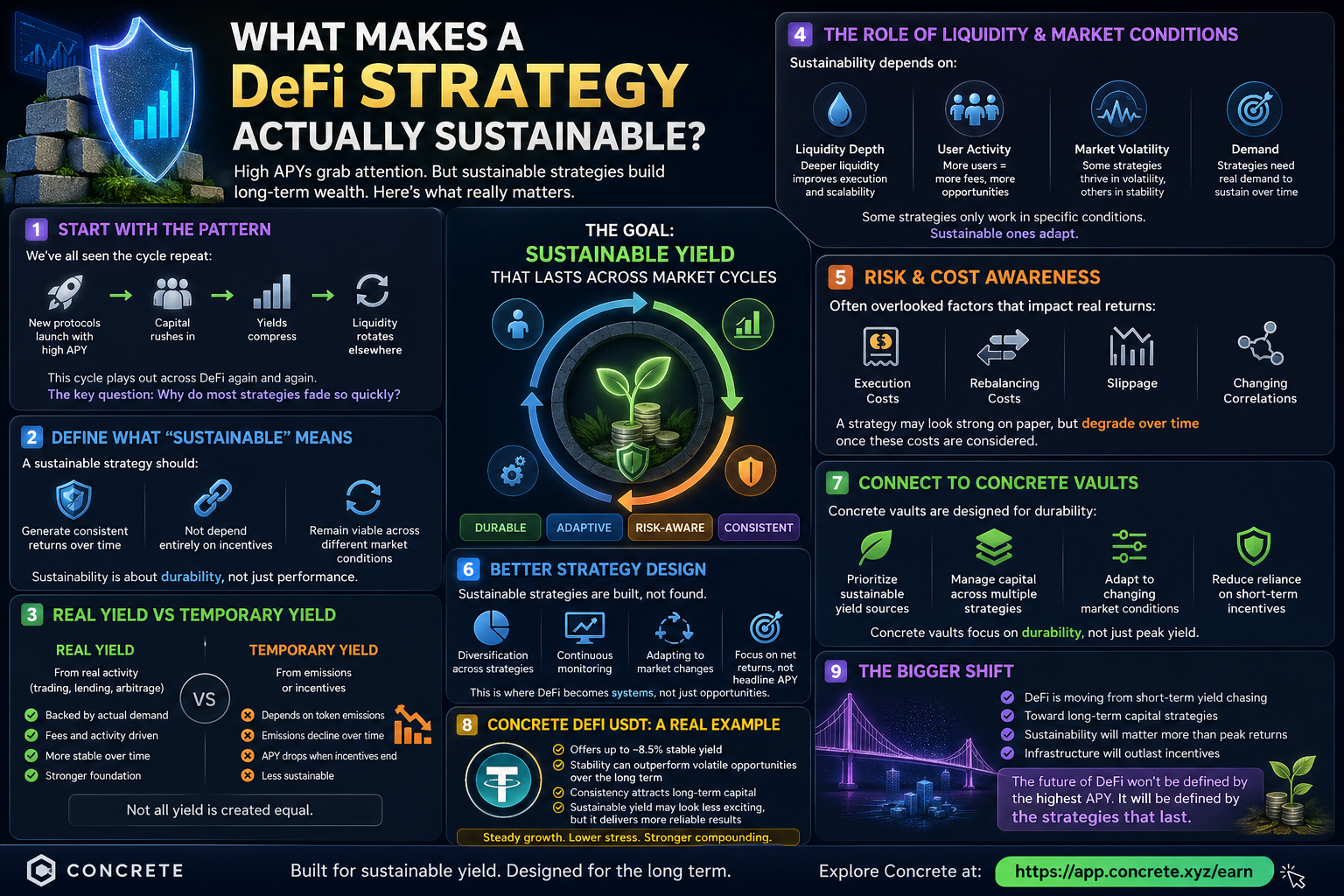
1) Start With the Pattern: The Cycle We Keep Seeing in DeFi
If you have spent enough time in DeFi, you start noticing a pattern that repeats over and over again.
A new protocol launches with attractive rewards. It promises innovation, efficiency, and one thing that always captures attention — high yield. Sometimes it is 20% APY. Sometimes 50%. Sometimes even higher. Immediately, capital begins to move. Liquidity providers deposit funds. Traders start talking about it. Communities build excitement around the opportunity. For a brief period, everything looks strong.
Then reality begins to set in.
As more capital enters, returns start compressing. The opportunity becomes crowded. The edge that made the strategy attractive begins to disappear. Incentive programs slowly reduce emissions. Market conditions change. Liquidity starts rotating toward newer opportunities offering better short-term returns. Eventually, the once “hot” strategy becomes just another faded chapter in DeFi’s fast-moving history.
We have seen this happen across yield farms, liquidity mining programs, emissions-driven protocols, and speculative incentive structures. It is not rare — it is one of the most common patterns in decentralized finance.
This raises an important question for serious capital allocators:
Why do most DeFi strategies fade so quickly?
The answer often comes down to one simple truth: many strategies are built to attract capital, but very few are built to sustain it.
And that is where the real conversation begins — not around which strategy offers the highest APY today, but around what creates sustainable yield that can survive tomorrow.
2) Define What “Sustainable” Means: Durability Over Excitemen
In DeFi, sustainability is often misunderstood.
Many people assume a sustainable strategy simply means lower risk or smaller returns. But sustainability is not about being conservative — it is about being durable.
A truly sustainable strategy is one that can continue generating returns over time without relying entirely on temporary support mechanisms. It is designed to remain viable in bull markets, bear markets, volatile environments, and changing liquidity conditions.
At its core, sustainability means three things.
First, a strategy must generate consistent returns over time, not just perform well during a short window of favorable conditions. Consistency builds trust, attracts long-term capital, and allows compounding to work.
Second, it must not depend completely on external incentives. If a strategy only works because token emissions are subsidizing returns, then it is fragile by design. Once those incentives fade, performance often fades with them.
Third, it must remain functional across different market cycles. Markets are dynamic. Liquidity shifts. Volatility rises and falls. User behavior changes. Sustainable DeFi strategies are built to adapt rather than collapse under pressure.
This is why the best investors increasingly focus on risk-adjusted yield, not just raw yield. High returns mean little if they come with instability, hidden downside, or short lifespan.
In mature financial systems, durability is valuable. The same principle is now becoming central to DeFi.
3) Compare Real Yield vs Temporary Yield: Not All Yield Is Equal
One of the biggest mistakes in decentralized finance is assuming all yield is the same.
It is not.
There is a major difference between temporary yield and real yield, and understanding that difference is essential when evaluating long-term opportunities.
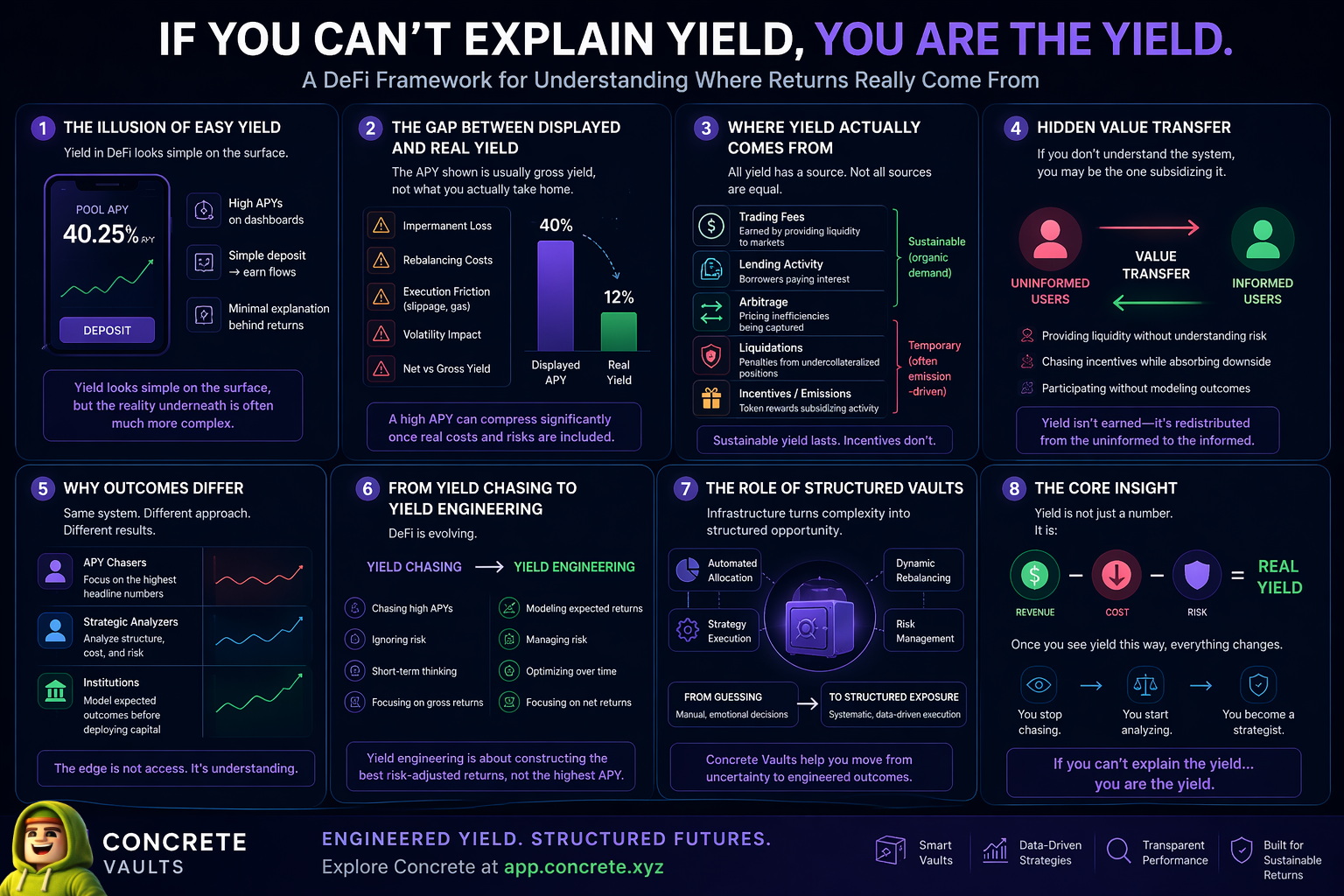
Temporary yield is usually driven by incentives. This includes liquidity mining rewards, token emissions, promotional farming campaigns, and ecosystem subsidies designed to attract users quickly. These mechanisms are powerful for bootstrapping liquidity, but they are often short-lived. They create attention — but not necessarily durability.
The problem is simple: incentives cost money.
Protocols cannot distribute rewards forever without dilution, treasury strain, or pressure on token economics. Once emissions decrease, the attractive APY that brought in capital begins to disappear. When returns drop, liquidity leaves. The cycle resets.
This is yield built on distribution — not economics.
Real yield is fundamentally different.
Real yield comes from actual market activity — trading fees generated by volume, lending interest paid by borrowers, arbitrage opportunities created by inefficiencies, structured market-making returns, and productive onchain financial activity that exists because users genuinely need the service.
This yield is supported by economic demand rather than promotional incentives.
That is why real yield is often more stable.
It may not always look flashy. It may not generate explosive short-term numbers. But it is more likely to persist, and persistence is what creates meaningful long-term returns.
This is the foundation of sustainable yield.
4) Highlight the Role of Liquidity & Market Conditions: Context Matters
Even strong strategies can fail if market conditions are not supportive.
Liquidity is one of the biggest forces shaping whether a DeFi opportunity becomes durable or disappears.
Deep liquidity improves execution quality. It reduces slippage. It allows larger capital deployment. It creates healthier markets. It builds user confidence. Without liquidity depth, even well-designed strategies become difficult to scale.
User activity also matters.
A lending strategy depends on borrower demand. A trading-fee strategy depends on trading volume. A market-making strategy depends on continuous market participation. If users disappear, revenue generation weakens.
Volatility plays an equally important role.
Some DeFi strategies perform exceptionally well during high volatility because spreads widen and trading activity increases. Others work better during stable market periods where capital preservation becomes more valuable. Sustainability often depends on understanding which market conditions support a strategy — and whether that strategy can adapt when those conditions change.
This is where many short-term opportunities fail. They only work in narrow environments.
But durable DeFi vaults are built differently. They are designed to respond to changing market conditions rather than depend on one perfect setup.
Adaptability is a major competitive advantage in DeFi.
5) Introduce Risk & Cost Awareness: The Hidden Reality Behind APY
Headline APY can be misleading.
A strategy may look exceptional on paper, but once real-world costs are included, actual performance can be far lower.
Execution costs are one factor. Every strategy requires movement of capital, transaction settlement, and operational execution. Fees matter — especially when rebalancing is frequent.
Slippage matters too.
A strategy might show profitable numbers based on ideal entry and exit prices, but real execution in live markets often creates friction that reduces returns.
Rebalancing costs quietly compound over time. Strategies that constantly shift allocations may improve positioning, but those adjustments come with cost.
Correlation risk is another hidden factor. Strategies that appear diversified may actually become highly correlated during market stress, increasing downside exposure when protection matters most.
Then there is smart contract risk, liquidity withdrawal risk, and structural market risk.
When these factors are ignored, APY becomes marketing — not reality.
This is why sophisticated onchain capital increasingly focuses on net returns and risk-adjusted yield rather than headline numbers.
What matters is not what a strategy promises.
What matters is what capital actually keeps.
6) Connect This to Better Strategy Design: Systems, Not Opportunities
The strongest DeFi strategies today are no longer isolated opportunities — they are systems.
They are built with diversification in mind. Instead of relying on one source of yield, they allocate capital across multiple productive strategies. This reduces concentration risk while improving resilience.
They are continuously monitored. Markets move fast. Conditions change quickly. Sustainable systems require active observation and intelligent adjustment.
They are adaptive. If one yield source weakens, capital can be reallocated toward stronger opportunities. This flexibility improves durability.
They prioritize net returns, not vanity metrics. A lower but stable return can outperform a volatile high-return strategy over time because compounding favors consistency.
This is what managed DeFi increasingly looks like — capital allocation guided by structure, discipline, and strategic design rather than emotion and short-term speculation.
This shift is important because it transforms DeFi from chasing opportunities into building infrastructure.
And infrastructure lasts.
7) Connect to Concrete Vaults: Building for Durability
This is where Concrete vaults represent an important evolution in DeFi.
Rather than focusing purely on peak yield, Concrete is designed around sustainability, intelligent capital management, and long-term performance.
The goal is not simply to find yield.
The goal is to build systems that can generate risk-adjusted yield consistently while adapting to changing markets.
Concrete vaults aim to do this by prioritizing durable yield sources rather than relying heavily on short-lived incentives. Capital is managed across structured opportunities with a focus on efficiency, resilience, and strategic deployment.
This creates a stronger foundation for long-term participation.
Instead of asking users to constantly monitor markets, rotate liquidity, and chase new opportunities, Concrete vaults offer a more structured approach to managed DeFi — where capital is positioned intelligently and adjusted as conditions evolve.
This is how DeFi becomes more attractive to larger pools of institutional DeFi capital: through reliability, transparency, and disciplined strategy design.
8) Use Concrete DeFi USDT as an Example: Stability Can Win
A strong real-world example is Concrete DeFi USDT, offering up to approximately ~8.5% stable yield.
At first glance, some investors may compare that number against higher short-term opportunities elsewhere and think it looks modest.
But sustainable finance is not built on excitement — it is built on consistency.
Stable yield compounds.
Stable yield attracts long-term capital.
Stable yield improves predictability.
Stable yield reduces the constant need for repositioning.
Over time, a durable 8.5% return can outperform unstable double-digit opportunities that collapse after incentives end or risk events emerge.
This is the difference between temporary upside and lasting performance.
For serious onchain capital, consistency often matters more than spectacle.
That is why sustainable products like Concrete DeFi USDT may ultimately become more attractive than volatile yield farms built on short-term hype.
Sometimes the strongest opportunity is not the loudest one.
It is the one still delivering years later.
9) Close With the Bigger Shift: The Future Belongs to Sustainable Yield
DeFi is evolving.
The early phase of decentralized finance was largely defined by experimentation, rapid incentives, and aggressive yield chasing. That phase helped bootstrap innovation — but it is not the final form of DeFi.
The next phase is about maturity.
Capital is becoming smarter. Strategy design is becoming more sophisticated. Infrastructure is improving. Risk frameworks are becoming stronger.
The market is moving:
from short-term farming → to long-term capital allocation
from emissions → to real economic activity
from hype → to durability
from isolated products → to scalable DeFi vaults
from speculative yield → to sustainable, risk-adjusted yield
This is the direction of institutional DeFi.
This is where managed DeFi becomes essential.
This is where durable infrastructure wins.
Because in the end, the future of decentralized finance will not be defined by the highest APY.
It will be defined by the strategies that last.
Explore Concrete at: https://app.concrete.xyz/earn