concrete
 killua3 min read·Just now
--
DeFi Doesn’t Remove Trust — It Engineers It
“Trustless.”
That word did a lot of heavy lifting in early DeFi.
It promised a world where you didn’t have to rely on people anymore.
No banks. No middlemen. No gatekeepers.
Just code.
And for a while, that narrative was enough.
But the longer you stay in DeFi, the more obvious it becomes:
👉 nothing here is actually free from trust.
The Idea Was Right — Just Incomplete
“Don’t trust people, trust code” isn’t wrong.
It’s just not the full picture.
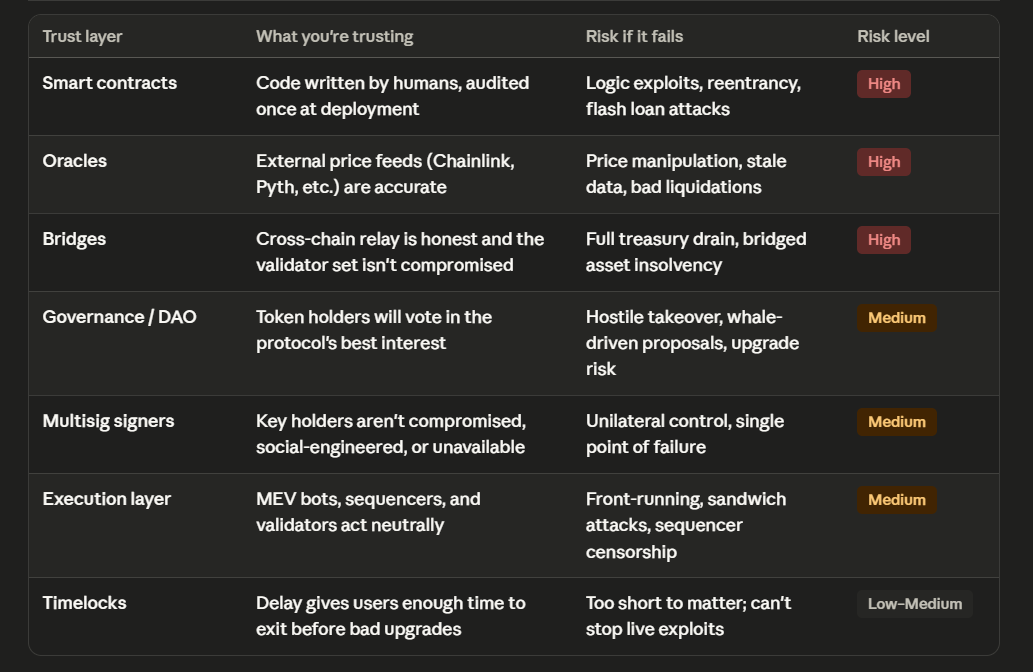
Because the moment you interact with any DeFi system, you’re already trusting something:
- that the contract won’t break
- that governance won’t act against you
- that price feeds are accurate
- that infrastructure won’t fail
So trust didn’t disappear.
It just changed form.
Trust Didn’t Go Away — It Got Harder to See
In traditional finance, trust is visible.
You know who you’re relying on.
In DeFi, it’s different.
Trust is embedded in layers:
- smart contract logic
- upgrade mechanisms
- oracle systems
- bridges and cross-chain messaging
- execution environments
Most of the time, users don’t see these layers.
They just see a clean UI and a working product.
That creates a dangerous gap:
👉 you’re trusting systems you don’t fully understand
The Illusion of Decentralization
A lot of DeFi systems look decentralized.
But appearance isn’t the same as resilience.
We’ve seen setups where:
- multisigs act as central control points
- DAOs exist, but few people actually participate
- timelocks delay decisions but don’t prevent bad ones
- systems freeze when fast action is needed
This is where the idea of “decentralization theatre” comes in.
Everything looks distributed.
But under pressure, control often concentrates.
The Real Question Isn’t “Trustless”
At this point, the conversation needs to change.
Instead of asking:
👉 “Is this trustless?”
A better question is:
👉 “How is trust structured here?”
Because every system has it.
The difference is whether it’s:
- hidden and assumed
- or explicit and designed
What Engineered Trust Looks Like
Mature systems don’t pretend trust doesn’t exist.
They define it.
Engineered trust means:
- clear roles and responsibilities
- controlled permissions
- constraints that can’t be bypassed
- systems that can react to real-world conditions
It’s less about removing trust, and more about making it reliable.
Why Pure Code Isn’t Enough
“Code is law” sounds strong.
Until something unexpected happens.
Markets move fast.
Edge cases appear.
Attacks evolve.
In those moments, static logic isn’t always enough.
You need:
- monitoring
- response mechanisms
- human oversight in critical situations
- layered security
The strongest systems aren’t the ones that remove humans entirely.
They’re the ones that use both code and structure intelligently.
Where Concrete Fits In
This is where Concrete vaults take a more grounded approach.
Instead of leaning on the “trustless” narrative, they focus on designed systems.
That includes:
- role-based architecture
- controlled execution layers
- onchain enforcement
- operational security as a priority
The goal isn’t to pretend risk doesn’t exist.
It’s to manage it deliberately.
That’s closer to how institutional systems operate.
The Direction DeFi Is Heading
DeFi is maturing.
And with that, the priorities are shifting:
- from ideology → to reliability
- from appearance → to performance under stress
- from “no trust” → to well-structured trust
Because in real markets, survival matters more than narratives.
Final Thought
The early promise of DeFi was bold:
Remove trust.
The reality is more nuanced:
👉 trust is unavoidable
So the systems that will last aren’t the ones that deny it.
They’re the ones that:
- make it visible
- make it structured
- and make it enforceable
Because in the end:
👉 it’s not about eliminating trust
It’s about engineering it better than anyone else.
Explore Concrete:
👉 https://concrete.xyz/