concrete
 jinwo3 min read·Just now
--
DeFi Doesn’t Remove Trust — It Engineers It
For a long time, DeFi sold a very simple idea:
“Don’t trust people. Trust code.”
It sounded clean. Logical. Even revolutionary.
No intermediaries.
No human bias.
Just transparent systems running on-chain.
And for a while, that idea worked.
But as DeFi matured, something became obvious:
👉 Trust didn’t disappear. It just moved.
The “Trustless” Myth
The word trustless gets used a lot.
But no real financial system is completely free of trust.
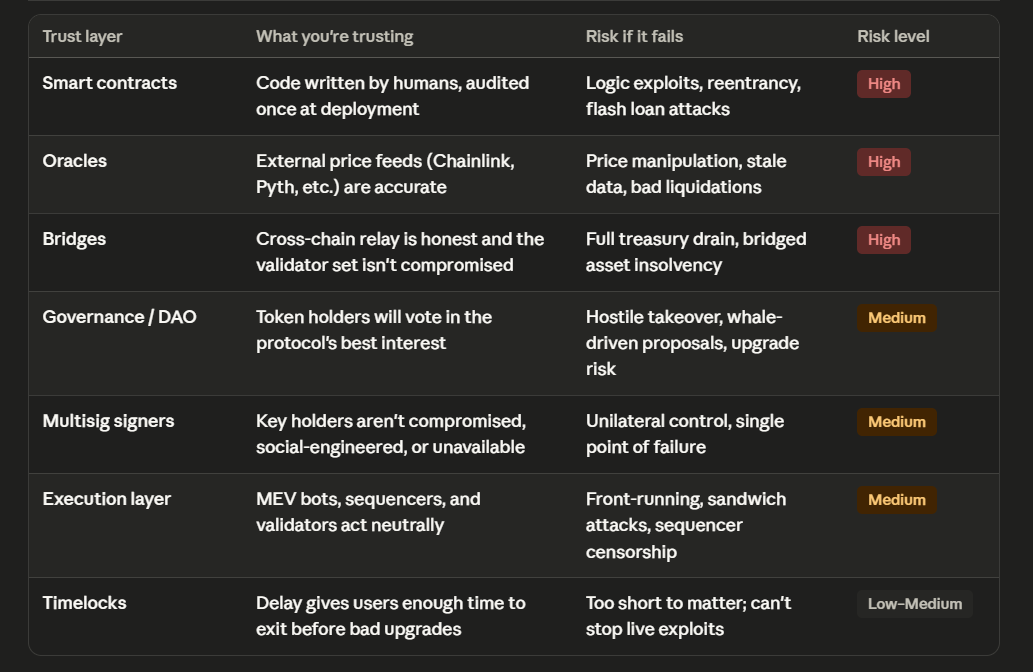
Instead, trust shifts into different layers:
- you trust the smart contract is written correctly
- you trust governance won’t act against you
- you trust oracles are accurate
- you trust bridges won’t break
- you trust execution behaves as expected
So the question isn’t:
👉 “Is this trustless?”
It’s:
👉 “Where is the trust, and how is it handled?”
Where Trust Actually Lives
In practice, DeFi is full of assumptions.
Some are obvious. Others are hidden.
For example:
- Smart contracts — bugs, exploits, edge cases
- Governance — token holders making decisions
- Oracles — external data feeding on-chain logic
- Bridges — some of the biggest attack surfaces in crypto
- Execution layers — how transactions are processed and prioritized
None of these eliminate trust.
They just relocate it into systems that are harder to see.
The Problem With “Decentralization Theatre”
Not everything that looks decentralized is actually resilient.
There’s a difference between:
👉 appearing decentralized
👉 and being secure under stress
We’ve seen patterns like:
- multisigs treated as “safe enough”
- DAOs with low participation but high control
- timelocks that delay problems instead of preventing them
- systems that fail when fast decisions are required
This creates what many call decentralization theatre.
The structure looks right.
But the guarantees are weaker than they appear.
Trust, But Designed Properly
The next step for DeFi isn’t removing trust.
It’s engineering it properly.
That means making trust:
- explicit
- structured
- constrained
- enforceable
In other words:
👉 not something you assume
👉 something the system defines and controls
This is how mature financial systems operate.
And it’s where DeFi is heading.
Why Code Alone Isn’t Enough
“Code is law” works… until it doesn’t.
Real systems face:
- unexpected market conditions
- edge-case failures
- security incidents
- coordination problems
In those moments, you need more than static code.
You need:
- monitoring
- response mechanisms
- defined roles
- the ability to act when things go wrong
Pure automation is powerful.
But resilience requires structure + response, not just rules.
How Concrete Approaches This
This is where systems like Concrete vaults take a different approach.
Instead of hiding trust behind a “fully trustless” narrative, they make it explicit.
Concrete focuses on:
- clearly defined roles and permissions
- controlled execution environments
- onchain enforcement combined with off-chain intelligence
- systems designed to respond, not just prevent
The goal isn’t to remove trust entirely.
It’s to design it in a way that is visible, predictable, and managed.
That’s a very different philosophy from most early DeFi.
The Bigger Shift
DeFi is moving past its early narratives.
The industry is starting to realize:
- trust doesn’t disappear
- complexity doesn’t vanish
- risk doesn’t go away
What changes is how these are handled.
The systems that will matter long-term are not the ones that claim to remove trust.
They’re the ones that:
- define it clearly
- enforce it consistently
- and hold up under stress
Final Thought
“Trustless” was a powerful idea.
But it was never the full story.
Because in any system involving capital:
👉 trust always exists
The real question is:
👉 is it hidden… or engineered?
And going forward, that difference will define which systems survive.
Explore Concrete:
👉 https://concrete.xyz/