concrete
 kaiden2 min read·Just now
--
DeFi Doesn’t Remove Trust — It Engineers It
“Trustless” sounds great.
It’s clean. Simple. Convincing.
No middlemen. No human error. Just code.
But if you’ve actually used DeFi long enough, you know:
👉 that’s not how it really works.
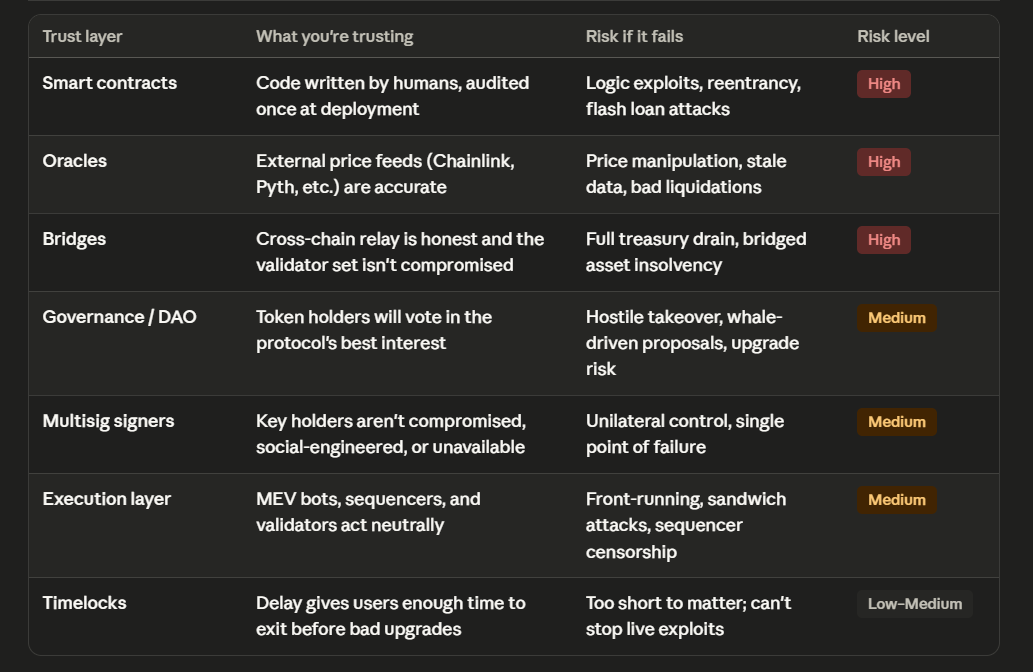
You Still Trust — Just Different Things
Every time you use DeFi, you’re making assumptions.
You trust that:
- the smart contract won’t break
- the team didn’t miss something critical
- governance won’t turn against users
- price feeds are accurate
- infrastructure holds up under stress
That’s still trust.
It’s just packaged differently.
The Problem Is It Feels Invisible
In traditional finance, trust is obvious.
You know who you’re relying on.
In DeFi, it’s abstract.
You interact with a UI.
Click a button.
Everything works.
So it feels trustless.
But behind that, there are layers of dependencies you don’t see.
And most users never think about them.
Not Everything “Decentralized” Is Actually Safe
There’s a big difference between:
👉 looking decentralized
👉 and being resilient
We’ve seen systems where:
- a few keys control everything
- governance exists but barely participates
- safety mechanisms slow things down but don’t stop failure
- protocols freeze when something unexpected happens
From the outside, it looks solid.
Until it isn’t.
The Real Question
At some point, the narrative needs to shift.
Instead of asking:
👉 “Is this trustless?”
Ask:
👉 “Where is the trust, and how is it controlled?”
Because every system has it.
The only difference is whether it’s:
- hidden and assumed
- or explicit and designed
What “Engineered Trust” Actually Means
Good systems don’t pretend trust doesn’t exist.
They define it.
That means:
- clear roles
- strict permissions
- enforced limits
- systems that can react when things go wrong
It’s not as catchy as “trustless.”
But it’s a lot more real.
Code Alone Isn’t Enough
“Code is law” works… until something unexpected happens.
And in markets, something always does.
You get:
- volatility spikes
- liquidity issues
- edge-case bugs
- new attack vectors
At that point, static code isn’t enough.
You need structure around it:
- monitoring
- response
- controlled intervention
That’s what makes a system durable.
Where Concrete Comes In
This is where Concrete vaults take a more practical approach.
Instead of relying on the idea of “no trust,” they focus on structured trust.
That includes:
- role-based architecture
- controlled execution environments
- onchain enforcement
- operational security as a core layer
The goal isn’t perfection.
It’s reliability.
The Direction DeFi Is Going
DeFi is growing up.
And with that, priorities are changing:
- less narrative
- more infrastructure
- less ideology
- more performance under stress
Because at scale, what matters isn’t how a system sounds.
It’s how it behaves when things go wrong.
Final Thought
“Trustless” was a powerful starting point.
But it was never the full story.
Because in any real financial system:
👉 trust doesn’t disappear
It gets designed.
And the systems that win long-term will be the ones that:
- make trust visible
- control it properly
- and hold up when it matters most
Explore Concrete:
👉 https://concrete.xyz/