CONCRETE: If You Can’t Explain Yield, You Are the Yield
--
If You Can’t Explain Yield, You Are the Yield
DeFi didn’t just make yield accessible — it made it visible. And that changed everything.
Today, anyone can open a dashboard, deposit assets, and watch returns update in real time. Numbers move, APYs fluctuate, and positions seem to grow effortlessly.
But there’s a problem hiding in plain sight:
Yield is easier to see than it is to understand.
And in markets, that’s where mistakes begin.
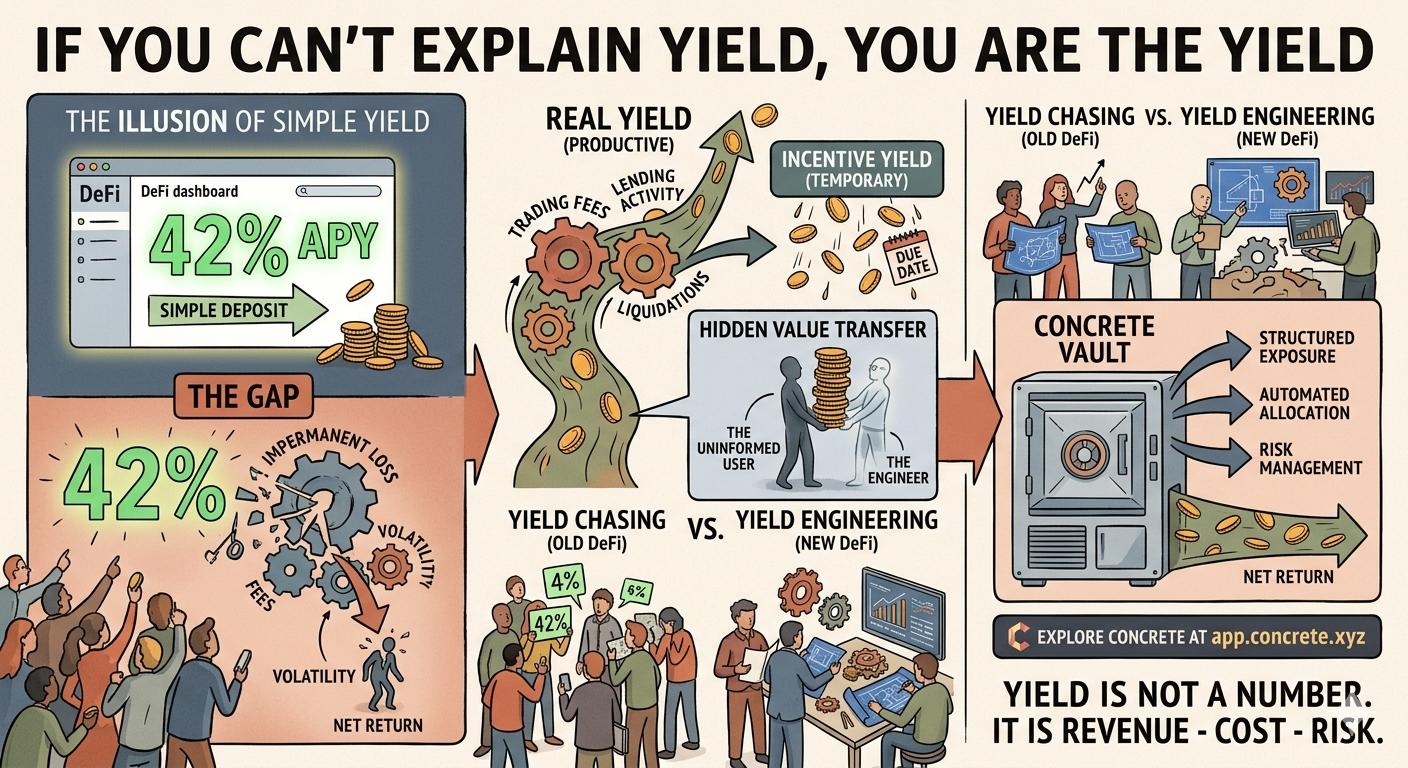
1.The Illusion of Simplicity
Modern DeFi interfaces are designed for clarity sometimes too much clarity
You see:
- High APYs
- Simple “deposit → earn” flows
- Clean dashboards with real-time updates
It feels intuitive. Almost mechanical.
Deposit funds → earn yield → compound → repeat.
But this simplicity is an abstraction.
Behind every clean number is a system of trades, incentives, risks, and counterparties. What you see is not the system — it’s a compressed version of it.
And that compression hides reality.
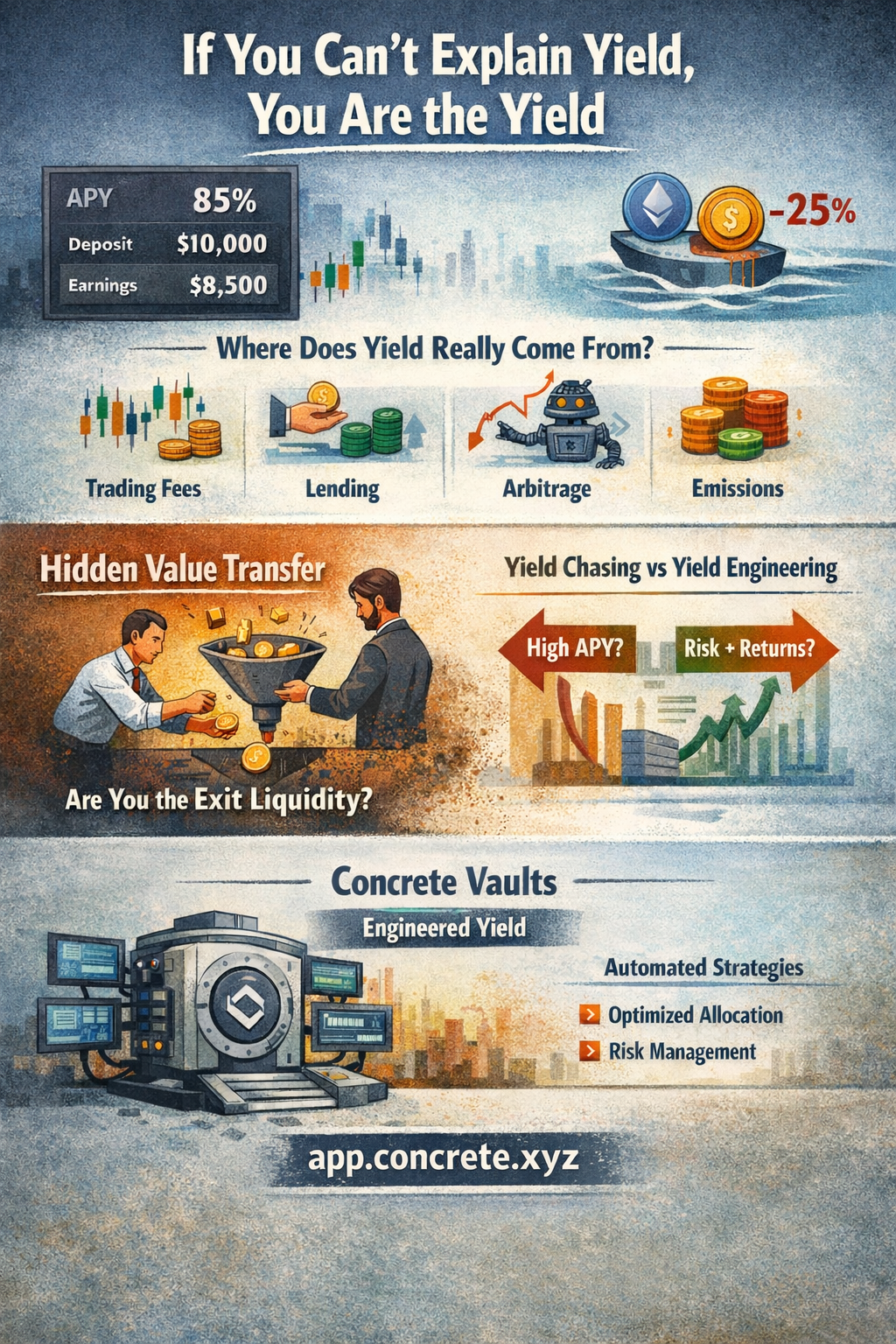
2. The Gap Between Displayed Yield and Real Yield
The APY shown on a dashboard is rarely the yield you actually take home.
Because displayed yield ≠ realized yield.
Let’s break down what gets ignored:
Gross vs Net Return
Most platforms show gross returns.
Your actual return includes:
- Gas fees
- Slippage
- Strategy overhead
- Exit costs
Impermanent Loss
Providing liquidity exposes you to price divergence.
Even if you earn fees:
- Asset price movement can reduce your position value
- Sometimes outperforming simply holding becomes impossible
Rebalancing & Execution Costs
Strategies require constant adjustment:
- Reallocation
- Rebalancing
- Arbitrage alignment
Each step introduces friction — and friction compounds.
Volatility Impact
Volatility increases:
- Fee generation
- But also risk exposure
Without modeling, volatility can erase gains faster than it creates them.
A Simple Reality Check
A pool showing 80% APY might look attractive.
But after:
- 25% impermanent loss
- 10–15% execution and gas costs
- Declining token incentives
Your real return can fall closer to 20% — or even lower.
The yield didn’t disappear.
It was redistributed.
3.Where Yield Actually Comes From
Yield is never created out of thin air. It always comes from somewhere.
In DeFi, the primary sources are:
- Trading fees → from swaps
- Lending activity → borrower interest
- Arbitrage → market inefficiencies
- Liquidations → system maintenance rewards
- Incentives / emissions → token distribution
But not all yield is equal.
Some is:
- Sustainable (fees, lending)
- Competitive (arbitrage, liquidations)
- Temporary (emissions)
Understanding the difference is critical.
4. Idea of Hidden Value Transfer
Here’s the uncomfortable truth:
If you don’t understand the source of yield, you may be the one funding it.
This is where most users quietly lose.
- Providing liquidity without modeling risk
- Earning incentives while absorbing downside
- Participating without understanding system mechanics
Arbitrageurs, advanced traders, and optimized strategies often extract value from inefficiencies.
And those inefficiencies are frequently created by uninformed participation.
If you don’t understand the mechanism, you’re not earning yield — you’re helping someone else extract it.
This is what the title really means.
5.Why Outcomes Differ
Two users can enter the same protocol and leave with completely different results.
The difference isn’t access.
It’s understanding.
- One user chases the highest APY
- Another evaluates structure, cost, and risk
- Institutions model outcomes before deploying capital
Same system.
Different approach.
Different outcome.
6.The Shift Toward Engineered Yield
DeFi is evolving.
We are moving from:
Yield Chasing → Yield Engineering
This shift changes the question from:
“What’s the highest APY?”
to:
“What is the expected net return after cost and risk?”
Yield engineering means:
- Modeling outcomes before deploying capital
- Managing risk dynamically
- Optimizing allocations over time
- Focusing on consistency, not spikes
This is how sophisticated capital operates.
7.From Guessing to Structure: Concrete Vaults
This is where Concrete Vaults come in.
Instead of leaving users to manually navigate complexity, Concrete provides structured, automated exposure to yield strategies.
Concrete Vaults:
- Automate allocation across opportunities
- Manage strategies with defined logic
- Rebalance positions dynamically
- Reduce manual errors and inefficiencies
This shifts users from:
- Reactive decisions
→ Systematic participation
From guessing
→ structured exposure
Concrete doesn’t just display yield.
It helps engineer it.
Explore Concrete at app.concrete.xyz
8.The Core Insight
Yield is not just a number on a dashboard.
It is:
Revenue
− Costs
− Risk (over time)
Understanding this changes everything.
You stop chasing APYs.
You start analyzing systems.
You stop reacting.
You start structuring.
And most importantly:
You stop being the yield.