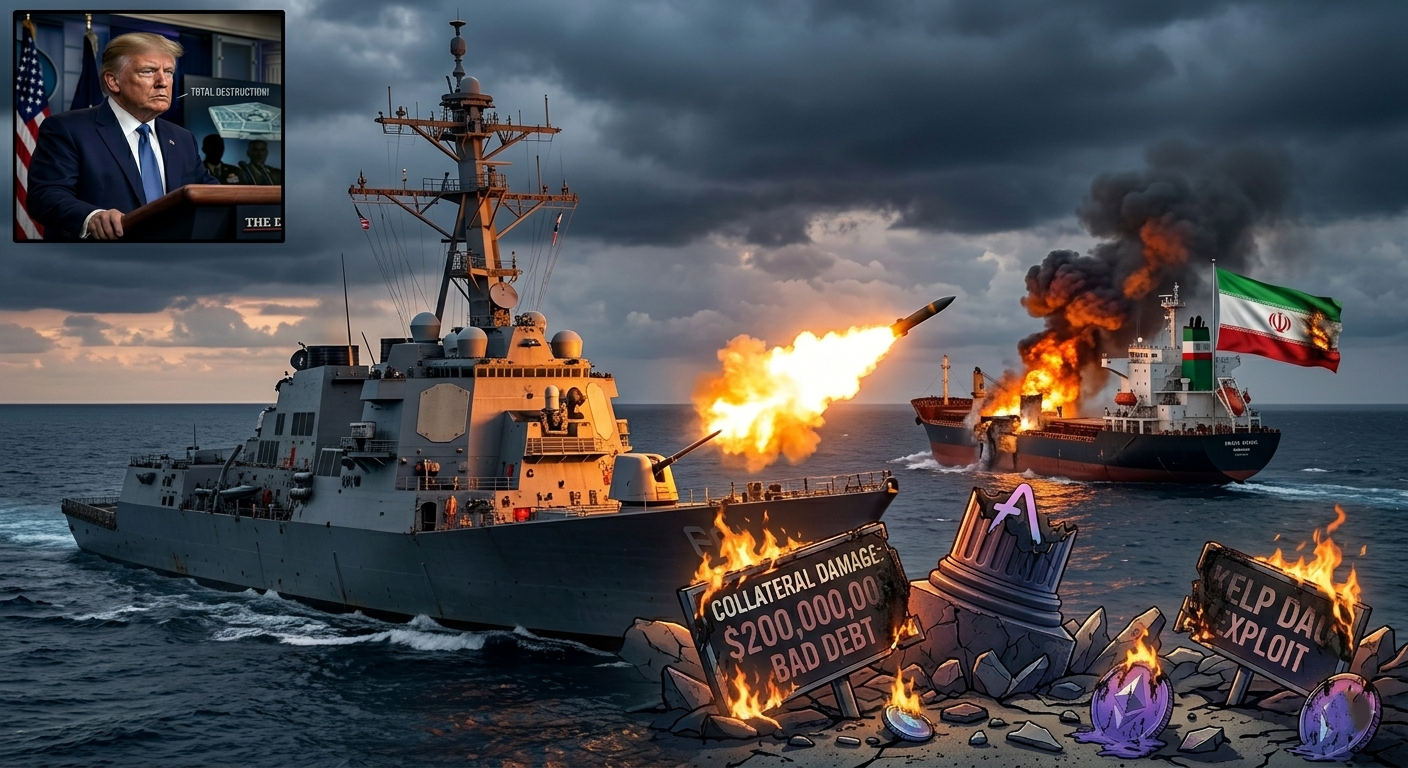
Collateral Damage
 Dick Lo6 min read·Just now
--
20-April-2026
- Markets endured a volatile weekend as initial optimism regarding a Middle East diplomatic breakthrough gave way to renewed friction. On Friday evening, Tehran announced the full reopening of the Strait of Hormuz to commercial shipping. This strategic good faith gesture was made in response to the Israel-Lebanon ceasefire and was intended to pressure Washington into lifting its naval blockade. The move provided a significant tailwind for risk assets with Bitcoin surging to $78k, as investors interpreted the reopening as tangible evidence of Iran’s willingness to move toward a comprehensive settlement. However, the rally faced an immediate headwind from the White House, as President Trump maintained that the US blockade remains non-negotiable until a full peace agreement is finalised
- The weekend’s early gains largely evaporated by late Saturday night as rhetoric from both Tehran and Washington turned sharply defensive. Iran’s Deputy Foreign Minister tempered expectations by clarifying that a date for the second round of formal negotiations has yet to be finalised. Emphasizing the gap between the two parties, he noted, “until we agree on the framework, we cannot set the date”
- Despite a lack of formal commitment from Tehran, a high-level U.S. delegation is scheduled to arrive in Islamabad today, however, this diplomatic deployment has been served with a side of intensifying threats from Washington. In a weekend interview, President Trump said that “maybe he won’t extend” the ceasefire when it expires on Wednesday. Trump then followed it up with a social media post threatening the total destruction of “every single power plant, every single bridge in Iran” if Tehran doesn’t accept the “fair and reasonable” deal that has been tabled
- Tensions further intensified following the U.S. seizure of the Iranian-flagged cargo vessel TOUSKA as it allegedly attempted to breach the U.S. naval blockade. Tehran has condemned the seizure as “maritime piracy” and according to local news agency Tasnim, responded with unconfirmed drone strikes against American warships in the region. While this friction could threaten the stability of the current ceasefire and the likelihood of a second round of negotiations, the underlying diplomatic pulse remains surprisingly active. Security remains at a heightened state in Islamabad today as the city prepares to host a potential second round of high-level U.S.-Iran negotiations, despite Tehran having yet to formally commit to the table. Iranian officials have signalled that their participation is contingent on a “positive signal” from Washington, specifically demanding a partial easing of the naval blockade. With the Wednesday ceasefire expiration looming, this conditional diplomacy suggests that Tehran is attempting to force a pre-negotiation concession
- Meanwhile, a sophisticated bridge exploit over the weekend has dealt a significant blow to DeFi sector confidence. An attacker successfully bypassed verification logic on Kelp DAO’s LayerZero-powered bridge, forging cross-chain messages to mint 116,500 rsETH (approx. $292 million) without underlying backing
- The exploiter immediately utilised this unbacked rsETH as collateral across major lending platforms, notably Aave, to borrow roughly $200 million in WETH. As the deposited rsETH lacks value support and cannot be effectively liquidated, Aave is now contending with a estimated $230 million in bad debt
- While Aave claims that rsETH is fully backed, the incident has triggered a broader confidence crisis resulting in aggressive user-withdrawals across DeFi protocols, whether or not they are directly exposed to rsETH. This contagion has spilled into the derivatives market, where ETH Perps has seen significant negative funding. This shift suggests that participants with trapped long exposure may be aggressively shorting perpetuals to hedge against further downside
- Strategy has proposed transitioning its STRC Perpetual Preferred Equity from a monthly to a semi-monthly dividend schedule. The structural objective of this shift is to shorten the recovery window for STRC to retrace from its ex-dividend drawdown back to its $100 par value. This would enable Strategy to maximise the availability of its ATM issuance programme to maintain a more consistent bid in the Bitcoin spot market. Meanwhile, Michael Saylor’s latest “think even bigger” social media post in combination with last week’s surge in STRC trading volume has the market bracing for the confirmation of a substantial purchase in the past week, likely in excess of 20,000 BTC
- In a keynote address at Auburn University, Fed Governor Chris Waller provided his policy outlook which is currently bifurcated by the Middle East conflict. Should the ceasefire hold and the Strait of Hormuz reopen, Waller anticipates that the transient energy price spike will dissipate, keeping long-term inflation expectations anchored. In this normalisation environment, his focus shifts to the “no-hire, no-fire” labour market, where he signalled a growing inclination toward easing later this year to prevent a fragile jobs market from fracturing. Conversely, if energy prices remain structurally elevated, Waller warned of the risk that higher input costs become embedded across the broader services sector. In this scenario, he remains committed to a restrictive stance, balancing the risks to the dual mandate but more likely tilting toward maintaining policy rates higher for longer
Trading Roadmap
- As we cautioned in Friday’s note, the involvement of President Trump in geopolitical negotiations introduces an inherent element of unpredictability, leaving markets vulnerable to low-liquidity, headline-driven volatility over the weekend. This played out accordingly as Bitcoin’s brief foray above $78k on Middle East optimism was swiftly retraced, and it is now consolidating just above the key $74.5k technical support level
- While the seizure of an Iranian vessel and the ensuing rhetoric suggest an escalation at the headline level, the relatively muted reaction in U.S. equity futures signals underlying market confidence that back-channel negotiations are still targeting a diplomatic off-ramp. Our core thesis remains unchanged that the mid-May Trump-Xi Summit in Beijing represents a hard deadline for the U.S. to resolve regional hostilities
- While we have remained disciplined and refrained from chasing market strength, we continue to tactically accumulate June exposure on pullbacks via low-cost, asymmetric structures designed to capture upside while providing significant downside buffers. For instance:
26-June-2026 $82k/$88k/$95k Call Ladder partially funded by a Short $50k Put (potential 10x payout on premium, along with a potential to exit long BTC holdings at an effective sale price of $101k)
The Kelp DAO exploit triggered a localised liquidity crisis, but we view the resulting discount on Lido’s stETH as a compelling entry point. Despite the substantial outflow of TVL from Aave and the DeFi ecosystem across the board, stETH remains fully backed 1:1 and we are opportunistically accumulating at a healthy discount to par. Additionally, with ETH retracing below Friday’s levels, we have seen renewed client interest in the May Bullish Structures we highlighted last week
Contact the desk for bespoke structures and live pricing
Disclaimer
All information, levels, prices and documents provided herein are being provided for general informational purposes only and should not be considered as a solicitation, offer or recommendation by TDX Strategies Ltd or any of its affiliates. Please read and fully understand our “Electronic Communication Disclaimer” which can be found at https://www.tdx-strategies.com/electronic-communication.