Coinbase named the model: AI-native pods are the new marketing org
 Jukka Blomberg7 min read·Just now
--
On the afternoon of May 5, 2026, Brian Armstrong sent a memo. Coinbase was cutting 14 percent of its staff — about 700 people — and the surviving organisation would be reorganised around what the memo called AI-native pods. Some of those pods, Armstrong told Fortune the next morning, would be a single person doing engineering, design and product. Management would be capped at five layers below the CEO. Every leader would remain an individual contributor. Hiring would concentrate around the pods.
The press read it as a layoff story with an AI cover. They were not wrong about the cover. They missed what was underneath.
The largest publicly listed US exchange just told the market, in plain language, that the AI-leveraged solo operator is the new unit of work. Not a tool. Not a productivity gain. The org chart. That is a different statement than the one Crypto.com, Gemini and Algorand made when they cut their teams in March. Those three told a cyclical-reset story dressed up as an AI story. Coinbase told an AI story dressed up as a layoff story. Both are doing real layoffs. Only one named the new operating model.
For exchanges still running thirty-person marketing teams, this matters. The benchmark moved.
What “AI-native pod” means in practice
Strip the layoff framing and read the org change. A pod is a small, durable unit — typically one to three people — that owns an outcome end to end, with the AI stack doing the work that used to be distributed across functions. The pod’s leader is an individual contributor by mandate, not by accident. The work that used to be coordinated through three or four hand-offs now collapses inside the pod, because the AI stack closes the gaps the hand-offs used to span.
In engineering, that means one operator doing what used to take a team — Armstrong cited engineers shipping in days what used to take weeks. In marketing, the equivalent shape is more boring than the press releases will admit, and more disruptive than the tooling vendors will admit.
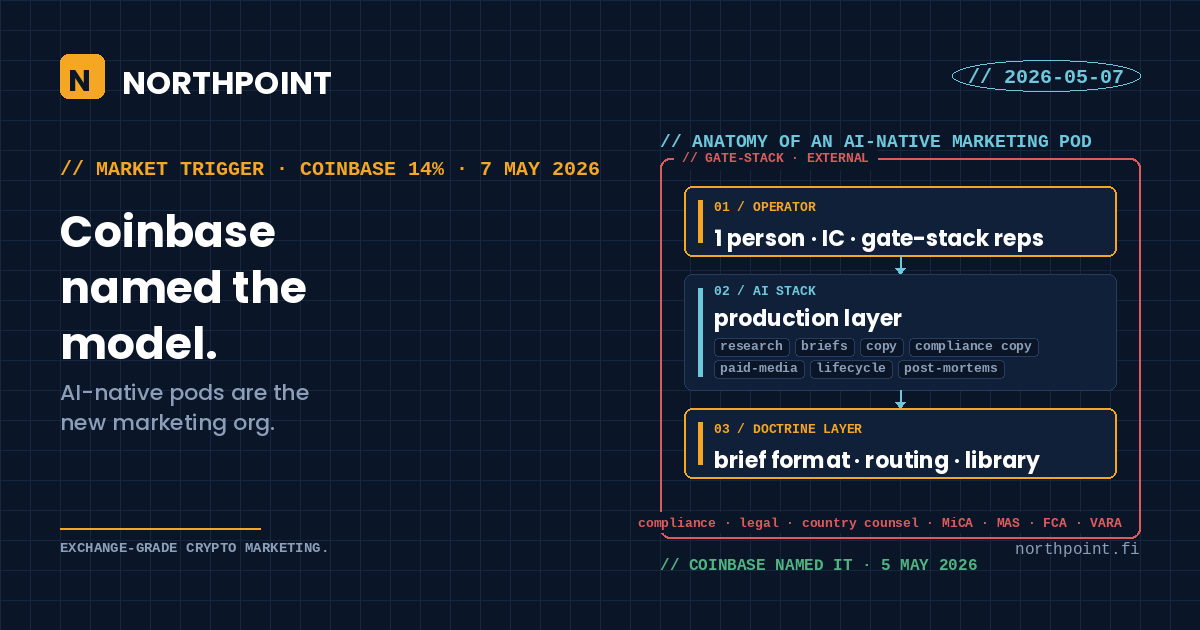
The marketing pod is one operator with the gate-stack reps, a working AI stack, and the authority to ship. The AI stack runs the production layer — research, brief drafts, copy iteration, jurisdictional compliance copy, paid-media review, lifecycle messaging, post-mortem write-ups. The operator runs the doctrine layer — the brief format that survives compliance, the routing logic for the gate-stack, the country-specific risk-disclosure library, the campaign-pull authority chain, the post-mortem template that legal will sign. The pod ships the work that a team of fifteen used to ship, and it ships it with less coordination overhead because the coordination layer has been moved inside the AI stack.
This is not a theoretical model. It is what one ex-CMO running an AI-native marketing function looks like in 2026. It is also exactly the productisation that NorthPoint shipped as AI Crypto CMO. Coinbase just made it the default.
Why the marketing variant is harder than the engineering variant
The Coinbase announcement is going to get copied. Most of the copies will fail. The reason is structural, and it shows up most clearly in marketing.
A pure-engineering pod can run on the AI stack alone because the gate-stack for engineering work is mostly internal — code review, security review, testing, deploy. The AI stack maps cleanly onto each of those. An LLM can write the code, write the tests, run the security review, and write the deploy script. The engineer’s job becomes orchestration, taste, and edge-case judgement.
A marketing pod inside a regulated exchange does not have the same shape. The gate-stack is external. Compliance, legal, treasury, listings, country counsel in three jurisdictions, the CFO on quarterly campaigns, the CISO on anything touching the SDK. The brief that survives that gate-stack is a different artefact than the brief that comes out of an LLM by default. The AI stack can draft it, but the brief that ships is the one the operator has rewritten enough times to know which clause will trigger which gate. That muscle does not come out of the model. It comes out of having been through the gates.
The same shape applies to country-specific risk-disclosure copy under MiCA, suitability copy under MAS, financial-promotion language under FCA, and risk warnings under VARA. The AI stack can hold the library and serve the right clause for the right jurisdiction. It cannot tell you which clause will get the campaign pulled in Frankfurt next Tuesday at 3pm. The operator has to know that, and the pod fails without them.
This is why the Coinbase announcement does not flatten the senior-marketing market. It widens it. The exchanges that will run a working AI-native marketing pod in Q3 are the ones that already had an exchange-grade operator. The exchanges that read the memo and try to convert their three-person agency retainer into “an AI-native pod” by re-labelling the channel manager will spend the next two quarters writing post-mortems they cannot ship.
The benchmark just moved for everyone else
If you are an exchange running a 25-to-40-person marketing org and reading this in the week of the Coinbase announcement, the realistic question is not whether to copy the model. It is whether your board is going to ask you about it inside the next two earnings cycles. The answer is yes. So is your CFO’s. So is the analyst that covers you.
The defensive posture is to wait. Run the model the team has, ship the campaigns in the queue, and see whether Coinbase actually delivers on the structural change in Q3 or quietly walks it back when the campaigns get killed at the gates. That posture is rational. It is also slow.
The offensive posture is to map the pod model onto the function deliberately, before the next earnings call, while the team is still intact and the doctrine is still owned. That is a different shape of work, and it does not look like a layoff. It looks like splitting the existing team into two clusters — the doctrine cluster (one or two senior operators with gate-stack reps, owning brief format, routing, library, post-mortem) and the production cluster (the rest of the team, augmented by the AI stack, executing the work the doctrine cluster ships). The doctrine cluster is the pod. The production cluster is what the pod scales through. Six months in, the production cluster is smaller, the doctrine cluster has not changed size, and the function ships more campaigns with fewer hand-offs.
That re-shape is doable inside an existing team. It is not doable from a cold start during a layoff. The exchange that runs it now has a quarter or two of head-start over the exchange that waits for the press cycle to confirm the model. The cost of the head-start is one re-org. The cost of waiting is a rebuild from outside.
What this changes for the agency model
There is one more move buried in the Coinbase memo that the agency market has not priced yet. Armstrong said hiring would concentrate around the pods. He did not say the pods would buy services from the existing agency stack. The math of an AI-native pod cuts against the retainer agency in two specific ways.
The pod’s production layer is run by the AI stack the operator already owns. The deliverables that used to justify the retainer — content, lifecycle copy, paid-media drafts, jurisdictional copy variants, post-campaign reports — are now the cheapest layer of the pod, not the most expensive. The pod’s bottleneck is doctrine, and doctrine does not come from a retainer agency that did not write it. So the pod buys senior strategic depth on a pulse — fractional CMO, design-partner engagements, project-shaped work — and runs the rest in-house with the stack. The agency that priced its model on retained production hours is mispriced for this shape of buyer.
The agencies that will adapt are the ones that move from production to doctrine — selling the operator-grade reps, not the channel coverage. The agencies that will not adapt will discover, somewhere around the third quarter of 2026, that their renewal conversations are getting harder for reasons their account leads do not yet have language for. The reason is the pod.
The shorter version
Coinbase did not invent the AI-native marketing pod. It named it. Naming a thing in public, at scale, with the pricing-power of the largest publicly listed US exchange, is what shifts the market. Every other exchange CMO is going to be asked about the model inside the next quarter. The CMOs who already have the doctrine, the gate-stack reps and the AI stack will answer the question with a roadmap. The ones who don’t will answer it with a hire. The hire is the most expensive answer in the room.
The thesis the rest of crypto marketing has been arguing about for six months is settled now. The work, from here, is execution. That is a different kind of week.
— Jukka Blomberg, Helsinki, 7 May 2026
— -