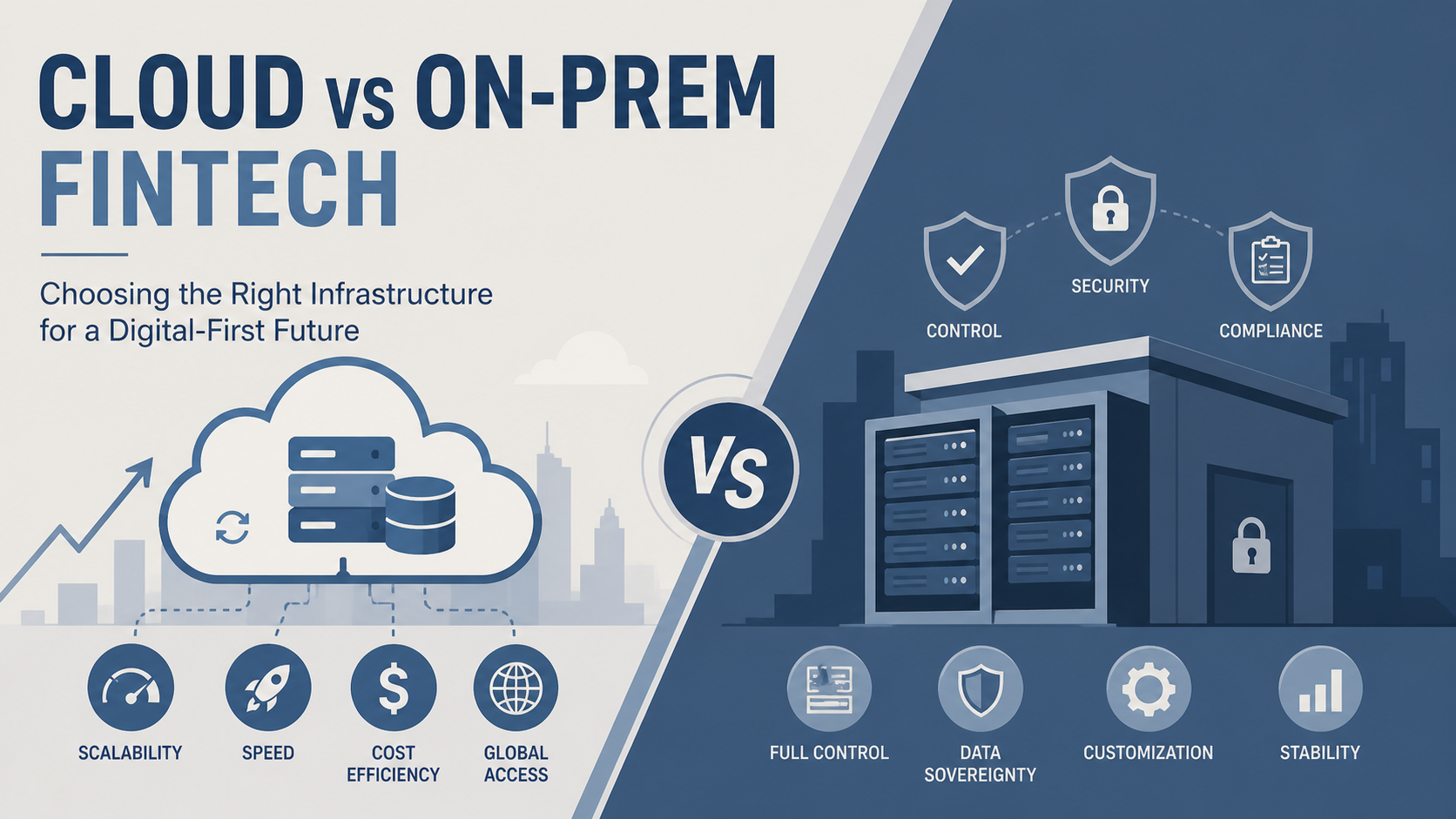
Cloud vs On-Prem Fintech: The Battle for the Future of Financial Infrastructure
How financial institutions are balancing control, scalability, and compliance in a rapidly evolving digital economy
 Prashant Thinks6 min read·Just now
--
In fintech, infrastructure decisions are no longer just IT choices. They are strategic business decisions that shape speed, compliance, customer experience, and even survival. The debate between cloud and on-premise systems has become one of the most important architectural questions for financial institutions, from traditional banks to modern neobanks and payment startups.
On one side, cloud computing promises agility, scalability, and rapid innovation. On the other, on-premise systems offer control, predictability, and perceived security. Both models have evolved, and neither is universally right or wrong.
The real question is not which is better, but which is better for what context. Regulatory pressure, data sensitivity, operational complexity, and growth ambition all influence the decision.
As fintech ecosystems expand globally, this choice is becoming less about technology preference and more about business philosophy. Over the past decade, the acceleration of digital banking, embedded finance, and real-time payments has intensified this debate further.
Infrastructure is now directly tied to user experience, fraud prevention, and regulatory responsiveness, making architectural decisions more critical than ever before.
The legacy of on-prem systems in financial services
Before cloud computing became mainstream, financial institutions built their entire infrastructure on-premise. This meant owning physical servers, maintaining data centers, and managing every layer of the technology stack internally. For banks, this model was not just standard practice, it was a regulatory expectation in many jurisdictions.
On-premise systems offered a sense of control. Data never left the organization’s physical environment, which reduced perceived exposure to external threats. For decades, this model supported core banking systems, payment processing networks, and trading platforms.
However, this control came at a cost.
- High capital expenditure for hardware and infrastructure
- Long deployment cycles for new features
- Heavy dependency on internal IT teams
- Limited scalability during peak transaction loads
- Slow adaptation to regulatory changes
Over time, these limitations became more visible as fintech startups began outpacing traditional institutions in speed and innovation. The rigidity of on-prem systems made it difficult to respond to rapidly changing customer expectations, especially in digital payments, mobile banking, and cross-border finance.
Still, on-premise systems have not disappeared. They remain deeply embedded in legacy banking architecture, especially for core ledger systems where stability is critical.
The rise of cloud fintech and the shift to scalability
Cloud computing changed the fintech landscape by shifting infrastructure from ownership to access. Instead of maintaining physical servers, companies could now rent computing power, storage, and services from providers like AWS, Microsoft Azure, and Google Cloud.
This shift unlocked a new wave of innovation in financial services.
Cloud fintech platforms enabled:
- Rapid product deployment without heavy infrastructure setup
- Elastic scalability during transaction spikes
- Global accessibility for distributed teams
- Continuous integration and deployment pipelines
- Reduced upfront capital expenditure
For fintech startups, this meant faster time to market. For established banks, it created pressure to modernize legacy systems.
Cloud also enabled entirely new business models such as embedded finance, real-time payments, and API-driven banking ecosystems. Developers could now build financial products without needing to manage underlying infrastructure.
However, cloud adoption also introduced new concerns, especially around data sovereignty, vendor lock-in, and shared responsibility security models. Financial institutions had to rethink how they manage risk in a distributed environment.
In addition, cloud providers are now offering industry-specific fintech solutions such as compliance-ready infrastructure, financial data lakes, and built-in regulatory reporting tools. This reduces the burden on fintech companies to build compliance systems from scratch, accelerating innovation further.
Despite these challenges, cloud computing has become the default infrastructure choice for most digital-first fintech companies today.
Cloud vs on-prem: a structured comparison
Cloud and on-premise systems are often compared as opposites, but in reality they exist on a spectrum of trade-offs rather than a binary choice.
Key differences include:
- Control vs flexibility: On-prem offers full control over infrastructure, while cloud prioritizes flexibility and speed
- Cost structure: On-prem requires heavy upfront investment, cloud follows operational expense models
- Scalability: Cloud scales dynamically, on-prem scales physically and slowly
- Maintenance: On-prem demands internal maintenance, cloud shifts responsibility to providers
- Innovation speed: Cloud enables faster experimentation and deployment cycles
In fintech, these differences directly impact business strategy. A digital wallet startup may prioritize cloud for speed, while a central bank or large financial institution may retain on-prem systems for core ledger operations.
Security perceptions also differ. On-prem is often seen as safer because data is internally controlled, while cloud security relies on shared responsibility models and advanced encryption protocols.
Regulatory compliance adds another layer. Some jurisdictions require financial data to remain within national borders, influencing infrastructure decisions significantly.
We are also seeing the emergence of platform-agnostic architectures designed to reduce dependency on any single infrastructure model. Technologies such as containerization, Kubernetes orchestration, and API gateways are allowing fintech systems to become more portable across cloud and on-prem environments.
This shift is particularly important for financial institutions operating across multiple regulatory zones. It enables them to deploy consistent services while adapting infrastructure constraints locally.
In many cases, the future is not about choosing one infrastructure type, but about building abstraction layers that hide infrastructure complexity entirely from business logic. This will define the next generation of fintech scalability and interoperability across global financial ecosystems.
The rise of hybrid fintech infrastructure
Rather than choosing strictly between cloud and on-premise, many fintech organizations are moving toward hybrid infrastructure models. This approach combines the strengths of both systems while minimizing their weaknesses.
In a hybrid setup, critical workloads such as core banking ledgers may remain on-premise, while customer-facing applications, analytics, and APIs run on the cloud. This allows organizations to balance control with agility.
Key benefits of hybrid fintech infrastructure include:
- Optimized workload distribution based on sensitivity and performance needs
- Improved resilience through distributed architecture
- Gradual modernization of legacy systems
- Enhanced compliance flexibility across jurisdictions
- Better cost optimization across workloads
Hybrid models also enable smoother digital transformation journeys. Instead of replacing entire systems, institutions can incrementally migrate services to the cloud.
However, hybrid systems introduce complexity. Managing two environments requires strong orchestration, monitoring, and security governance. Without proper architecture, hybrid systems can become fragmented and inefficient.
Despite this, hybrid infrastructure is increasingly seen as the most realistic path for traditional financial institutions transitioning into digital-first operations.
Decision-making framework for fintech infrastructure
Choosing between cloud, on-prem, or hybrid infrastructure requires a structured decision framework rather than intuition.
Financial institutions typically evaluate based on:
- Regulatory requirements: Data residency and compliance obligations
- Risk tolerance: Sensitivity of financial data and operational exposure
- Scalability needs: Transaction volume and growth projections
- Cost structure: Capital expenditure vs operational expenditure
- Legacy dependencies: Existing infrastructure complexity
A simplified decision matrix often looks like:
- Startups and digital-native fintechs: Cloud-first approach
- Large banks with legacy systems: Hybrid transition strategy
- Highly regulated entities: On-prem or restricted hybrid models
- Global payment platforms: Multi-cloud or distributed hybrid systems
Another critical factor is organizational maturity. Companies with strong DevOps and cloud engineering capabilities tend to adopt cloud faster, while traditional IT-led organizations move more cautiously.
Ultimately, infrastructure strategy is not static. Most institutions evolve their approach over time as regulatory landscapes, technology capabilities, and business priorities change.
The future of fintech infrastructure is convergence
We are entering an era where infrastructure decisions define competitive advantage in fintech. Cloud has democratized access to powerful computing resources, while on-premise systems continue to anchor stability in critical financial operations.
The real evolution is not replacement but integration. Cloud and on-prem are no longer competing endpoints, but complementary layers in a broader financial architecture.
As fintech continues to expand globally, the organizations that succeed will not be those that choose the perfect infrastructure model, but those that design flexible systems capable of adapting to change.
Regulators are also beginning to adapt, creating frameworks that are cloud-neutral and infrastructure-agnostic. This will further accelerate the convergence of cloud and on-prem systems into unified compliance-driven architectures.
What once was a technical infrastructure decision is now a boardroom-level strategic priority influencing valuation, customer trust, and market expansion.
In the end, cloud vs on-prem is not a technology debate. It is a strategic reflection of how a financial institution defines control, speed, risk, and innovation in a digital economy that never stands still.
Organizations that master this balance will lead the next wave of fintech transformation. While technology evolves, the core challenge remains aligning regulation, innovation, and customer trust in a unified system.