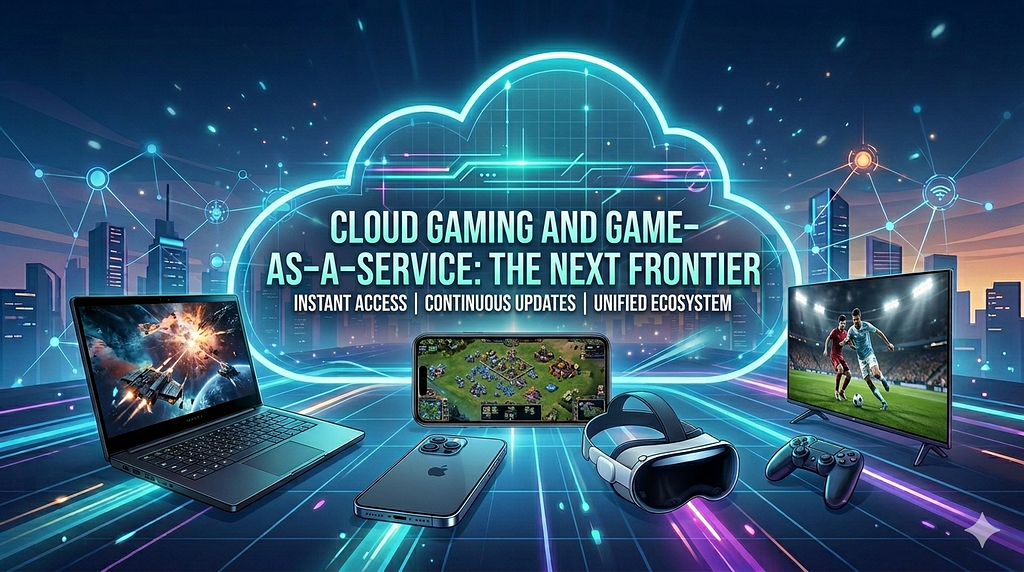
The landscape of interactive entertainment in 2026 has moved beyond the “hardware wars” that defined previous decades. We are now firmly entrenched in the era of platform-agnostic play, where the distinction between a high-end console, a mid-range PC, and a smartphone has been blurred by the cloud. For a modern game development company, this shift represents the most significant architectural and economic pivot since the transition from arcade cabinets to home systems.
Cloud gaming and the Game-as-a-Service (GaaS) model are no longer “emerging trends” — they are the foundation of the industry’s next frontier. This evolution is driven by the democratization of access, the sophistication of server-side rendering, and a fundamental change in how players perceive the value of a digital experience.
1. The Death of the “Hardware Barrier”
The most immediate impact of cloud gaming is the total decoupling of high-fidelity graphics from expensive local hardware. In 2026, the “Minimum Specification” is no longer a physical GPU; it is a stable, high-speed internet connection.
A. Elastic Compute and Server-Side Rendering
Cloud gaming leverages data centers to do the heavy lifting. When a player inputs a command, it is sent to a remote server, processed within a high-end virtual machine, and the resulting frame is streamed back as a video packet.
- Instant Gratification: The concept of “downloading” a 200GB game is becoming obsolete. “Click-to-Play” allows players to jump from a YouTube trailer directly into the live game environment.
- Infinite Scalability: Because the game runs on a server, it can tap into “Elastic Compute.” A single-player experience can instantly scale its physics or AI complexity by pulling resources from neighboring server nodes, something a local console cannot do.
B. The Mobile Revolution
This technology has revolutionized mobile game development services. Previously, mobile developers had to aggressively “downscale” their visions to fit the thermal and processing limits of a handheld device. With the cloud, a smartphone is simply a high-resolution window into a AAA world. We are seeing “Triple-A Mobile” titles that feature ray-tracing and complex global illumination, rendered entirely in the cloud.
2. Game-as-a-Service (GaaS): From Product to Ecosystem
If Cloud Gaming is the delivery mechanism, Game-as-a-Service is the economic engine. In 2026, a game is no longer a static product delivered on a disc; it is a living, breathing ecosystem that evolves daily based on player data.
A. The Perpetual Content Cycle
GaaS titles thrive on “LiveOps” (Live Operations). The goal is to maximize the “Lifetime Value” (LTV) of a player by providing a constant stream of reasons to return.
- Seasonal Content: The “Battle Pass” has evolved into narrative seasons that change the physical geography of the game world.
- Dynamic Events: AI-driven quest systems now generate unique, time-limited events based on the collective actions of the community. If the community fails a global challenge, the story moves in a darker direction.
B. The Psychology of Retention
The GaaS model shifts focus from “Sales” to “Monthly Active Users” (MAU). This requires a deep understanding of player psychology:
- The Social Glue: Games are now the “Third Place” — a social hub where players meet to hang out, watch virtual concerts, or trade items, with the actual “gameplay” often serving as the backdrop.
- Frictionless Entry: Most GaaS titles are Free-to-Play (F2P), removing the $70 barrier to entry and focusing on high-volume, low-friction microtransactions.
3. The Technical Challenges: Latency and Edge Computing
Despite the promise, the “Next Frontier” faces a formidable opponent: the speed of light. Latency remains the primary hurdle for cloud gaming, particularly in twitch-based competitive genres.
A. Reducing the “Motion-to-Photon” Gap
To feel “local,” a cloud game must have a total latency of less than 30–50ms. To achieve this, the industry has turned to Edge Computing.
- Edge Nodes: Instead of one massive data center in the middle of a continent, providers are placing smaller server clusters at the “edge” of the network — often inside ISP facilities — to shorten the physical distance the data must travel.
- Predictive Input: 2026-era engines now use “Latent AI” to predict player movement. If the network hiccups, the server “guesses” the player’s next move based on their historical patterns, smoothing out the experience and hiding lag.
B. Bandwidth and Compression
Streaming 4K at 120FPS requires massive bandwidth. Modern codecs (like AV1 and AI-enhanced super-resolution) allow servers to send a lower-resolution stream that is upscaled on the player’s device using local NPU (Neural Processing Unit) power, saving bandwidth without sacrificing visual clarity.
4. The Developer’s New Toolkit
For developers, the shift to Cloud and GaaS requires a new set of skills. We are moving away from “Mastering the Hardware” toward “Mastering the Cloud.”
- Server-Authoritative Design: To prevent cheating and ensure synchronization in the cloud, almost every game logic calculation must happen on the server. This requires specialized backend engineering.
- Telemetry and Big Data: GaaS developers are part-time data scientists. They must analyze “Heatmaps” to see where players are getting stuck, “Churn Rates” to see when they are quitting, and “Conversion Funnels” to optimize the in-game economy.
- DevOps Integration: Launching a patch is no longer a monthly event. “Continuous Integration/Continuous Deployment” (CI/CD) allows studios to push hotfixes and small content updates daily without taking the servers offline.
5. Ethical Monetization and The “Player-First” Approach
As GaaS matures, the industry is facing a reckoning regarding monetization. The “Loot Box” era has been replaced by a demand for transparency and fairness.
- Direct Purchase vs. Gambling: Players in 2026 prefer knowing exactly what they are buying. “Battle Passes” that respect a player’s time (no expiration) and direct cosmetic shops are the gold standard.
- The “Pay-to-Win” Taboo: In competitive cloud gaming, any perceived mechanical advantage purchased with money is a death sentence for a game’s reputation. Retention is built on the “Fair Play” mandate.
Conclusion: The Unified Future
Cloud Gaming and Game-as-a-Service are merging into a single, unified experience. We are heading toward a future where “The Game” is a persistent digital world that you access through your TV at home, your phone on the bus, and your AR glasses at work — all synchronized in real-time.
For the player, this means unprecedented freedom. For the developer, it means an infinite canvas. The “Next Frontier” isn’t about better graphics or faster processors; it’s about the total removal of friction between a player’s imagination and their digital reality. The clouds are gathering, and the forecast for the gaming industry has never been brighter.
Cloud Gaming and Game-as-a-Service: The Next Frontier was originally published in Coinmonks on Medium, where people are continuing the conversation by highlighting and responding to this story.