
Circle's $222 million ARC token presale has given Wall Street a new way to value the USDC issuer, while raising a harder question for one of crypto’s most profitable alliances.
On May 11, Circle said investors led by a16z Crypto backed the presale of ARC, the native token for Arc, its planned public blockchain for institutional finance.
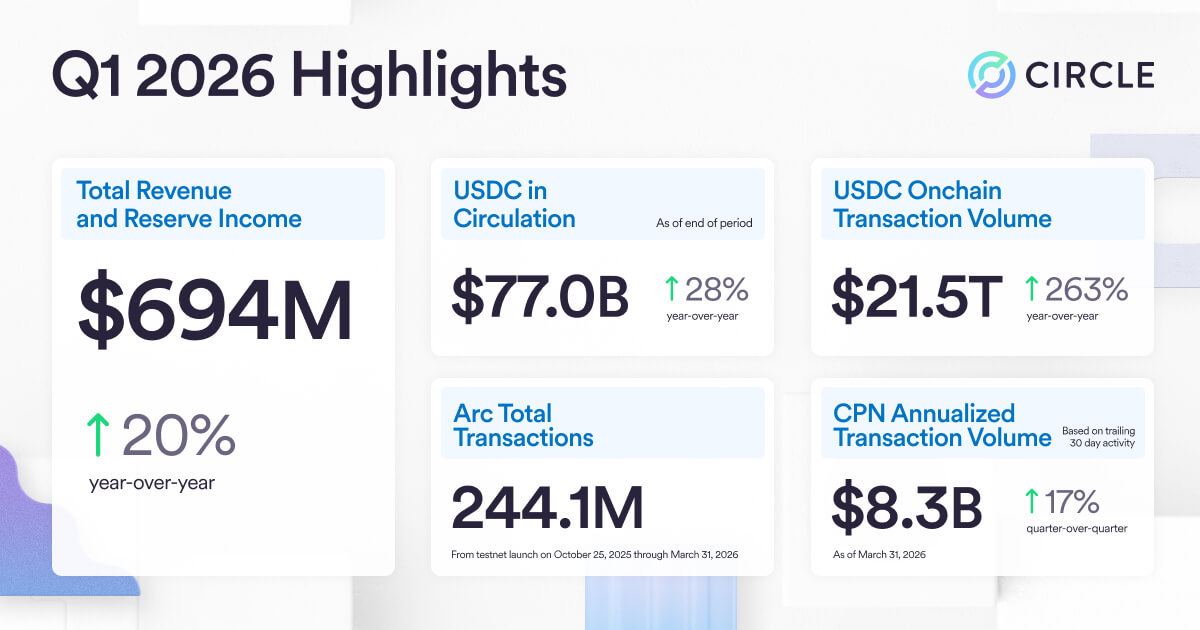
The sale valued the network at $3 billion on a fully diluted basis and came alongside first-quarter results that showed $694 million in total revenue and reserve income, up 20% from a year earlier.
At the same time, USDC in circulation rose 28% to $77 billion, while on-chain transaction volume reached $21.5 trillion, up 263% year over year.
Those figures reinforced Circle’s position as one of the main issuers in the global stablecoin market, where tokenized dollars have become core infrastructure for trading, payments, and settlement.
However, the more important development was Circle’s attempt to move beyond issuance through its new blockchain network, Arc.
Arc gives the company a network-level growth story built around payments, tokenized assets, foreign exchange, capital markets, and AI-driven commerce.
That push places Circle closer to the terrain already occupied by Coinbase, its longtime USDC partner and the operator of Base, the Layer 2 network that the US-based exchange has positioned as a settlement layer for stablecoins, consumer payments, and agentic transactions.
Considering this, Circle’s aggressive expansion could bring a new competition to the crypto landscape: a looming, head-to-head battle with Coinbase.
Circle gives investors a wider story
Circle’s business has long been tied to the economics of stablecoin reserves. The company issues USDC, holds safe assets backing the token, and earns income on those reserves.
That model can be powerful when rates are elevated, but it also raises questions about how durable its earnings will be as interest income declines.
Arc is Circle’s answer to that concern.
The company is pitching the network as an “economic operating system” for the internet, a shared environment where stablecoins, tokenized assets, and financial applications can operate on common infrastructure.
The chain is expected to be EVM-compatible, with stablecoin-native fees, deterministic sub-second finality, and configurable privacy designed for institutions that need auditability without exposing every transaction detail to the public.
Circle Chief Executive Jeremy Allaire framed the quarter around the convergence of AI platforms and on-chain money, saying:
“Circle’s first quarter reflected strong execution against a much bigger opportunity: the rapid convergence of AI platforms and economic operating systems into a new internet stack. With the ARC token presale, momentum behind the Arc network, and the launch of our Agent Stack, we are building trusted infrastructure for AI-native economic activity and a more programmable internet financial system.”
The investor list shows how far that pitch now reaches. a16z Crypto led the presale with a $75 million investment.
Other participants included BlackRock, Apollo Funds, Intercontinental Exchange, SBI Group, Janus Henderson Investors, Standard Chartered Ventures, General Catalyst,a IDG Capital, Haun Ventures, and Bullish.
The message to investors is clear: Circle wants to be valued less as a stablecoin issuer exposed to rate cycles and more as a full-stack infrastructure company for on-chain finance.
In a note shared with CryptoSlate, Clear Street analysts echoed that view, writing that Circle is “no longer a pure crypto play” and has built the Layer 1 network, application layer, and partner ecosystem required to become a critical infrastructure provider.
The firm raised its price target on the stock from $152 to $157, citing Arc, Agent Stack, Circle Payments Network, and regulatory momentum as potential sources of upside.
Arc gives Circle its own venue
Circle's new Arc blockchain changes the firm's role in the stablecoin economy.
USDC already moves across more than 30 blockchains and is integrated throughout exchanges, wallets, fintech platforms, and institutional systems.
That distribution has been one of the stablecoin’s main strengths. Circle could grow as USDC became more widely used, regardless of where the activity settled.
Arc gives Circle a reason to bring more of that activity onto the infrastructure it controls.
The network is designed to support payments, lending, foreign exchange, capital markets, and tokenized assets. Circle has also positioned ARC as a coordination token for validators, builders, liquidity providers, exchanges, institutions, and users.
In that structure, USDC remains the transactional asset, while ARC is intended to help govern economic rules and align network participants.
That creates a broader economic layer around Circle’s core product. If Arc gains traction, investors will not only measure Circle by USDC circulation and reserve income.
They will also track transaction volume, developer adoption, institutional participation, validator activity, and the degree to which Circle can capture revenue from the infrastructure surrounding USDC.
Circle Payments Network adds another part of that strategy. Clear Street said CPN reached $8.3 billion in annualized total payment volume and approached $10 billion by May 7, with 136 financial institutions enrolled.
Managed Payments is intended to reduce friction for banks and payment service providers by handling licensing, liquidity, custody, and compliance burdens.
Taken together, Arc, Agent Stack, CPN, and Managed Payments give Circle a more ambitious public-market story. The company is trying to become the platform where digital dollars move, settle, and interact with software.
That ambition makes the Coinbase relationship more complicated.
Coinbase already controls much of the flow
However, Coinbase has its own claim to the USDC infrastructure story.
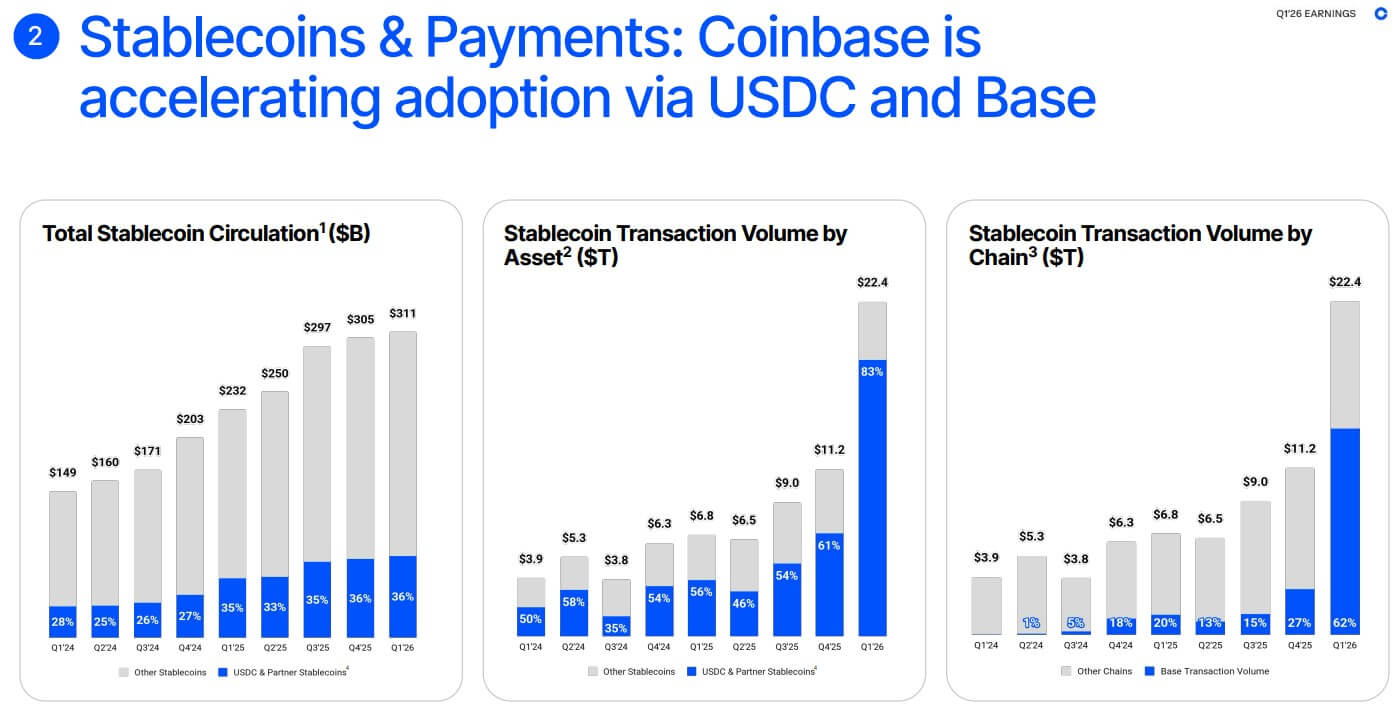
In its first-quarter report, the company described itself as the distribution engine for USDC, with more than 25% of total USDC in circulation, or about $19 billion on average, held across Coinbase products.
Coinbase said Base processed 62% of global on-chain stablecoin transaction volume during the quarter, more than all other chains combined.
The company also said more than 90% of on-chain agentic stablecoin transaction volume occurred on Base, making Coinbase the leading platform for agentic commerce.
At the same time, more than 100 million payments were processed through its x402 protocol, with more than 99% completed using USDC.
Those figures show why Arc is sensitive for Coinbase.
Coinbase is no longer merely a distribution channel for Circle’s stablecoin. It is building the rails around the asset.
Its stack includes USDC as the programmable dollar, Base as the low-cost settlement network, and Coinbase Developer Platform, AgentKit, and x402 as infrastructure for developers and AI-enabled payments.
Circle’s emerging stack points in the same direction. USDC provides the dollar asset, Arc provides the network, Agent Stack targets AI-native commerce, and CPN connects financial institutions and payment companies.
The companies remain commercially aligned around USDC growth. But their infrastructure strategies increasingly point toward the same flows.
The alliance gets a new scoreboard
For years, the Circle-Coinbase relationship was one of crypto’s cleanest partnerships. Circle issued USDC. Coinbase distributed it across its exchange, wallet, and institutional products. The stablecoin gained scale, and Coinbase shared in the economics.
That relationship helped make USDC one of the most important dollar assets in crypto. It also gave Coinbase a major stablecoin revenue line and helped turn USDC into a regulated alternative to Tether’s USDT for many US-based institutions.
However, Arc introduces a different incentive structure.
Omar Kanji, an investor at Dragonfly, captured the concern in a post asking how long the “marriage” between Circle and Coinbase can stay clean.
His argument was that the old model worked when Circle was the issuer, and Coinbase was the distributor. But Circle’s public-market demands and Arc’s token-backed network now require the company to show investors that it can own more customers, flows, and infrastructure directly.
That is where Arc overlaps with Base. Circle wants Arc to host USDC balances, tokenized assets, payments, settlement, and eventually foreign-exchange activity. Coinbase wants Base to serve as the main venue for stablecoin payments, on-chain consumer transactions, AI-agent activity, and institutional settlement.
The tension is already visible in adjacent products. Coinbase has cbBTC, a wrapped BTC product used across DeFi. Circle is preparing cirBTC, which is designed to integrate with Arc and Circle Mint.
While this overlap does not signal an immediate rupture, it shows that the companies are no longer staying in separate lanes and are beginning to compete on similar products.
AI payments raise the stakes
The competition becomes more significant when viewed through the lens of agentic commerce.
AI agents are expected to become a larger share of internet activity, handling tasks such as purchasing data, paying for software, settling invoices, managing subscriptions, and executing business processes.
Those transactions require programmable money, low-cost settlement, and infrastructure that can authorize spending without constant human intervention.
Stablecoins are well-suited to that environment because they operate continuously, settle quickly, and can be embedded directly into software. That has made agentic commerce one of the most attractive long-term narratives for stablecoin infrastructure providers.
Coinbase is already claiming early leadership. Its first-quarter materials pointed to Base’s share of on-chain agentic stablecoin transaction volume and the rapid growth of x402 payments. The company is presenting Base, USDC, AgentKit, and x402 as a ready-made stack for machine-driven economic activity.
Circle is moving to meet that opportunity with Agent Stack and Arc. Allaire has framed AI platforms and on-chain money as part of a new internet stack, and Circle’s product roadmap suggests the company wants USDC to become a settlement layer not only for humans and institutions, but also for software agents.
Considering this, Tom Wan, the head of data at Entropy Research, concluded:
“[Circle and Coinbase] business lines are converging across blockchain, tokenization, payments and stablecoins. A formal split is unlikely given the mutual benefits still on the table, but the trajectory is clear. Both sides are building toward a less dependent relationship, and the overlap will only create more friction over time.”
The post Circle adds $3 billion Wall Street Arc token risking an uncomfortable rivalry with Coinbase appeared first on CryptoSlate.