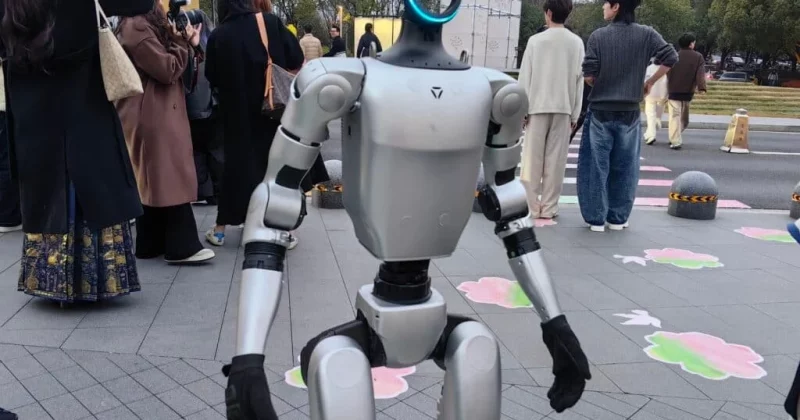
China assigns digital IDs to over 28,000 humanoid robots
A new national platform gives every humanoid robot a 29-character identity code, tracking them from factory floor to recycling bin.
Share
Add us on Google by Editorial Team May. 28, 2026China just launched what amounts to a national birth certificate system for humanoid robots. The country’s new Humanoid Full Lifecycle Management Service Platform has already registered over 28,000 robots across 200 models, each one tagged with a unique 29-character digital ID.
The system tracks everything from production and deployment to maintenance and eventual recycling, creating a cradle-to-grave paper trail for every unit in the country.
How the system works
The platform originated from Hubei province’s Humanoid Robotics Innovation Center and is overseen by the Humanoid Robotics and Embodied Intelligence Standardization committee, which falls under the Ministry of Industry and Information Technology. More than 100 Chinese manufacturers have already enrolled their products in the registry.
Each robot’s 29-character ID is divided into four segments, encoding information that allows regulators and operators to trace its entire history. The platform collects real-time data on joint wear, battery status, AI training history, and operational performance.
AdvertisementState media has framed it as a necessary tool for managing exponential growth in the sector while getting ahead of liability and safety concerns.
The system is entirely centralized. There’s no blockchain component, no decentralized identity layer, no tokenized anything. The architecture mirrors China’s citizen ID program more than it resembles any Web3 identity solution. The government maintains full control over the data and the standards governing it.
Why robots need IDs in the first place
Investment in the sector hit $3.4B based on early 2025 data. When you have tens of thousands of increasingly capable machines operating in factories, hospitals, and public spaces, the question of accountability becomes urgent.
A humanoid robot recently completed a Beijing half-marathon. The 200 registered models span a wide range of capabilities and use cases, from industrial assembly line workers to service-oriented machines designed for elder care and hospitality.
What this means for investors
China chose a fully centralized identity system over any decentralized alternative. No distributed ledgers, no self-sovereign identity protocols, no tokenized registries.
For the robotics sector itself, the ID system creates a clearer competitive landscape. Companies that comply early with the new standards gain a built-in advantage, since registration essentially becomes a license to operate.
Real-time performance data across 28,000 robots and 100-plus manufacturers creates an unprecedented dataset for identifying quality issues, predicting failures, and benchmarking performance.
Disclosure: This article was edited by Editorial Team. For more information on how we create and review content, see our Editorial Policy.