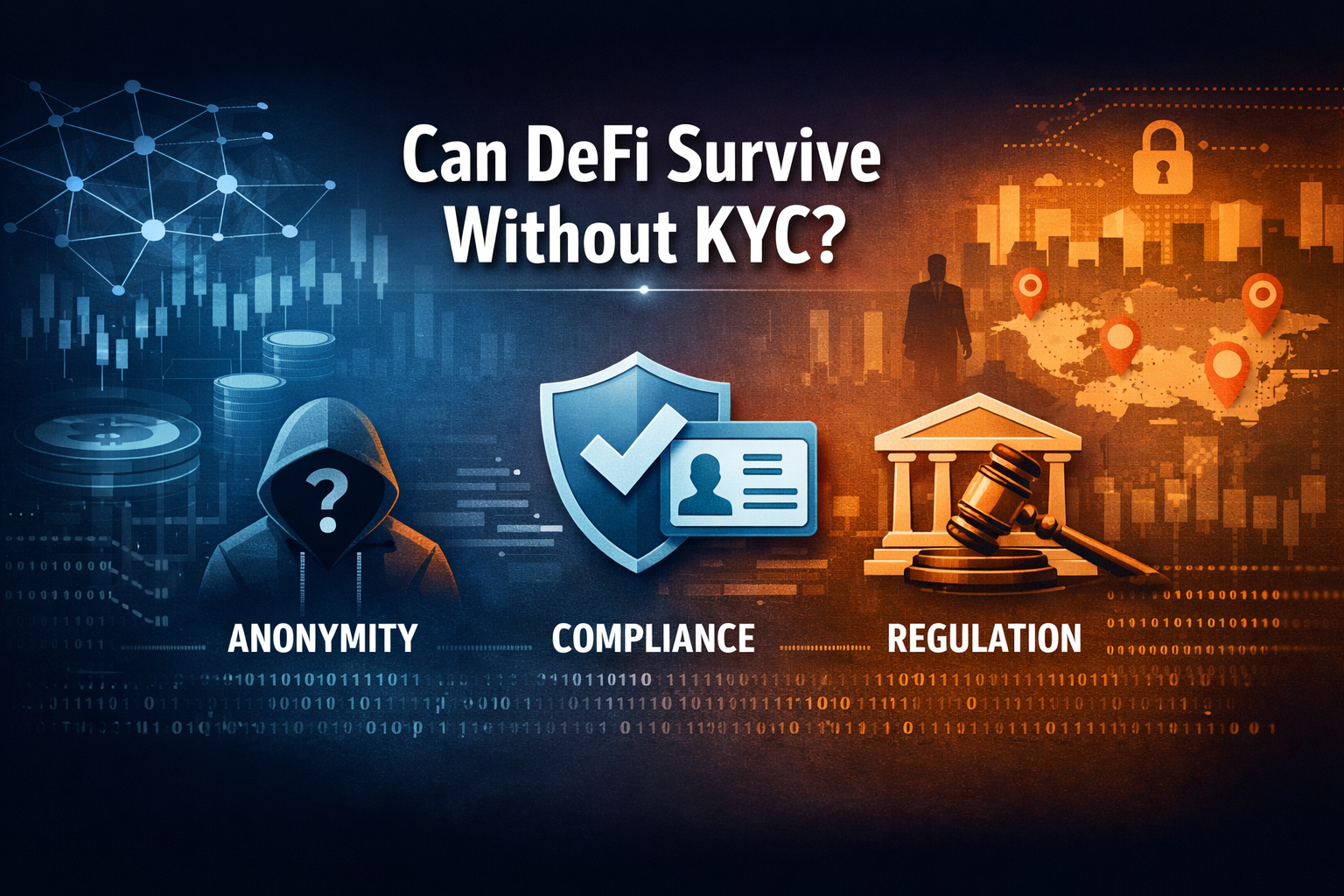
Can DeFi Survive Without KYC?
In the early days of decentralized finance, there was a quiet but powerful promise embedded in the code: access without permission.
 Ritika Prajapati7 min read·Just now
--
No forms.
No compliance desks.
No identity verification queues.
Just a wallet address and a protocol.
For many, that was not just innovation. It was ideology.
But as DeFi matures from an experimental sandbox into a multi-billion-dollar financial ecosystem, a harder question is emerging:
Can DeFi actually survive without KYC?
Not in theory. Not in principle.
But in practice at scale, across jurisdictions, under regulatory pressure, and with institutional capital at stake.
This is no longer a philosophical debate. It is an architectural one.
The Original Ethos: Permissionless by Design
DeFi was born in reaction to centralized gatekeeping.
Traditional finance requires identity verification for almost everything: opening an account, sending money, accessing credit, trading assets. The gate is identity, and identity is controlled by institutions.
DeFi inverted that logic.
Protocols such as Uniswap, Aave, Compound, and MakerDAO operate on smart contracts. They do not “know” users. They interact with wallets. The protocol logic executes automatically when conditions are met.
There is no compliance officer embedded in Solidity.
This model created:
Borderless liquidity
Instant onboarding
Pseudonymous participation
Programmable financial primitives
For the first time, a farmer in Vietnam, a developer in Nigeria, and a trader in Germany could access the same liquidity pool without differential treatment.
KYC was seen as antithetical to this structure. If the protocol cannot discriminate, it cannot exclude.
But that structural neutrality also created a vacuum.
The Regulatory Reality
As capital flowed in, regulators began asking predictable questions:
Who is responsible when funds are laundered?
How are sanctioned entities prevented from accessing liquidity?
What happens when hacked funds pass through decentralized exchanges?
Who enforces AML standards?
Regulators are not concerned with decentralization as a concept. They are concerned with risk containment.
The Financial Action Task Force (FATF) extended travel rule expectations into virtual asset service providers. The United States applied sanctions lists to wallet addresses. Europe introduced MiCA. Multiple jurisdictions now require licensing for entities facilitating crypto transactions.
Here is the tension:
DeFi protocols are often described as “software,” but regulators increasingly interpret them as financial infrastructure.
Infrastructure attracts oversight.
And oversight historically requires identity.
The Institutional Capital Question
Retail adoption can tolerate ambiguity. Institutional capital cannot.
Banks, asset managers, and payment companies operate within strict compliance frameworks. If they allocate liquidity into a DeFi protocol, they must answer:
Who are the counterparties?
What AML controls exist?
How is exposure to illicit flows mitigated?
Is the protocol exposed to sanctioned wallets?
Permissionless liquidity pools are powerful, but they also introduce uncontrollable counterparty risk.
An institution cannot explain to a regulator that “the smart contract did it.”
This is why we see the rise of:
Permissioned liquidity pools
Whitelisted DeFi platforms
Institutional-grade DeFi wrappers
On-chain compliance monitoring
The survival question is shifting from ideological purity to capital compatibility.
The Myth of “No KYC”
There is a common misconception that DeFi currently operates without identity.
In reality, identity has not disappeared. It has been displaced.
Analytics firms monitor wallet behavior. Blockchain forensics tools cluster addresses. Exchanges act as fiat on-ramps and off-ramps with mandatory KYC. Stablecoin issuers blacklist sanctioned addresses.
The ecosystem is layered:
Protocol layer: pseudonymous
On-ramp layer: regulated
Off-ramp layer: regulated
Stablecoin issuers: centrally governed
Infrastructure providers: increasingly compliant
Pure anonymity in DeFi is rarer than the narrative suggests.
What we actually have is selective identity enforcement at ecosystem edges.
That model works until regulators demand enforcement inside the protocol layer itself.
The Three Possible Futures
If we evaluate survival scenarios, there are three plausible paths.
1. Full Permissionless Continuation
In this scenario, DeFi remains fundamentally open.
Protocols continue operating without embedded KYC. Developers argue they publish code, not services. Enforcement remains at the exchange layer.
This preserves ideological integrity but creates long-term fragility:
Institutions stay cautious.
Regulators escalate pressure.
Developers face personal liability risks.
Jurisdictional fragmentation increases.
This path favors cypherpunk purity but limits mainstream financial integration.
2. Permissioned DeFi Hybrid
Here, compliance layers integrate directly into DeFi infrastructure.
Examples already exist:
Whitelisted liquidity pools
KYC-verified wallets interacting with restricted contracts
Decentralized identity (DID) verification
Zero-knowledge proof-based compliance
This approach does not eliminate decentralization. It re-architects it.
Instead of verifying identity publicly, protocols verify compliance status cryptographically.
A wallet proves:
Not sanctioned
Not on a blacklist
Meets regulatory requirements
Without revealing full identity data on-chain.
This hybrid model is technologically feasible and commercially attractive.
But it fundamentally changes the access model.
3. Regulatory Segmentation
A third possibility is geographic bifurcation.
Compliant DeFi platforms operate within regulated jurisdictions. Pure permissionless versions operate elsewhere. Liquidity fragments.
We already see glimpses of this:
Front-end interfaces geoblocking specific countries
DAO governance responding to regulatory risk
Separate institutional pools
This path preserves experimentation but creates liquidity inefficiency.
Fragmented liquidity undermines one of DeFi’s core advantages: composability.
The Philosophical Question vs The Structural Question
The philosophical argument against KYC in DeFi is strong:
Financial privacy is a right.
Identity-based exclusion perpetuates inequality.
Permissionless systems empower the unbanked.
Censorship resistance is core to decentralization.
But structural survival requires more than philosophical coherence.
A system survives if it can:
Attract sustained liquidity
Manage systemic risk
Withstand regulatory scrutiny
Integrate with global financial rails
Adapt to legal evolution
Pure anonymity may satisfy ideology but weaken structural resilience.
The Compliance Paradox
Ironically, some level of compliance may be necessary to preserve decentralization.
Consider this:
If regulators perceive DeFi as uncontrollable risk infrastructure, they will attempt aggressive containment. That may include targeting developers, hosting providers, stablecoin issuers, or access interfaces.
Excessive enforcement could centralize the ecosystem around a few compliant players.
But if DeFi proactively integrates compliance primitives, it may avoid existential confrontation.
This is the paradox:
Strategic compliance may preserve long-term decentralization better than rigid non-compliance.
Zero Knowledge as the Bridge
Technology offers a potential compromise.
Zero-knowledge proofs allow a user to prove a statement without revealing underlying data.
For example:
Prove you are not on a sanctions list.
Prove you passed KYC with an approved provider.
Prove you reside in a permitted jurisdiction.
Prove you meet investor accreditation thresholds.
All without publishing personal information on-chain.
This transforms KYC from identity disclosure into compliance validation.
The protocol does not “know” who you are. It knows you meet conditions.
This is not theoretical. Projects are building decentralized identity frameworks that integrate with smart contracts.
If implemented correctly, this could reconcile privacy with regulatory expectations.
The Liquidity Incentive Problem
There is another dimension often ignored: incentives.
Permissionless pools maximize liquidity depth. Anyone can contribute capital. Anyone can trade.
Introduce KYC barriers, and liquidity participation shrinks.
Less liquidity means:
Wider spreads
Higher slippage
Lower efficiency
Reduced arbitrage stabilization
DeFi’s core advantage is liquidity aggregation without friction.
Adding friction impacts the economic engine.
So the survival question becomes economic:
Can compliant DeFi pools compete in capital efficiency with permissionless ones?
If not, liquidity will migrate to less restrictive environments.
The Developer Liability Risk
Developers once believed decentralization insulated them from legal exposure.
Recent enforcement trends challenge that assumption.
If regulators classify certain DeFi activities as financial intermediation, developers may face scrutiny for facilitating unlicensed financial services.
Embedding compliance mechanisms could serve as a protective architecture for builders.
Survival is not only about protocol resilience. It is about human risk tolerance.
If developers fear prosecution, innovation slows.
The Payment Rail Convergence
Another overlooked factor is convergence with traditional financial rails.
Stablecoins increasingly function as settlement layers for fintech, merchant acquiring, and cross-border payments.
If DeFi protocols want to integrate into payment ecosystems:
Banks will demand AML compatibility.
Card networks will require sanctions screening.
Payment processors will require auditability.
The closer DeFi moves to real-world financial infrastructure, the stronger the identity question becomes.
DeFi isolated from fiat rails can remain pseudonymous.
DeFi integrated into global payment systems likely cannot.
The Political Dimension
Financial systems are not purely technical constructs. They are political.
States regulate money flows because money influences sovereignty, taxation, and capital controls.
A financial system that cannot implement sanctions or tax enforcement directly challenges state authority.
History suggests that states do not tolerate parallel financial systems indefinitely.
Survival requires coexistence, not confrontation.
So, Can DeFi Survive Without KYC?
Short term: yes.
Long term at global scale: unlikely.
But that does not mean DeFi must become TradFi 2.0.
The more accurate framing is this:
DeFi cannot survive at scale without some form of compliance assurance.
Whether that assurance takes the form of traditional KYC, decentralized identity, zero-knowledge compliance proofs, or hybrid permissioned pools is the real design question.
The binary debate is misleading.
The future is likely layered:
Open permissionless protocols for experimentation.
Compliant institutional layers for regulated capital.
Privacy-preserving compliance bridges.
Regional segmentation based on jurisdiction.
Survival will depend on adaptability.
The Identity Evolution
Identity itself is evolving.
Traditional KYC is document-based and centralized.
Future compliance may be credential-based and decentralized.
Instead of uploading passports repeatedly, users may hold verifiable credentials issued by trusted entities.
Protocols verify credentials, not documents.
If designed well, this model could:
Reduce data leakage
Preserve privacy
Satisfy regulators
Maintain composability
The survival of DeFi may hinge less on rejecting KYC and more on redefining it.
The Real Risk
The greatest threat to DeFi is not KYC.
It is rigidity.
If DeFi communities treat compliance as betrayal rather than architecture, they risk isolation.
If regulators treat decentralization as inherently criminal, they risk driving innovation offshore.
Survival demands negotiation through code.
Conclusion: Survival Through Evolution
DeFi began as rebellion.
To endure, it must mature into infrastructure.
Infrastructure carries responsibility.
Responsibility invites oversight.
Oversight demands adaptation.
The question is no longer whether DeFi can avoid KYC forever. The question is whether it can design compliance in a way that preserves its foundational principles:
Open access
Transparency
Programmability
User sovereignty
If it succeeds, DeFi will not just survive. It will redefine financial identity itself.
If it refuses to evolve, it may remain ideologically pure but economically marginal.
The next phase of decentralized finance will not be decided by slogans about anonymity.
It will be decided by architecture.
And architecture, unlike ideology, must withstand real-world pressure.