BUILD VS BUY
 VICTOR RAPHAEL3 min read·1 hour ago
--
Every Operator Faces This Decision. The Wrong Answer Costs Two Years and More Money Than the Acquisition Would Have.
His engineering team spent fourteen months building a cross-chain data indexing layer from scratch.
He had a technical founder, three senior engineers, and a clear product vision. He believed building it was the right move because nobody else had exactly what he needed. What he did not check, carefully enough, was whether someone had something close enough.
There was a protocol on Arbitrum that had been building the same infrastructure for three years. It had eleven paying enterprise customers, a working codebase, and a founder who was ready to sell. The acquisition price would have been $3.2 million. His internal build cost, by the time the team shipped a working version, was $4.8 million in salaries and eighteen months of opportunity cost on everything else he could have been doing.
He built something that already existed. He paid more for a worse version of it. And he gave away a year and a half of time he cannot recover.
This is the build versus buy decision, and most operators in Web3 and AI are making it wrong by default not because they analyzed the options and chose to build, but because they never seriously considered buying in the first place.
The default in most startups and growth-stage companies is to build. It feels like ownership. It feels like control. It feels aligned with the identity of people who started companies because they wanted to create things. Buying feels like taking a shortcut. It feels like admitting you cannot build it yourself.
None of those feelings are financial analysis.
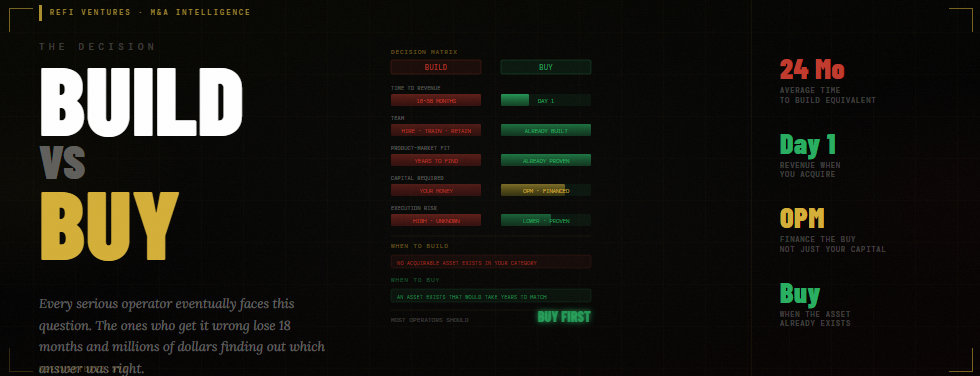
The real question in a build versus buy decision has one input: what is the total cost of building versus the total cost of acquiring, measured in time, capital, and execution risk? The company that answers this question honestly rather than emotionally makes a different decision in most situations.
Time is the variable that almost never appears correctly in the analysis. A founder who estimates that building something will take six months is usually looking at a twelve to twenty-four month timeline by the time the feature is production-grade, integrated, and defensible. A company that is already operating in your category solved those problems years ago. You are not buying a product. You are buying the accumulated solutions to every problem you have not encountered yet.
Capital comes second. Most operators budget for the direct cost of building salaries, infrastructure, tooling and undercount the indirect cost. Every senior engineer working on an internal build is not working on the core product. Every month the team spends building infrastructure that could have been acquired is a month they are not building the differentiated capability that actually wins the market. The opportunity cost is almost always larger than the acquisition price would have been.
Execution risk is the variable that makes buying the dominant strategy in the majority of cases. Building is a bet that your team can produce a working version of something, at scale, within a time frame that still matters. Buying converts that bet into a known outcome. The acquired company already runs. It already has customers. It already has the technical problems solved. You are underwriting a business history, not a development estimate.
There are legitimate reasons to build instead of buy. If the capability you need does not exist in acquirable form anywhere in the market, building is the only option. If the existing assets in your category are priced at multiples that do not make financial sense relative to the cost of building, building is rational. If your competitive moat depends on a proprietary implementation that cannot be replicated from an acquired base, building is strategically necessary.
But most of the time, for most capabilities, in most categories — the asset exists. Someone has already built it. Someone is ready to sell it. And the price of buying it is lower than the real cost of building it, once time and opportunity cost are honestly included.
Buy first. Build what cannot be bought.
Find what exists before you build it at refiventures.xyz