
Build Privy Embedded Wallet Swaps
 Vybe Network4 min read·Just now
--
Build Solana swaps for Privy embedded wallets with fresh blockhash signing, ALT preservation and efficient in-app transaction execution on Solana.
Vybe’s Privy mode is designed for fresh blockhash signing, ALT preservation, and cleaner embedded wallet execution.
If you are building swaps with embedded wallets, the hard part is usually not pricing or routing. The hard part is making sure the transaction still behaves properly once the wallet takes over the signing flow.
That is the problem covered by Vybe’s Privy Integration guide. It focuses on a real issue in Solana swap execution: embedded wallets often need a fresh blockhash at signing time, and if that is handled naively, the transaction can become larger and less efficient. Instead of treating this as an edge case, Vybe exposes a Privy-friendly path for swap transaction building so embedded wallet products can preserve the structure of the original transaction. It ties directly into Vybe’s broader execution stack, including Build Transaction and the Build Swap endpoint
Why embedded wallet swaps break in practice
A normal swap flow sounds simple enough. You fetch a quote, build a transaction, send it to the client, and let the wallet sign it.
Embedded wallets complicate that model.
Privy’s signing flow may require a fresh blockhash at the moment of signing. That seems small, but on Solana it can affect the actual shape of the transaction. The Privy integration docs explain that careless deserialize-modify-reserialize handling can break Address Lookup Table compression. When that happens, transaction size can grow and execution quality can suffer.
That makes this more than a wallet SDK detail. It becomes a transaction construction problem.
For teams building embedded wallet swaps, the real question is not only whether Privy can sign the transaction. It is whether Privy can sign it without degrading the transaction that was built.
What Vybe does for Privy-compatible swap execution
Vybe solves this through a dedicated Privy mode in the swap build flow. The goal is to let developers build swaps for Privy wallets while still preserving transaction efficiency.
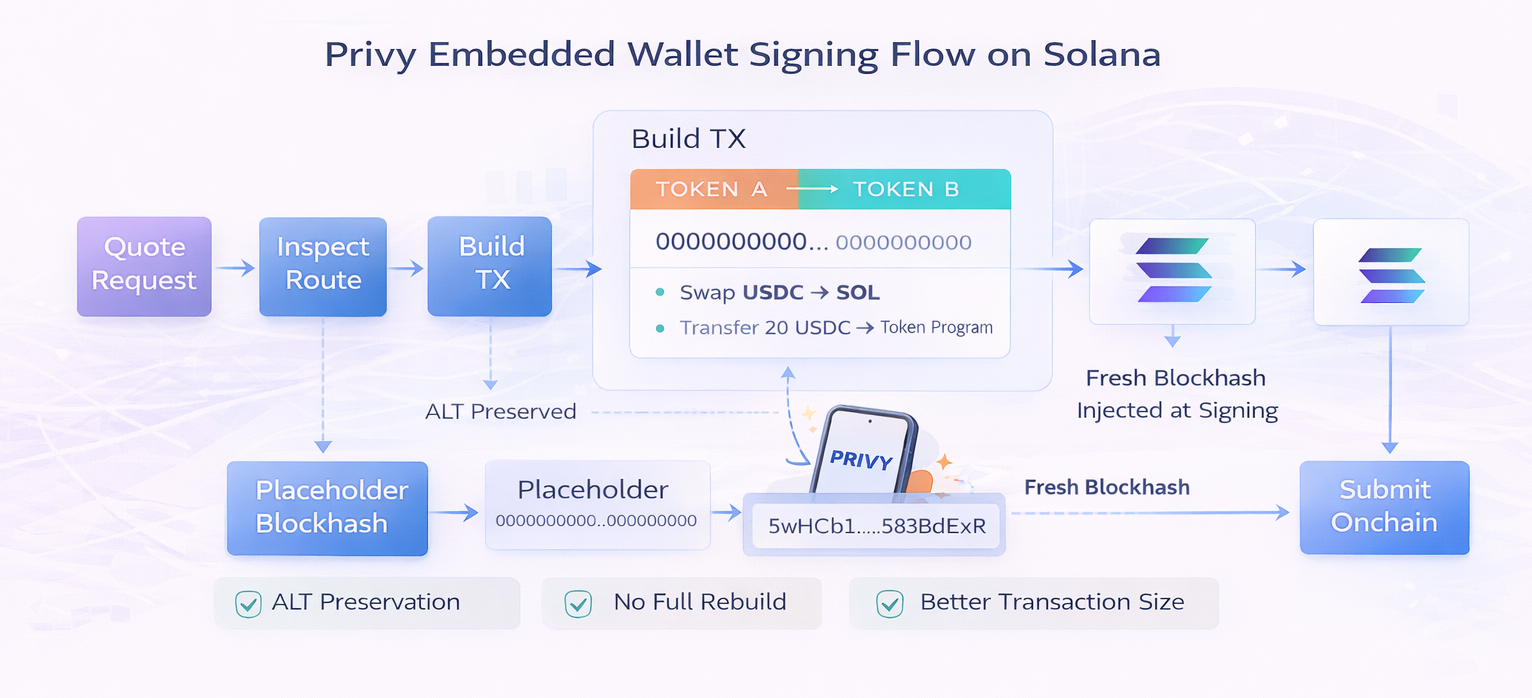
At a high level, the Privy-friendly approach is:
- build the transaction normally
- validate and simulate it with a real blockhash
- patch the blockhash in a way that works for Privy signing
- let Privy inject the fresh blockhash at signing time
The important point is the outcome: transaction size, ALT compression, and instruction layout are preserved far better than in a naive rebuild flow. That is exactly the kind of thing developers are searching for when they look for terms like Privy Solana swap integration, embedded wallet swaps, or how to build swaps with Privy wallets.
Where this fits in the swap flow
Privy mode is not a separate product bolted on top. It fits into the same execution pattern most swap products already use.
A typical flow looks like this:
- fetch a quote
- inspect the route
- build the transaction
- sign through the embedded wallet
- submit onchain
Vybe documents that flow across multiple pages, including Swap Overview, Fetch Quotes & Routes, Build Transaction, and the Build Swap API reference.
Why this matters for product teams
Embedded wallets are supposed to simplify onboarding. Users should be able to swap inside the app without dealing with extension wallets, seed phrases, or wallet setup friction.
But if the transaction-building layer is not designed for embedded-wallet signing, the product can still break underneath the nice interface. You may end up with larger transactions, wallet-specific hacks, or inconsistent execution behavior that only shows up in production.
That is why this matters beyond engineering neatness. A Privy-friendly transaction model helps product teams ship:
- smoother in-app swap flows
- fewer wallet-specific failures
- more reliable embedded wallet execution
- cleaner onboarding for mobile and consumer users
Why this matters for engineers
For engineering teams, the Privy story is really about preserving transaction quality.
Supporting embedded wallets is not just a checkbox that says “wallet connected.” The deeper question is whether your transaction builder respects the signing constraints of the wallet without making the transaction worse. Vybe’s Privy integration is valuable because it addresses the actual failure mode: blockhash freshness and ALT preservation, not just wallet compatibility.
That makes it relevant for teams searching for:
- build swaps with Privy wallets
- Privy embedded wallet Solana swap API
- embedded wallet transaction builder
- Solana swap API for embedded wallets
Final takeaway
A swap can be technically valid and still fail to be product-ready once the wallet signing layer gets involved.
That is why Privy-friendly transaction building matters. If you are building embedded wallet swaps on Solana, you need more than quote and route support. You need a build flow that respects fresh blockhash signing and preserves transaction efficiency at the same time.
Vybe’s Privy integration exists for exactly that reason.
Further reading
Guides
- https://docs.vybenetwork.com/docs/swap-overview
- https://docs.vybenetwork.com/docs/get-quote
- https://docs.vybenetwork.com/docs/build-transaction
- https://docs.vybenetwork.com/docs/slippage-fees
- https://docs.vybenetwork.com/docs/supported-protocols
- https://docs.vybenetwork.com/docs/gasless-mode
- https://docs.vybenetwork.com/docs/privy-integration


