Build Gasless & Fee-Sponsored Swaps
 Vybe Network5 min read·1 hour ago
--
Build and sign gasless Solana swaps with fee sponsorship using a swap API that supports user-signed execution without requiring SOL for network gas.
If you are building a swap product for onboarding, one of the most common failures has nothing to do with route quality or pricing. The user already has the token they want to swap, but they do not have enough SOL to submit the transaction.
That is the problem covered by Vybe’s Gasless Mode
guide. The feature allows Vybe to act as fee payer while the user still signs the transaction themselves. In practice, that means your app can support gasless swaps for users who are funded in tokens but not funded in SOL. It also fits directly into the broader execution stack documented in Swap Overview, Build Transaction, Fetch Quotes & Routes, and the Build Swap endpoint.
Why gasless swaps matter
The user problem is simple.
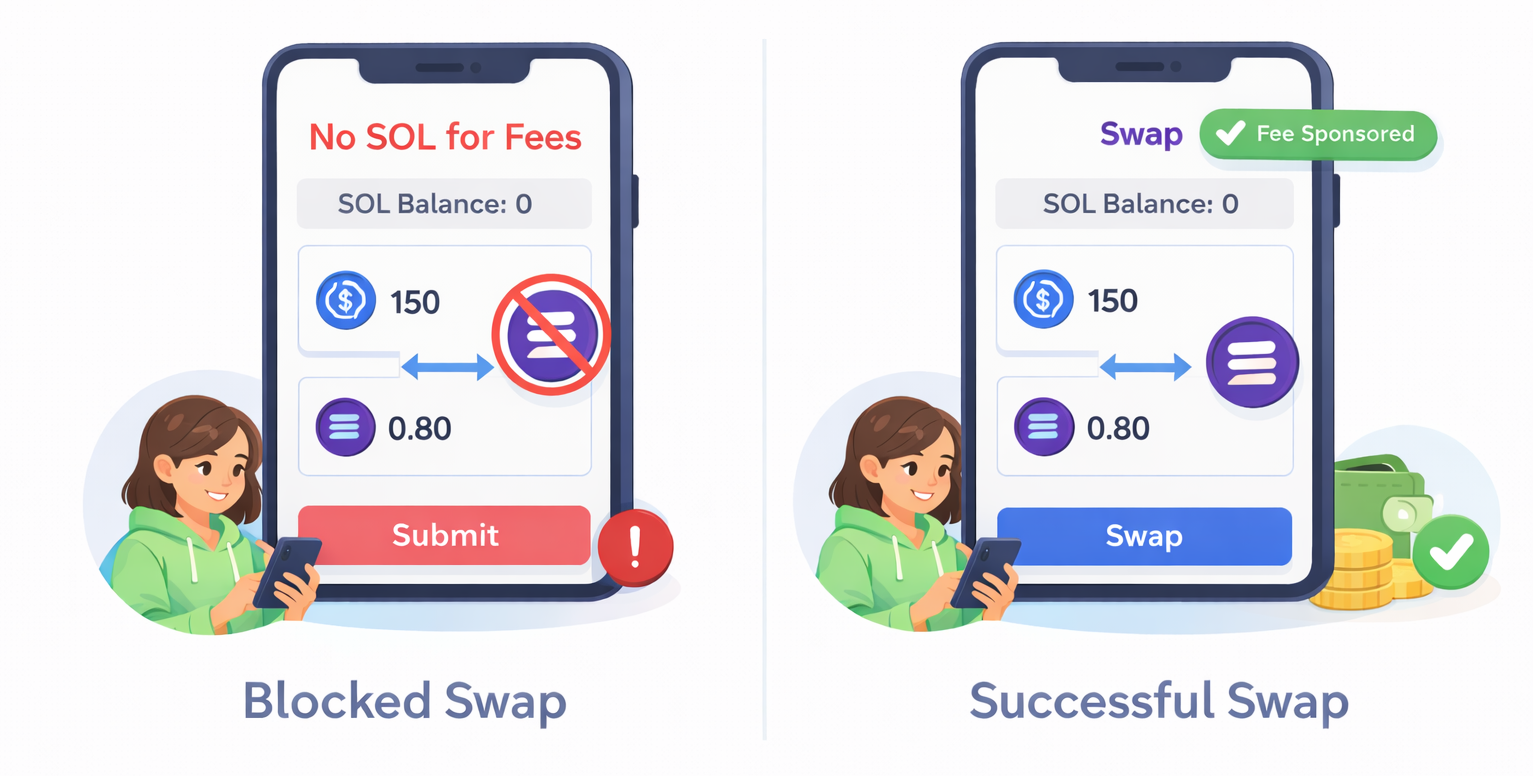
A first-time user receives USDC, a reward token, or another asset in their wallet. They want to swap it immediately. But the transaction cannot go through because there is no SOL available for the fee.
That creates a terrible onboarding loop. The app now has to stop the user and explain that before they can perform their first action, they need to complete another action just to fund gas. In consumer products, that is exactly the sort of friction that causes drop-off.
This is why developers search for phrases like gasless Solana swaps, swap without SOL gas, Solana swap with fee payer, and how to build swaps with gasless fee payer. The need is not theoretical. It shows up in real products all the time, especially when teams are already building on top of a quote flow, a transaction builder, and a swap execution endpoint.
What gasless mode actually changes
Gasless mode does not change the fundamental idea of the swap. The user still signs. The swap still follows the usual quote-build-sign-submit path.
What changes is who pays the network fee.
With Vybe gasless mode enabled, Vybe acts as the fee payer while the user remains in control of the transaction. That distinction matters because it lets products remove a major onboarding blocker without turning the swap into a custodial flow. Vybe’s Gasless Mode guide explains the concept at the product level, while the Build Swap API reference exposes the actual request parameters used to enable it.
In plain terms, gasless mode helps products support:
- first-time user onboarding
- token-only wallets
- rewards and airdrop claim flows
- embedded finance experiences
- consumer apps where users do not already understand SOL gas requirements
Where gasless mode fits in the swap flow
Gasless mode is best understood as part of the normal execution stack, not a separate flow.
A typical pattern looks like this:
- fetch the quote
- build the swap transaction
- let the user sign
- submit to Solana
That flow is described across Vybe’s Swap Overview, Fetch Quotes & Routes, Build Transaction, and the Build Swap API reference.
If you want to be more explicit in the article, you can even call out the split between the quote endpoint and the swap build endpoint. The only difference in gasless mode is that the returned transaction uses Vybe as fee payer when gas sponsorship is enabled.
Why this matters for product teams
Gasless swaps are often framed as a nice convenience feature, but for real products they are closer to an activation tool.
They help remove:
- failed first-swap attempts
- “you need SOL first” confusion
- extra onboarding steps before the first meaningful action
- needless friction in reward and airdrop flows
That makes gasless support especially important for teams building wallets, onboarding funnels, embedded-finance apps, and user journeys where the first swap is a key conversion point. This is also why the Gasless Mode page belongs alongside the more execution-focused docs like Build Transaction and Swap Overview, not treated as a standalone gimmick.
Why this matters for engineers
For engineers, the attraction is that gasless mode solves the fee problem without forcing the product into awkward workarounds.
Without fee sponsorship, teams often end up doing one of three bad things: telling users to manually fund SOL first, splitting onboarding into multiple disconnected steps, or adding conditional UX just to explain why a swap cannot be submitted. None of those approaches makes the product cleaner.
With a gasless fee payer model, the fee handling happens inside the swap transaction flow itself. That is why it matters for developers looking for:
- gasless fee payer Solana swap API
- build swaps with sponsored fees
- Solana swap API for onboarding
- fee-sponsored first swap flow
If someone wants to understand the implementation side, the best path is usually to read Gasless Mode first, then Build Transaction, then inspect the Build Swap API reference. If they also need route logic before execution, they should pair that with Fetch Quotes & Routes and the quote endpoint reference.
Final takeaway
A swap flow is not really usable if the user cannot submit the transaction.
That is why gasless mode matters. It removes one of the most common sources of onboarding friction while keeping the transaction user-signed and non-custodial. For teams building first-swap experiences, token-only wallet flows, or onboarding-heavy products, gasless support is often not a bonus feature. It is part of the core product requirement.
If you are exploring this stack, the most useful pages to keep together are Gasless Mode, Swap Overview, Fetch Quotes & Routes, Build Transaction, the quote endpoint, and the swap build endpoint.
Further reading
Guides
- https://docs.vybenetwork.com/docs/swap-overview
- https://docs.vybenetwork.com/docs/get-quote
- https://docs.vybenetwork.com/docs/build-transaction
- https://docs.vybenetwork.com/docs/slippage-fees
- https://docs.vybenetwork.com/docs/supported-protocols
- https://docs.vybenetwork.com/docs/gasless-mode
- https://docs.vybenetwork.com/docs/privy-integration