Breakout Liquidity Sweeps: What I Learned After 5 Months of Watching My Stops Get Hunted
 @OviMacro5 min read·1 hour ago
--
Opening
I used to think catching breakouts while I slept was a legitimate trading strategy.
I’d spot price struggling at a resistance level, place a Buy Stop a few pips above it, set my stop loss just below the zone, and go to bed convinced I was being smart — systematic, even. I’d wake up the next morning expecting to see profits stacking up, my trade having ridden a clean breakout to my take profit while I got a full night’s rest.
Instead, what I woke up to, almost every single time, was a stopped-out trade. And the cruelest part? I’d then watch price actually break out and push cleanly toward my original target — without me on board.
Where I Started
My approach made logical sense to me at the time. When I saw price struggling at a resistance level, I’d place a Buy Stop 5–10 pips above it with my stop loss just below the resistance zone. Let the breakout come to me. No screen time. No emotional decisions. Clean, passive, systematic.
The problem: I kept losing. Not occasionally. Almost every time. Price would spike up, touch my entry, trigger me into the trade — and then immediately reverse. My stop loss would get hit. Trade closed. And then, maddening as clockwork, price would turn around and push through the resistance cleanly — going exactly where I thought it would go, just after throwing me off first.
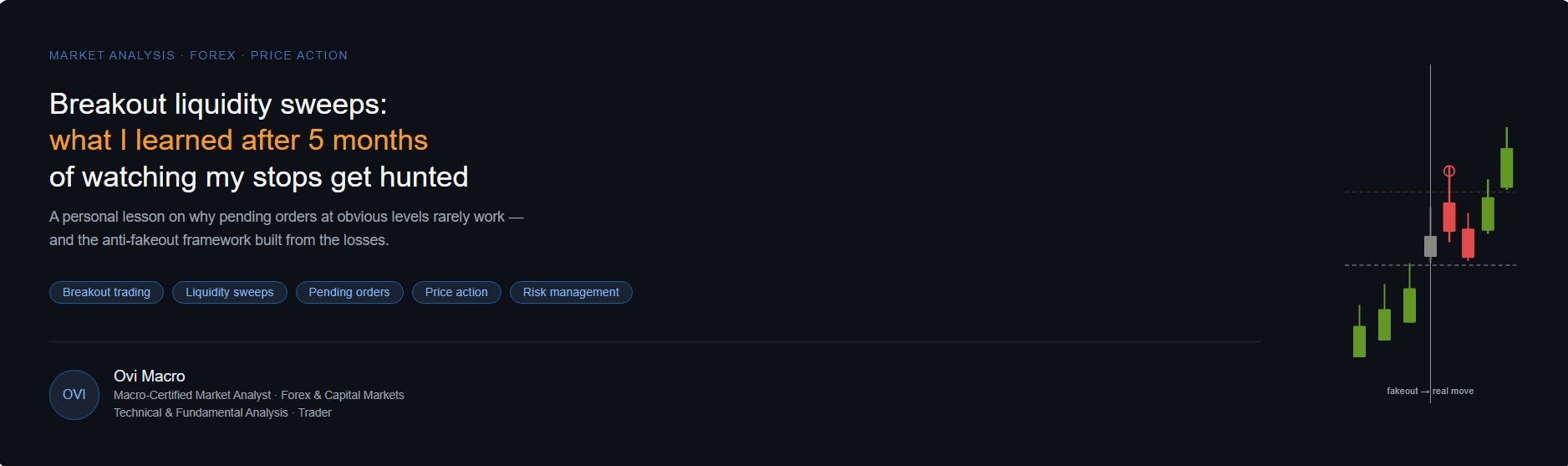
The diagram above shows exactly what kept happening to me. Notice how the fakeout spike pierces the resistance just enough to trigger the Buy Stop cluster sitting above it — then reverses sharply before the real breakout even begins.
What I Was Missing
For a long time I couldn’t reconcile the contradiction: the breakout was real, my directional read was correct — so why was I losing?
The answer, once I stopped making excuses and started digging, was humbling. I wasn’t trading the breakout. I was the liquidity that funded the breakout.
Large operators need retail liquidity to fill their own enormous positions. Retail traders — people like me — were handing it to them by placing pending orders at the most predictable, obvious levels imaginable. Just above resistance. Just below support. Exactly where every breakout-hunting retail trader puts them.
Price gets walked up to that cluster of Buy Stops, triggers all of them, institutions use that retail buying pressure to offload their own sell positions — price reverses, retail stops get hit. Then, once the liquidity is consumed and the real institutional position is established, price moves in the intended direction.
That move I kept watching happen after my stop got hit? That wasn’t the market being random. That was the market doing its job. I was always on the wrong side of the mechanism.
My Rule Now
I rebuilt everything around one core shift: stop thinking of a breakout as a price level and start thinking of it as a behavior.
The result is my Anti-Fakeout Breakout Checklist — each item individually tested over months before I locked it in. Use the checklist below to evaluate any breakout setup in real time. Use each filter — if even one fails, the setup is disqualified. No exceptions.
The four filters work as a system:
The Proximity Rule catches exhaustion moves from distance. The ATR Buffer prevents random wicks from triggering entries. The Time-of-Day Filter keeps me out of low-volume sessions where sweeps are rampant. Momentum Divergence exposes hidden weakness before the trap springs.
Why Session Timing Matters
The session quality chart above reflects something I observed painfully over five months: most of my stopped-out trades happened during the Asian session or low-volume windows. When there’s no institutional flow behind a move, the “breakout” is almost always a sweep.
The London/New York overlap is different. Real money is moving. Setups that survive all four checklist filters during this window behave fundamentally differently from the same-looking setups during dead hours.
Why This Matters
Here’s the core lesson I carried out of those five months:
We are actively competing against players who are specifically hunting our order placement levels.
It’s not paranoia — it’s market structure. Large operators need retail liquidity to move their own positions, and predictable pending orders sitting at obvious technical levels are exactly what they target. Every time I placed a Buy Stop just above resistance, I was announcing my position to the market.
Understanding that changed everything. It moved me from thinking about where price would go to thinking about how it would behave to get there — and what I needed to see before trusting that the move was real.
Don’t Make This Mistake
I see the same pattern repeating constantly:
Traders watch aggressive, fast-moving candles and feel the pull to jump in — FOMO disguised as conviction. They don’t wait for a candle to close. They don’t read what the candle is telling them. They place entries and stops at the most predictable spots on the chart, which are the exact spots that get targeted. They let their directional bias override what price is actually doing. They ignore high-impact news events, then wonder why a sharp wick invalidated the whole move.
I made every one of those mistakes. Most of them, repeatedly.
What You Should Do
Run every breakout candidate through all four checklist filters before placing any pending order — not most of them, all of them. One failed filter means no trade.
Then eliminate the predictable mistakes: stop placing entries and stops at round numbers and obvious swing highs. Use the ATR buffer. Wait for candle closes before committing.
Track your filtered setups for at least 4–6 weeks. Don’t judge after three trades. Let the data accumulate. Compare before and after applying the checklist — the difference will tell you if it’s working.
Conclusion
Five months. That’s what it cost me to understand something you just read in one article.
I started by placing blind pending orders and calling it strategy. I lost consistently, watched real breakouts happen without me, and spent too long convincing myself it was temporary. The market made the lesson impossible to ignore — and only then did I do the work to understand what was happening beneath the surface.
The checklist came from that work. Every item was tested. Every item earned its place.
Don’t just read this. Open the checklist above, apply it to your next ten breakout setups, and let your own results tell you the rest.