BLOCKv Is Dead. Dual Is Born. Why the $VEE → $DUAL Migration Gives Holders Twice as Many Tokens — and a Completely New Protocol
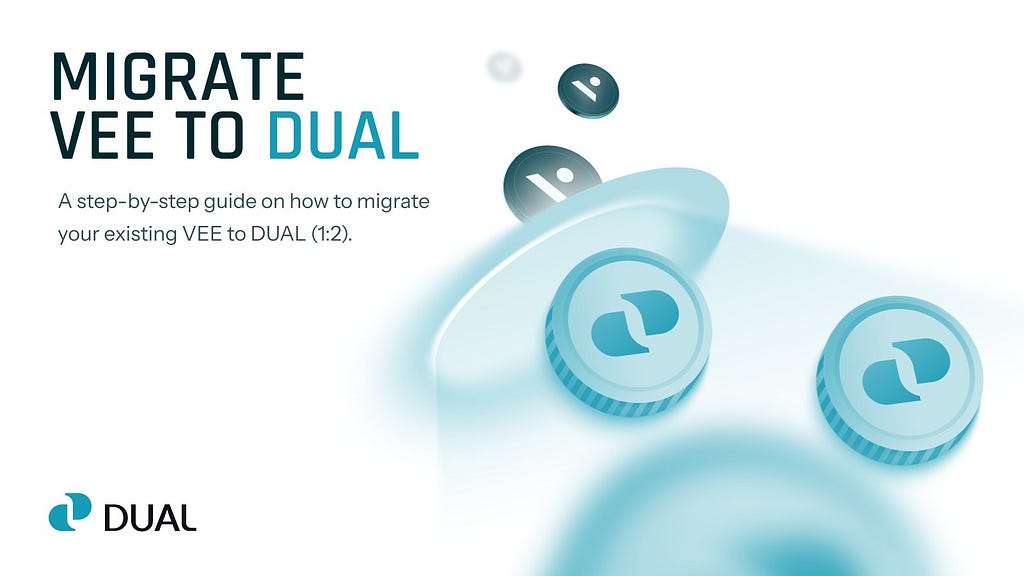
The project that powered Web3 experiences for VISA, Verizon, PepsiCo, and Accenture just reinvented itself. VEE migrates to DUAL at a 1:2 ratio — you get double the tokens, plus staking and governance launching next month. Here’s the complete guide.
Go to the official Dual Migration Tool
Type dual.org directly into your browser. Navigate to the Migration section. Do not use any links from Telegram, Discord, or social media
Since 2015, BLOCKv has been quietly powering some of the most sophisticated enterprise Web3 deployments in the world.
VISA used it. Verizon used it. PepsiCo, Unilever, Accenture — all Fortune 500 companies who needed programmable digital assets at scale chose BLOCKv’s infrastructure. Not Ethereum. Not Solana. BLOCKv’s purpose-built vAtom (Virtual Atom) protocol, running on the VEE token.
Now, after years of enterprise deployment and a clear vision for what comes next, BLOCKv is becoming Dual — and the $VEE → $DUAL migration is one of the most interesting token transitions happening in crypto in 2026.
Why? Because unlike most migrations where you swap one token for one token, this one gives you two DUAL for every VEE you hold. The 1:2 ratio is an explicit statement from the Dual team: we’re rewarding the holders who stayed through the early years, and we’re building something worth staying for.
The migration is live. The window is open until December 31, 2027. Trading on Kraken has already begun. And the smart contracts have been audited by ChainSecurity. If you hold $VEE, here is everything you need to know.
Migration Details: Everything Confirmed
Detail Information Old token $VEE (BLOCKv) New token $DUAL (Dual) Ratio 1:2 — one VEE = two DUAL Migration window Open until December 31, 2027 New chain Ethereum Mainnet (Layer 1) DUAL contract (ETH) 0x6aF487BEb661CCeCD1D045E9561A0dAC9AA5c7db Migration tool Official Dual Migration Tool at dual.org Smart contract audit ChainSecurity Listed on Kraken, Uniswap (trading live) Official Twitter @DualOrg
Token allocation breakdown:
- 72.92% reserved for migration (VEE → DUAL conversions)
- 17.07% Foundation Treasury
- 10% Rewards
All allocations vest linearly over 5 years. Staking and governance launch next month.
What Is Dual — and Why Does It Matter?
Dual is not a new project built from scratch. It is the evolution of BLOCKv — a protocol with nearly a decade of enterprise production deployments behind it.
BLOCKv’s original product was the vAtom — a Virtual Atom. A vAtom is a programmable digital object: an NFT-like asset that can hold logic, rules, and real-time data. Unlike static NFTs, vAtoms can change state, respond to user interactions, restrict access, expire, split, merge, and connect to real-world events.
The practical applications are significant:
- Digital loyalty points that expire, unlock rewards, and transfer automatically
- Event tickets with embedded AR experiences that activate at specific GPS coordinates
- Programmable certificates that verify credentials on-chain
- Interactive brand experiences that reward user engagement in real time
BLOCKv’s infrastructure has been battle-tested by some of the world’s largest enterprises in production environments where reliability isn’t optional. That foundation is what Dual is built on.
What Dual adds on top of BLOCKv’s foundation:
Dual Chain — Ethereum Layer 2 via Arbitrum Stack: Dual operates as a Layer 2 blockchain on Ethereum, built using the proven Arbitrum technology stack — the same infrastructure behind enterprise-grade tokenization networks like Robinhood Chain. This means Dual inherits Ethereum’s security and decentralization while offering the low fees and high throughput needed for real-world asset applications.
Layer 3 for Programmable Logic: On top of Dual Chain sits a Layer 3 where the protocol’s programmable logic runs. This is where asset rules are enforced, permissions are defined, and workflows execute in real time with low latency and minimal cost. This architecture makes it practical for real applications to operate continuously at scale — not just occasionally, as with most blockchain applications.
AI Agent Compatibility: Dual is built to be compatible with AI-driven development workflows. AI agents can interact directly with Dual’s infrastructure to create and manage programmable assets using secure, production-tested modules — eliminating the need to write raw smart contract code. As AI development becomes the primary mode of software creation in 2026, this positions Dual as the infrastructure layer for AI-generated Web3 applications.
Programmable Economy Infrastructure: The rebrand from BLOCKv to Dual reflects a clear thesis: the future of the internet is a programmable economy — where digital assets are not static ownership records but active, rule-following participants in automated economic systems. Dual is the infrastructure for building that economy.
The 1:2 Ratio: What It Actually Means for Your Holdings
The most immediately impactful aspect of this migration for existing $VEE holders is the conversion ratio: 1 VEE = 2 DUAL.
Let’s be precise about what this means and what it doesn’t mean.
What it means: If you hold 10,000 VEE tokens, you will receive 20,000 DUAL tokens after migration. Your token count doubles.
What it doesn’t mean: This is not free money created from nowhere. The total market capitalisation is recalibrated when the new token supply is set. The 1:2 ratio effectively halves the per-token price relative to the old VEE price. If VEE was worth $0.015, DUAL at launch would be priced around $0.0075 — with the same total value represented.
Why do a 1:2 ratio instead of 1:1? Token splits serve real strategic purposes. A lower per-token price makes the asset more psychologically accessible to retail buyers. More tokens in circulation increases trading liquidity. And in this case, doubling the token count of existing holders is a deliberate signal: the team is rewarding early community members by giving them a proportionally larger position in the new ecosystem relative to any new entrants who buy DUAL on the open market.
For long-term VEE holders who believed in the protocol through multiple market cycles, the 1:2 ratio is an acknowledgement of that loyalty built directly into the migration mathematics.
The Vesting Schedule: Understanding the 5-Year Linear Vest
One aspect of the Dual migration that requires careful attention is the 5-year linear vesting applied to all token allocations — including the migration pool.
What this means practically: your DUAL tokens do not become fully liquid the moment you migrate. They vest — unlock gradually — over a 5-year period on a linear schedule.
Example: If you hold 10,000 VEE and receive 20,000 DUAL after migration:
- You don’t receive all 20,000 DUAL immediately accessible for trading
- Tokens unlock progressively over 60 months (5 years)
- Monthly unlock: approximately 333 DUAL per month per 10,000 VEE migrated
This is a significant structural feature that differentiates Dual from most token migrations. The vesting schedule is designed to:
- Prevent immediate sell pressure that would crater DUAL’s price on launch
- Align long-term holder incentives with the protocol’s development timeline
- Ensure the Foundation Treasury and Rewards allocations also vest on the same schedule — demonstrating the team is not giving themselves faster access than the community
Before migrating, understand this vesting mechanic clearly. DUAL is not a quick flip opportunity. It is a long-term position in a protocol that is building over years. The 5-year vest enforces that time horizon for everyone.
The migration window remaining open until December 31, 2027 gives holders over 18 months to decide — giving you time to research the project thoroughly before committing to a 5-year vesting position.
What Happens to VEE If You Don’t Migrate?
The migration window is long — December 31, 2027 — which means you are not under immediate pressure the way you are with some migrations that close in days or weeks.
However, the directional pressure on VEE is clear. As more holders migrate to DUAL, $VEE’s trading volume and liquidity will continue to thin. The project’s development, exchange listings, and community focus are entirely on DUAL. VEE receives no further development, no new integrations, and no exchange listing support.
The practical timeline:
- Near-term: VEE still trades on some DEXs (Uniswap V3, Sushiswap on Polygon)
- Medium-term: Liquidity drains progressively as holders migrate
- Long-term: VEE becomes effectively illiquid — a forgotten legacy token
You have until December 31, 2027. But waiting is not without cost. Every month you wait, VEE’s liquidity diminishes and the execution quality of any eventual migration worsens.
The right time to migrate is when you have researched the project and are comfortable with the 5-year vesting schedule — not at the last minute in December 2027 when liquidity has already evaporated.
Where VEE Exists — and What to Do on Each Chain
VEE was deployed across multiple blockchains. Your migration path depends on where your VEE is currently held.
VEE on Ethereum Mainnet: Go directly to the official Dual Migration Tool at dual.org. Connect your Ethereum wallet, enter your VEE amount, and execute the single-transaction migration. Your DUAL will be issued to the same wallet at 2:1.
VEE on Polygon: You must bridge to Ethereum first using the official bridge for Polygon. Once your VEE is on Ethereum, use the Dual Migration Tool to convert to DUAL.
VEE on Base: Same as Polygon — bridge to Ethereum first using Base’s official bridge, then migrate via the Dual Migration Tool.
VEE on Optimism: Bridge to Ethereum via Optimism’s official bridge, then migrate via the Dual Migration Tool.
VEE on BLOCKv Mainnet (BLOCKv’s own chain): Bridge your tokens to Ethereum using BLOCKv’s bridge infrastructure, then proceed with the Dual Migration Tool.
VEE staked on the BLOCKv platform: The unstaking fee has been removed specifically to support this transition. Go to staking.blockv.io, unstake your VEE (now fee-free), then migrate via dual.org.
Step-by-Step Migration Guide
What you need before starting:
- VEE tokens in an Ethereum-compatible wallet (MetaMask recommended)
- VEE on Ethereum mainnet — bridge from other chains first if needed
- ETH for gas fees — 0.01 ETH is sufficient for the migration transaction
Step 1: Go to the official Dual Migration Tool
Type dual.org directly into your browser. Navigate to the Migration section. Do not use any links from Telegram, Discord, or social media
Step 2: Connect your Ethereum wallet
Connect MetaMask or your preferred Ethereum wallet. Ensure you are on Ethereum Mainnet, not a testnet or Layer 2.
Step 3: Enter your VEE amount
The interface will display your VEE balance. Enter the amount you wish to migrate. The tool will automatically show the DUAL you will receive at the 1:2 ratio.
Example:
- 1,000 VEE → 2,000 DUAL
- 50,000 VEE → 100,000 DUAL
- 500,000 VEE → 1,000,000 DUAL
Step 4: Execute the migration
Approve and confirm the single transaction. Your VEE will be burned — permanently removed from the VEE supply — and the corresponding DUAL will be issued to the same wallet address.
Step 5: Add DUAL to your wallet
In some cases, DUAL will not auto-appear in your wallet. Add it manually using the official contract address:
DUAL (Ethereum): 0x6aF487BEb661CCeCD1D045E9561A0dAC9AA5c7db
You can verify this contract on Etherscan and it is confirmed across the official @DualOrg announcement and the CoinCarp migration page.
Security: How to Stay Safe
The VEE → DUAL migration has a long window, which means scammers have time to build increasingly sophisticated phishing operations. Here is your complete security checklist:
✅ Only use dual.org
✅ Verify the DUAL contract address from multiple official sources: 0x6aF487BEb661CCeCD1D045E9561A0dAC9AA5c7db Check it against @DualOrg on Twitter AND Etherscan AND the CoinCarp announcement page. All three must match.
✅ The migration burns your VEE. After a successful migration, your VEE balance will be zero. This is correct — your VEE has been burned and DUAL has been issued. Do not panic if VEE shows zero.
✅ Bridge first, migrate second. If your VEE is on Polygon, Base, or Optimism — use only official bridges for those networks before touching any migration tool.
✅ Never share your seed phrase. Not with Dual support, not with anyone in Telegram, not with anyone claiming to be the team. The real migration requires only a wallet connection.
✅ ChainSecurity audited the smart contracts. The migration contract has been independently audited. If any site claims to be the migration tool but can’t reference the ChainSecurity audit, leave immediately.
Trading DUAL After Migration
$DUAL is already live and trading on multiple venues:
Centralised exchanges:
- Kraken — major listing, trading began at 14:00 UTC on launch day. This is the primary CEX venue for DUAL liquidity.
Decentralised exchanges (Ethereum):
- Uniswap — available independently, accessible to anyone with an Ethereum wallet
As DUAL’s ecosystem matures and staking/governance launch in the coming weeks, additional exchange listings are expected. A project with enterprise credentials — VISA, Verizon, PepsiCo as past clients — and a ChainSecurity-audited token is well-positioned for Tier 1 exchange listings beyond Kraken.
Why This Is One of the Most Interesting Migrations of 2026
Most token migrations are straightforward infrastructure upgrades — same project, cleaner contract, new name. The VEE → DUAL migration is something more ambitious.
Consider what Dual is actually launching:
A Layer 2 blockchain built on the Arbitrum stack — the same technology stack used by enterprise networks like Robinhood Chain. This is not a side project. It is purpose-built Layer 2 infrastructure for programmable economy applications.
A Layer 3 for programmable logic — making it practical to run complex asset rules, permissions, and workflows on-chain in real time. Most blockchains can record ownership. Dual can enforce dynamic rules continuously.
AI agent compatibility — allowing AI systems to create and deploy programmable assets without writing raw smart contracts. As AI becomes the dominant development paradigm, the protocols that AI can natively interact with will capture extraordinary developer adoption.
Enterprise credibility — BLOCKv’s production deployments with Fortune 500 companies are not just marketing material. They are proof that the underlying technology works in environments where failure is not an option.
And all of this comes to holders with a 1:2 token ratio — double the tokens, staking launching next month, and a migration window that gives you until December 2027 to decide.
For a migration, that combination is genuinely unusual.
Frequently Asked Questions
What is the VEE to DUAL conversion ratio? 1:2 — one VEE becomes two DUAL. If you have 1,000 VEE, you receive 2,000 DUAL.
What is the DUAL contract address on Ethereum? 0x6aF487BEb661CCeCD1D045E9561A0dAC9AA5c7db — verify on Etherscan and through @DualOrg before use.
How long does the migration window stay open?
Until December 31, 2027. You have time — but don’t wait for the last minute as VEE liquidity will deteriorate.
Are my DUAL tokens vested after migration?
Yes. All DUAL allocations vest linearly over 5 years. Your tokens unlock progressively each month over 60 months.
What if my VEE is on Polygon, Base, or Optimism?
Bridge to Ethereum mainnet first using each chain’s official bridge, then use the Dual Migration Tool at dual.org.
What if my VEE is staked on BLOCKv?
Go to staking.blockv.io and unstake — the unstaking fee has been removed specifically for this migration. Then migrate via dual.org.
Is the migration contract audited?
Yes — by ChainSecurity, one of blockchain’s most respected smart contract audit firms.
Where does DUAL trade?
Kraken (CEX) and Uniswap (DEX on Ethereum).
Does my DUAL automatically appear in my wallet?
Not always. Add it manually using the contract address: 0x6aF487BEb661CCeCD1D045E9561A0dAC9AA5c7db
✅ Migrate $VEE → $DUAL Right Now
👉 dual.org — Official Dual Migration Tool
What you need:
- VEE tokens on Ethereum Mainnet (bridge from other chains first)
- ETH for gas — 0.01 ETH minimum
- MetaMask or compatible Ethereum wallet
Migration steps:
- Go to dual.org directly — type the URL manually
- Connect your Ethereum wallet
- Enter VEE amount → confirm 2x DUAL output
- Approve the single migration transaction
- Add DUAL to your wallet: 0x6aF487BEb661CCeCD1D045E9561A0dAC9AA5c7db
If VEE is staked:
👉 staking.blockv.io — Unstake fee-free, then migrate
Migration window: Open until December 31, 2027 Ratio: 1 VEE = 2 DUAL Audit: ChainSecurity verified
⚠️ The official migration tool is at dual.org only. Never use migration links from Telegram, Discord, or social posts. The VEE burn is irreversible — always verify the DUAL contract address 0x6aF487BEb661CCeCD1D045E9561A0dAC9AA5c7db before executing.
Final Word
BLOCKv spent nearly a decade proving that programmable digital assets could work at enterprise scale. VISA, Verizon, PepsiCo — these aren’t proof-of-concept clients. They are production deployments at scale.
Dual is what you build when you’ve spent a decade learning what enterprise Web3 actually needs: a Layer 2 with programmable logic, AI agent compatibility, and a token economy designed for long-term participation rather than short-term speculation.
The 1:2 migration ratio says clearly what the team thinks: the people who stayed through BLOCKv’s early years deserve to start Dual’s next chapter with more, not less.
You have until December 2027. But the longer you wait, the thinner VEE’s liquidity becomes. The migration is free, audited, and simple. The only question is whether you want to be in DUAL before staking and governance launch next month — or after.
Follow for enterprise Web3 and token migration coverage. Share this with every VEE holder in your network — most people don’t realise this migration gives them double the tokens.
Tags: #VEE #DUAL #BLOCKv #Dual #TokenMigration #Ethereum #Layer2 #Arbitrum #Web3 #Crypto2026 #ProgrammableEconomy #Kraken #Uniswap #SmartNFT #DeFi #EnterpriseBlockchain
BLOCKv Is Dead. was originally published in Coinmonks on Medium, where people are continuing the conversation by highlighting and responding to this story.