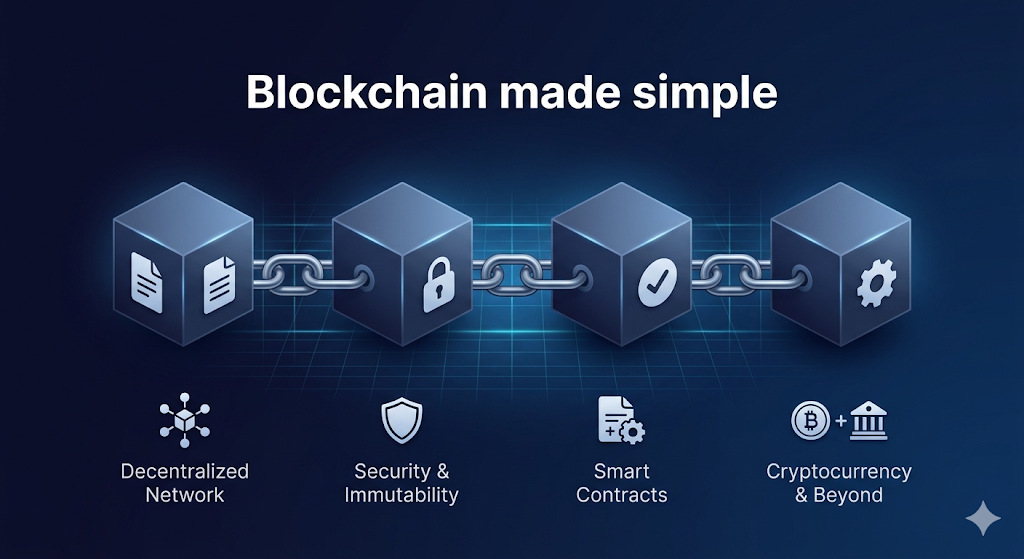
Blockchain Made Simple
 Muhammad Ali Saleem3 min read·Just now
--
Blockchain is one of those words that sounds complicated and overhyped at the same time.
You hear it with cryptocurrency, finance, apps, even voting systems.
But just like LLMs, blockchain is not magic.
It’s a system. Once you understand the basics, everything starts to make sense.
Let’s break it down step by step.
What Is a Blockchain, Really?
A blockchain is a type of database.
But unlike a normal database:
- It is shared across many computers
- It cannot be easily changed once data is added
- It does not rely on a single authority
Its main idea is simple:
Store data in blocks, and link those blocks together in a chain.
Step 1: What Is a Block?
A block is just a container of data.
It usually contains:
- A list of transactions
- A timestamp
- A reference to the previous block
Think of it like a page in a notebook.
Once a page is filled, you move to the next one — but you never erase the old pages.
Step 2: Linking Blocks Together
Each block is connected to the previous one using something called a hash.
A hash is:
- A unique digital fingerprint of the data
- Generated using a mathematical function
If even a small part of the data changes, the hash changes completely.
This creates a chain:
Block 1 → Block 2 → Block 3 → …
If someone tries to change Block 1, its hash changes, which breaks the entire chain.
That’s what makes blockchain secure.
Step 3: Decentralization
In traditional systems:
- One company controls the database
In blockchain:
- Many computers (called nodes) hold a copy of the data
This means:
- No single point of failure
- No single authority in control
Everyone has the same version of truth.
Step 4: How Do New Blocks Get Added?
New blocks are added through a process called consensus.
This is how all the nodes agree on:
“What is the correct next block?”
There are different methods, like:
- Proof of Work (used by Bitcoin)
- Proof of Stake (used by newer systems)
They all aim to solve the same problem:
Make sure no one can cheat the system.
Step 5: Immutability — Why Data Can’t Be Changed
Once data is added to a blockchain, it is very hard to change.
Why?
Because to change one block, you would need to:
- Change that block
- Recalculate all hashes after it
- Update it across most of the network
This is practically impossible at scale.
That’s why blockchain is called immutable.
Step 6: Transparency
Most blockchains are public.
This means:
- Anyone can see the transactions
- No one can secretly modify them
You may not know who owns an address, but you can see what it does.
This creates trust without needing a middleman.
Step 7: Smart Contracts
Blockchains are not just for storing data.
They can also run code.
This code is called a smart contract.
A smart contract:
- Runs automatically
- Executes when conditions are met
- Cannot be changed once deployed
Example:
“If payment is received → transfer ownership”
No need for a third party.
Step 8: What Blockchain Is Used For
Blockchain is used in many areas:
- Cryptocurrency (Bitcoin, Ethereum)
- Asset tokenization (like cars or real estate)
- Supply chain tracking
- Digital identity systems
It is useful wherever trust is important.
Step 9: What Blockchain Cannot Do
Blockchain is powerful, but not perfect.
It has limitations:
- Slower than traditional databases
- Can be expensive (transaction fees)
- Not suitable for storing large data
- Doesn’t guarantee truth — only consistency
It solves trust, not accuracy.
Step 10: Why Blockchain Feels Revolutionary
Blockchain removes the need for intermediaries.
Instead of trusting a bank, company, or platform:
You trust the system itself.
This shift is what makes blockchain feel so powerful.
Final Thoughts
Blockchain is not just about crypto.
It is about:
- Trust
- Transparency
- Decentralization
At its core, it is just a clever way of organizing data.
Once you understand the basics, it stops feeling confusing.
And like most technologies:
It’s not about replacing everything —
It’s about solving specific problems better.
Understanding blockchain is not difficult.
It just requires breaking it down —
one block at a time.