Bitcoin Merchant Privacy: Protecting BTC Revenue Patterns From Competitors
 BountyPortals Official Blog5 min read·1 hour ago
--
A merchant accepting Bitcoin can gain access to a borderless payment method, but bitcoin merchant privacy becomes a serious concern once revenue begins moving through public blockchain addresses. Every BTC transaction leaves a visible record. Payment timing, wallet movement, transaction sizes, and repeated address behavior can all become signals.
For a private individual, this may be uncomfortable. For a business, it can become commercially sensitive.
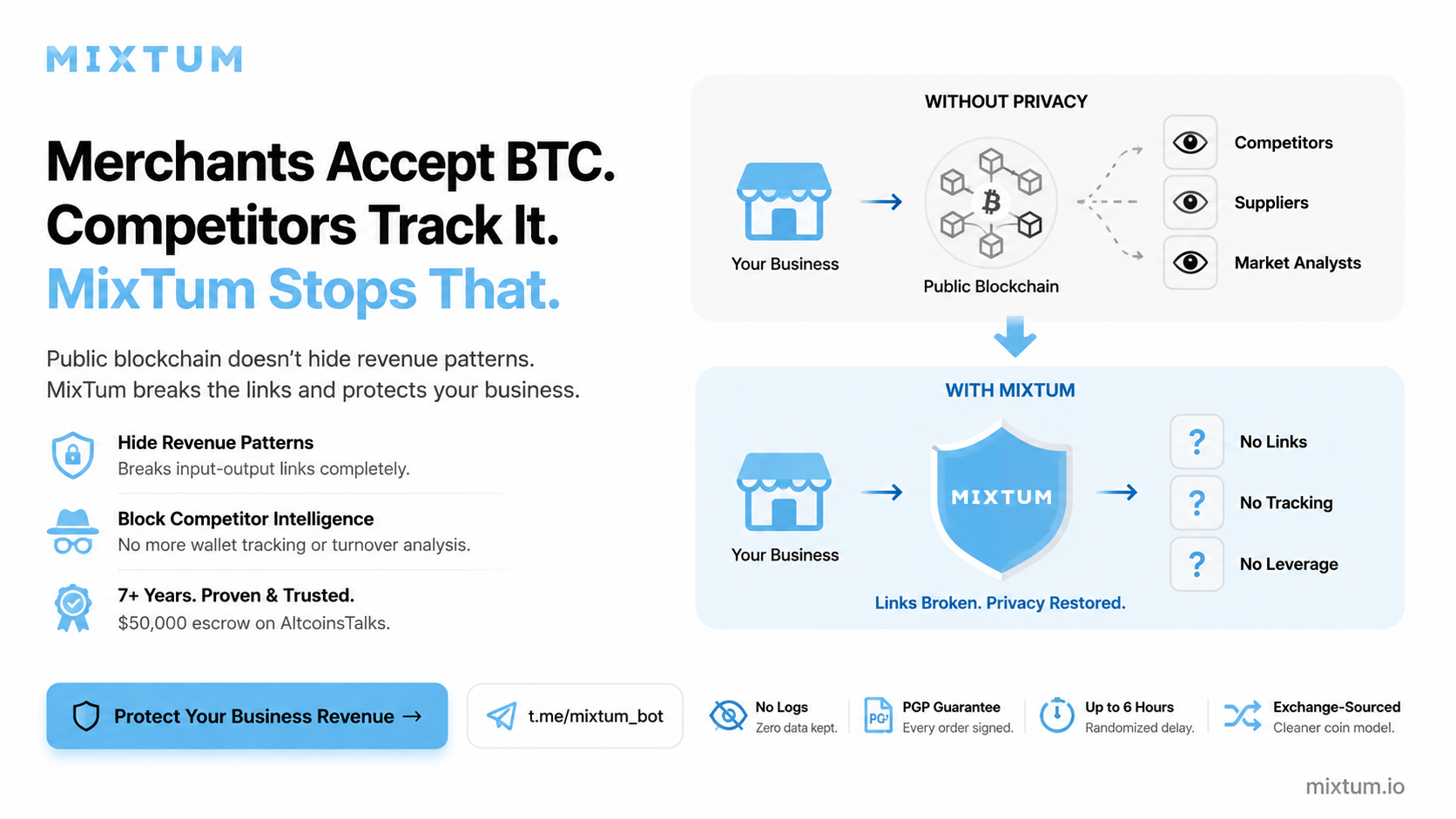
A merchant does not need to reveal profit margins directly for competitors to learn something useful. Public BTC flows can suggest revenue cycles, customer demand, supplier payments, campaign performance, and periods of high activity. The issue is not simply that Bitcoin is public. The issue is that business revenue can become readable if there is no privacy layer between incoming payments and outgoing wallet activity.
Bitcoin Merchant Privacy Is a Business Protection Issue
Many merchants think about Bitcoin privacy from a customer perspective. That matters, but the merchant side is just as important. When a business accepts BTC, the receiving wallet may become a source of business intelligence.
A competitor may watch wallet flows and identify when sales volume increases. A supplier may see stronger payment activity and use that information during negotiations. Market watchers may infer campaign performance from transaction timing. Even without knowing the full internal accounts of the business, repeated on-chain activity can reveal enough to create leverage.
This is why business bitcoin privacy should not be treated as an optional technical detail. It sits closer to revenue protection, operational privacy, and commercial risk management.
In traditional banking, competitors cannot simply inspect business payment movement on a public ledger. Bitcoin changes that. The strength of Bitcoin’s transparency for verification can also create exposure for merchants that need financial discretion.
How BTC Revenue Can Become Public Intelligence
Consider a merchant that accepts BTC for digital services, hardware, consulting, or online products. During a strong sales period, more payments arrive. If the merchant later moves those funds from the same wallet to another wallet or supplier address, the movement can become part of an observable pattern.
This may not reveal the full business ledger, but it can reveal enough to matter.
A competitor could notice that certain campaign windows produce higher BTC inflows. A supplier could identify that a merchant has stronger recent liquidity. A public observer could connect recurring payment behavior with business cycles. Over time, these patterns become easier to interpret.
This is the practical reason behind merchant transaction hiding. It is not about hiding business legitimacy. It is about reducing unnecessary exposure from public transaction trails.
For merchants, btc revenue protection means breaking the visible connection between business income and later wallet activity. The goal is simple: payment acceptance should not automatically become a public dashboard for competitors.
How MixTum Supports Competitor Analysis Protection
MixTum is a premium Bitcoin mixer built on the Jambler.io platform and launched in August 2018. It is not an exchange, wallet, or investment service. Its purpose is focused on Bitcoin mixing through an exchange-sourced coin model.
MixTum does not shuffle funds in one or multiple pools. Instead, it exchanges incoming BTC with coins purchased from investors at cryptocurrency stock exchanges such as Binance, OKEx, DigiFinex, Cryptonex, and others. This is different from a classical pool-based model.
The transfer algorithm selects independent investors and trading platforms, then breaks down funds in a manner designed to remove the link between input and output transactions. For a merchant, that means incoming BTC revenue does not have to remain directly connected to later clean coin delivery.
MixTum also sends clean coins through two or more transactions, showing random sums at different time intervals. Each interval can take up to 6 hours. This structure helps resist cluster and volume analysis, which is especially relevant when the concern is competitor analysis protection.
A simple business example makes the use case clearer. A merchant receives BTC from several customers during a product launch. Instead of moving those coins directly to another wallet in a way that preserves a readable trail, the merchant can use MixTum to break the link between incoming BTC and outgoing clean coins. The merchant’s revenue activity becomes less useful to external observers.
Why No-Log Architecture Matters for Merchants
A privacy tool for merchants needs more than transaction flow design. It also needs a clear operating structure around data retention and verification.
MixTum requires no registration and stores no logs. All order data is deleted upon completion or when the offer expires. User data on Bitcoin addresses is deleted after 7 days or immediately after service delivery. MixTum’s privacy policy states that it does not collect non-personal identity data, does not use cookies itself, and does not sell, share, or rent personal user information.
For every order, MixTum issues a PGP-signed letter of guarantee. This confirms obligations to the client and gives the user a verifiable record of the order terms. The letter can be checked through PGP client software such as Gpg4Win or online using PGP Checker.
MixTum’s PGP fingerprint is:
B8A5 CFCA F63F F2D8 384A 6B12 D3B2 8095 6F0E 7CAF
For businesses, this matters because privacy should not rely only on marketing claims. It should be supported by clear order guarantees, data deletion rules, and defined service conditions.
Transparent Pricing and Practical Limits
MixTum’s commission is randomized between 4–5% plus a 0.0007 BTC network fee. The minimum amount is 0.001 BTC, and the maximum is 50 BTC per request. Larger sums can be handled through multiple orders.
Processing takes up to 6 hours after the first confirmation. The delay is randomly chosen to resist deanonymization through volume and timing analysis. Deposit addresses remain valid for 7 days, which gives merchants a defined window for completing transfers.
MixTum also operates on both Clearnet and TOR. The TOR mirror uses no JavaScript and collects no visitor activity records. For merchants with stronger privacy requirements, this gives another access path.
Final View: BTC Payments Should Not Expose Business Strategy
Bitcoin can be useful for merchants, but public payment trails can expose more than intended. Revenue patterns, wallet movements, and timing behavior may become useful to competitors or suppliers.
MixTum addresses this use case by breaking the link between incoming BTC and outgoing clean coins through an exchange-sourced model, no-log architecture, PGP guarantees, and randomized clean coin delivery.
Bitcoin merchant privacy is not only about anonymity. It is about keeping business revenue from becoming competitor intelligence.
Protect your business revenue from blockchain snoopers: https://mixtum.io