At 10:30:34 a.m. ET, a single IBIT print of 29,212,864 shares, crossed at $43.16, for a notional of roughly $1.26 billion.
The next-largest visible movement was 1.3 million shares, making one trade dwarf everything else in IBIT's session, accounting for about 34.8% of the ETF's reported intraday volume of 83.86 million shares.
IBIT ended the sequence at $42.99, up about 0.09%, while Bitcoin traded around $75,911, down roughly 1.73%. A dark pool executed the trade with a momentary 1% dip in Bitcoin, which recovered immediately, confirming the block absorbed through organized liquidity and settled cleanly.
IBIT's intraday volume of 83.86 million shares gave the market enough daily turnover to absorb even a 29.2 million-share print, and a buyer or a network of buyers matched the seller at $43.16 without triggering a disorderly repricing of the ETF.
Before spot Bitcoin ETFs launched, moving a billion dollars of Bitcoin exposure required either a large OTC desk arrangement or a sequence of exchange orders that would leave visible price impact across crypto markets.
Today's block routed through block desks, market makers, arbitrage desks, authorized participants standing ready, and IBIT closed near where it started.
The secondary market distinction
IBIT shares trade continuously on the secondary market among investors, and a block trade between those investors changes ownership of the shares, leaving the trust's underlying Bitcoin holdings intact unless something else happens.
BlackRock's fund documentation states that IBIT shares are bought and sold on the secondary market and are not individually redeemable from the trust.
Only authorized participants, which are large financial institutions that interact directly with the fund, can create or redeem shares in large baskets. This happens through a separate process, and that process determines whether the trust actually sells Bitcoin.
Farside Investors May 26 IBIT flow row was not yet populated, leaving confirmation of whether today's block translated into fund-level Bitcoin selling still pending.
IBIT's previous single-day withdrawal record was approximately $523 million, set in November 2025. A confirmed outflow matching today's full notional size would more than double that record.
If IBIT reports no major outflow, the block transfer of exposure from one institutional holder to another is a liquidity event confined to the secondary market.
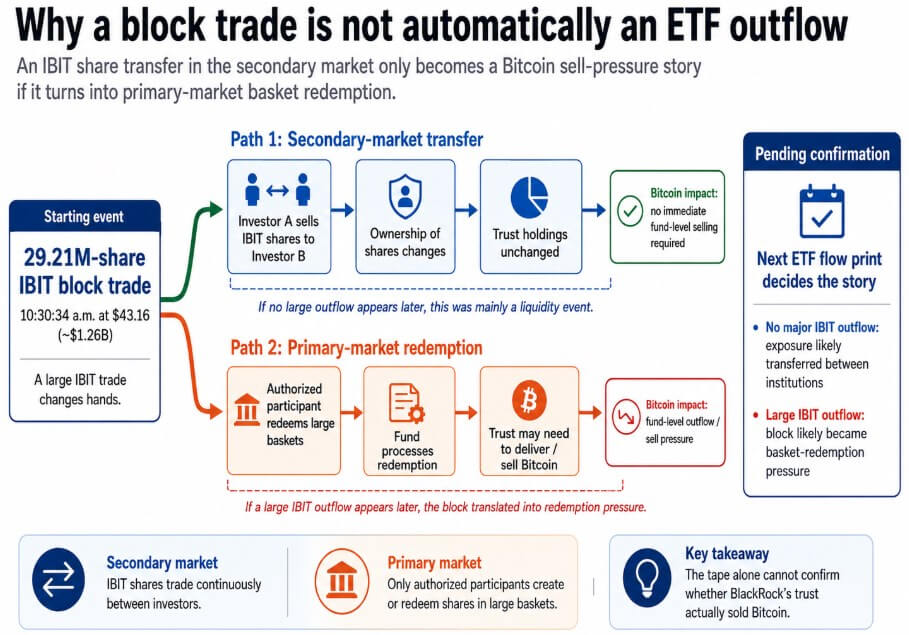
If IBIT posts a large outflow, particularly one approaching or exceeding its prior record of $523 million, the block translates into basket-redemption pressure.
A large holder may have wanted to cut Bitcoin exposure and used IBIT because it offered enough liquidity to move size discreetly. The buyer may have been a different institution rotating into Bitcoin exposure via the ETF wrapper.
The trade could also reflect a portfolio rebalancing, a basis-trade unwind, a hedge adjustment, or a mandate-driven allocation change, none of which requires a directional view on Bitcoin's price.
Plumbing under pressure
In the bull case, ETF flow data shows no major IBIT outflow, and today's block confirms the depth of Bitcoin's institutional market.
One institution reduced exposure, and another absorbed it through the ETF structure, keeping spot Bitcoin off the exchange order books and the ETF price intact.
That outcome supports the argument that Bitcoin's market structure has matured, as billion-dollar exposure transfers can now occur within ETF plumbing.
Institutions looking to size into or out of Bitcoin have a liquid, organized venue capable of handling the volume, and May 26 movement is the evidence.
In the bear case, IBIT reports a large outflow in the next flow print, one that approaches or exceeds its prior record of $523 million.
That would mean the block translated into basket redemption pressure, as authorized participants returned shares to BlackRock, the fund sold Bitcoin to meet redemptions, and the ETF structure amplified the concentrated selling, transmitting it into spot price pressure.
The broader implication is that institutional de-risking at scale can activate the redemption cycle, converting a secondary-market block trade into primary-market Bitcoin sales in a sequence the tape alone cannot show.
Whatever the flow data confirms, today's block already demonstrated the depth of Bitcoin's institutional infrastructure.
| Scenario | ETF flow print | Interpretation | Market meaning |
|---|---|---|---|
| Absorption | No major IBIT outflow | One holder sold, another absorbed the shares | ETF market passed a billion-dollar liquidity test |
| Partial redemption | Outflow below prior record | Some primary-market pressure, but not full block conversion | Mixed signal; secondary liquidity still absorbed part of trade |
| Record outflow | Outflow near or above $523M | Block likely translated into basket-redemption pressure | Institutional de-risking became fund-level selling |
| Extreme case | Outflow approaches full $1.26B notional | More than double prior IBIT withdrawal record | Could reframe the event as major ETF redemption shock |
A trade worth roughly $1.26 billion crossed at a single venue, and the ETF held its price, sustained by IBIT's order book depth, block-desk liquidity, and the arbitrage apparatus that keeps the ETF's price tethered to its net asset value under stress.
The block trade only converts into deeper Bitcoin sell pressure if it shows up in the next ETF flow print. Until then, the cleaner interpretation is that a billion-dollar transfer of Bitcoin exposure happened, and the market absorbed it.
The post Bitcoin just absorbed a single $1.3B IBIT block trade with barely any price movement appeared first on CryptoSlate.