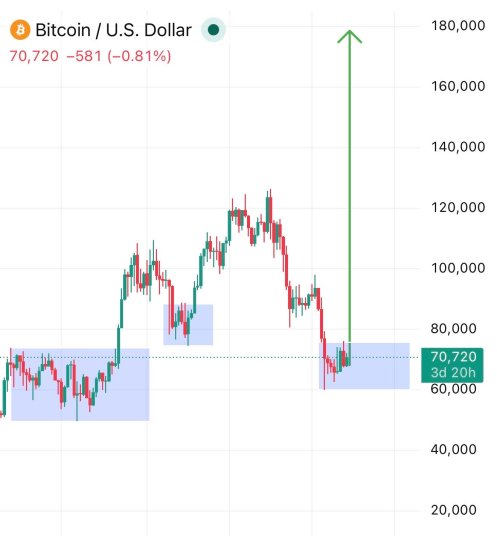
Bitcoin [BTC] fell to a low of $65.5K on Friday, 27 March. This was the same low that it rallied off of earlier in the month to reach $76K. The losses on Friday forced nearly $400 million in long liquidations in the crypto market, and $172 million for Bitcoin.

In a post on X, CoinGlass pointed out that the Open Interest was rising, while the price and the CVD were falling. Together, they pointed to a long squeeze. In fact, the sell-off over the past week and the recent long squeeze have effectively flushed most long positions out of the market.
The 30-day liquidation map showed there was another cluster of high leverage long levels up to the $64K-mark that could be hunted next.
Analysis of on-chain metrics found that accumulation was still fighting against distribution pressure. The market seemed to be in a stressed, transitional state, with full-on distribution not commencing yet.
In other words, it may be, once again, decision time for Bitcoin.
Bitcoin’s internal tug-of-war has not yet been resolved

Crypto analyst Axel Adler Jr observed that the 30-day net position change for long-term holders has been positive since January 2026. The LTH supply measured 14.2 million BTC at press time and despite the recent correction, they continued to accumulate.
A transition to selling was not yet underway. The last time this cohort transitioned to overall selling was in July 2025, with prices around the $120K-level.

At the same time, the LTH Spent Output Profit Ratio fell below 1 in late February. This meant that the long-term holders were realizing a loss, on average, when selling. The analyst pointed out that the “loss zone” was active on the chart, which has historically come during prolonged stress periods.
One difference between the previous stressed market conditions and this one was that BTC’s price was significantly higher than in previous LTH loss phases. This meant that the selling was not indicative of a broad LTH cohort capitulation, but from localized stress from those who bought near the 2025 peak.
The two metrics showed a divergence – Long-term holders continued to accumulate, but a section of the LTHs were selling at a loss.
If the 30-day net position change turns negative, it would be indicative of a shift towards a full distribution.
It remains to be seen if the loss-realizing sellers intensify as prices fall, or if their capitulation ends. If the LTH SOPR can climb back above 1, it would indicate that the current forced selling might be easing.
Final Summary
- Bitcoin’s market sentiment appeared to be extremely pessimistic as prices revisited the $65.6K local lows.
- Long-term holder behavior has not yet shown a transition to a full distribution regime.
Akashnath S is a Senior Journalist and Technical Analysis expert at AMBCrypto. He specializes in dissecting price action, identifying key market trends through advanced chart patterns, and forecasting both short-term and long-term asset trajectories.