Beyond the Hype: What Makes a DeFi Strategy Actually Sustainable?
 Capten TEN3 min read·Just now
--
DeFi is full of yield.
New protocols launch every week, APYs spike into the triple digits, and capital rushes in like a tidal wave. But as any seasoned onchain participant knows, this story usually ends the same way: yields compress, liquidity rotates, and the opportunity vanishes as quickly as it appeared.
The real question we should be asking isn’t “Where is the highest yield?” but rather What actually lasts?
As we move toward a more institutional DeFi landscape, the focus is shifting from chasing “shiny objects” to building durable, sustainable yield models.
1. The Cycle of Ghost Yield
We’ve all seen the pattern: a new protocol launches with massive incentives to bootstrap liquidity. For a week, everyone is a genius. Then, the token emissions slow down, the mercenary capital leaves for the next farm, and the strategy collapses.
Why do most strategies fade? Because they are built on incentives, not utility. They rely on a constant stream of new participants rather than actual economic value.
2. Defining Sustainability in DeFi
In simple terms, a sustainable strategy is one that offers durability over performance. It should:
- Generate consistent returns over months or years, not days.
- Function independently of temporary token subsidies.
- Remain viable whether the market is pumping, dumping, or crab-walking.
Sustainability means your capital is working for you, not just waiting for the music to stop.
3. Real Yield vs. Temporary Yield
Not all yield is created equal. To find sustainability, we must differentiate between:
- Temporary Yield: Driven by protocol emissions (printing tokens to pay users). This is often a “race to the bottom” as sell pressure increases.
- Real Yield: Generated from actual economic activity — trading fees from DEXs, interest from lending markets, or profits from arbitrage.
Real economic activity is more stable because it scales with the maturity of the ecosystem, whereas emissions-driven yield naturally decays.
4. The Role of Liquidity and Market Conditions
A strategy is only as strong as its foundation. Sustainability depends heavily on liquidity depth and user activity.
Some strategies thrive only in high-volatility bull markets. Others are “delta-neutral” but fall apart when correlations shift. A truly sustainable approach recognizes these conditions and adapts, ensuring that the onchain capital deployment isn’t caught off-guard when the market regime changes.
5. The Hidden Killers: Risk & Execution Costs
A strategy might look like it offers 20% on paper, but after you factor in execution costs, gas fees, slippage, and rebalancing, the net return might be closer to zero.
Managed DeFi solves this by accounting for these frictions. Sustainable yield is about net returns, not headline APYs. If a strategy doesn’t account for the cost of maintaining its position, it isn’t a strategy — it’s a leak.
6. Engineering Better Strategy Design
The future of DeFi looks more like a system and less like a casino. Sustainable design involves:
- Diversification: Not putting all capital into one pool.
- Continuous Monitoring: Adjusting parameters in real-time.
- Risk-Adjusted Thinking: Prioritizing the safety of the principal over the height of the yield.
7. Concrete Vaults: Built for Durability
This is where Concrete enters the conversation. Instead of chasing the latest inflationary farm, Concrete vaults are designed with a “longevity-first” mindset.
Our vaults aim to:
- Prioritize sustainable, real-yield sources.
- Manage capital dynamically across multiple proven strategies.
- Reduce reliance on short-term incentives that create “vampire” liquidity.
8. Case Study: Concrete DeFi USDT
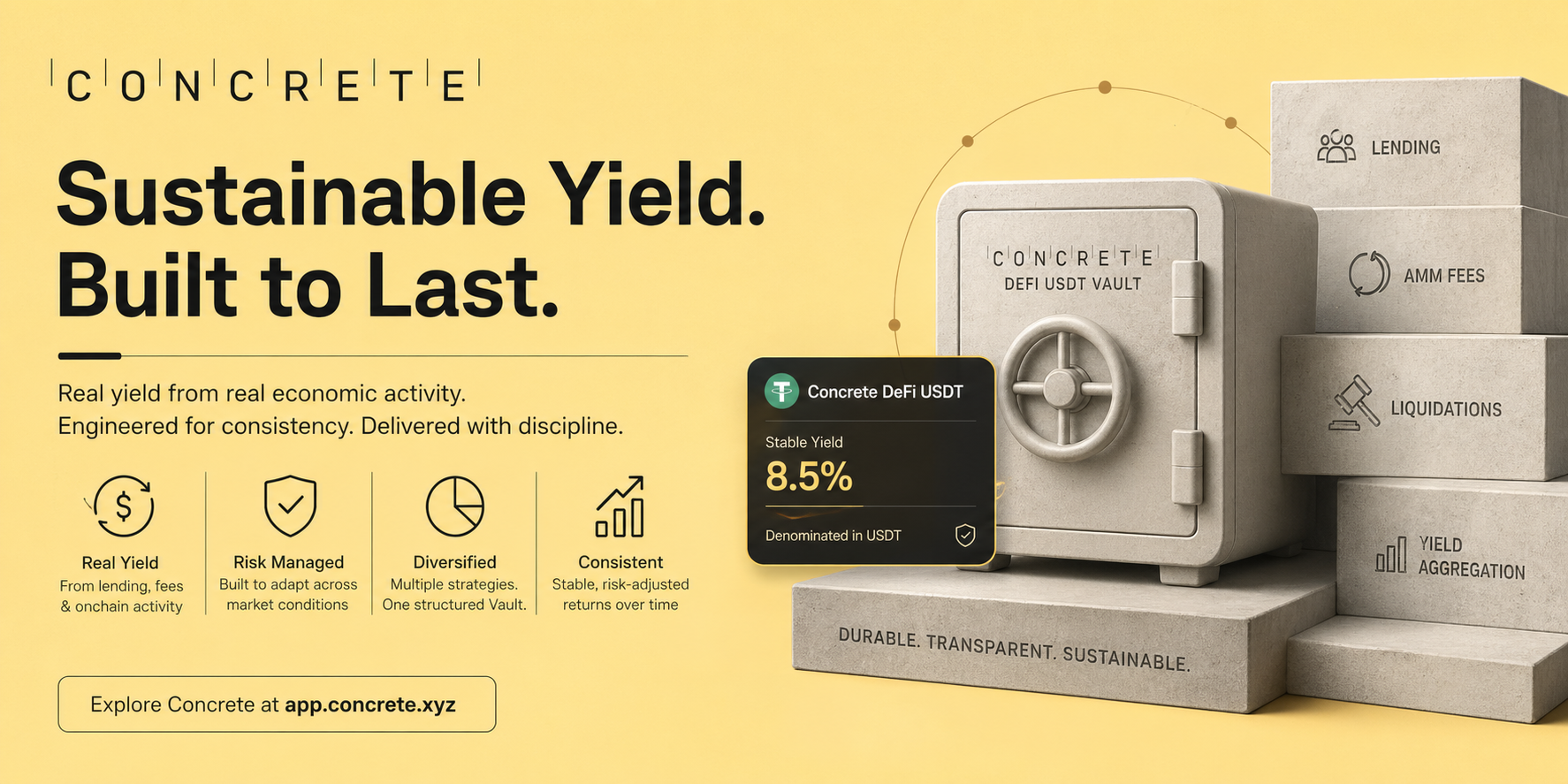
To see this in action, look at Concrete DeFi USDT. While other pools might promise 50% only to drop to 2% a week later, Concrete offers up to ~8.5% stable yield.
In the long run, consistent mid-single-digit returns almost always outperform volatile “moon” yields that suffer from impermanent loss or protocol collapse. Consistency is what attracts institutional DeFi and long-term capital.
9. The Bigger Shift
DeFi is growing up. We are moving away from short-term yield chasing and toward sophisticated, managed DeFi infrastructure.
The future won’t be defined by who had the highest APY for 48 hours. It will be defined by the strategies that survive across market cycles — the ones that prioritize risk-adjusted yield and long-term sustainability.
In the end, infrastructure will always outlast incentives.
Ready to explore sustainable yield?
Explore Concrete at app.concrete.xyz