Beyond the Hype - The Security Framework Behind AGNT Hub’s Autonomous Orchestration
 LockDown4 min read·Just now
--
Hello everyone! I’ve prepared a new article for you — the third in 3 days. Enjoy reading!)
As decentralized autonomous agents begin to dominate on-chain activity, a critical question emerges: how do we delegate control of assets to an algorithm without inheriting catastrophic risk? In a landscape where “autonomous” often equates to “unpredictable,” AGNT Hub is distinguishing itself not just through its execution speed, but through a multi-layered security and verification architecture.
The goal is to move from “blind delegation” to “verified autonomy.” By integrating real-time risk parameters with cryptographic proof of performance, AGNT Hub is setting a new technical standard for safe agentic interaction.
The Guardrail Protocol - Real-Time Risk Isolation
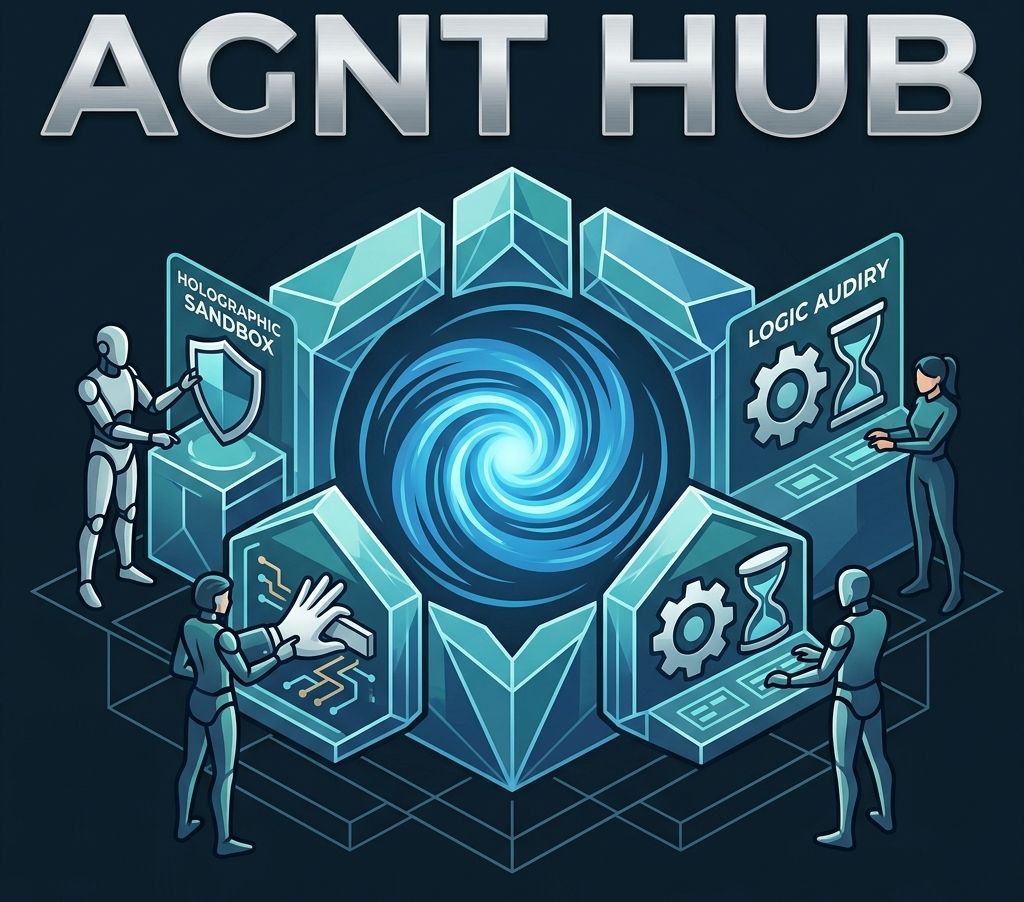
Most automated systems operate on binary permissions — either the bot has access to the wallet, or it doesn’t. AGNT Hub introduces a more granular approach through its Guardrail Protocol. This layer acts as a programmable sandbox for every intent-driven action.
Instead of granting broad execution rights, the Hub allows users to define “Hard Constraints” within the orchestration layer. These include:
- Slippage Ceilings. Automatic termination of a cross-chain swap if the liquidity depth shifts beyond 0.5% during the intent’s lifecycle.
- Contract Whitelisting. Agents are physically unable to interact with unverified or newly deployed contracts unless they pass a specific reputation threshold within the Hub.
- Gas Expenditure Caps. Preventing “runaway” agents from draining a wallet during periods of high network congestion.
These guardrails are baked into the intent itself, meaning the security logic travels with the transaction across different chains.
Solving the Oracle Problem in Agentic Execution
For an AI agent to be effective, it needs accurate off-chain and on-chain data. However, reliance on a single data feed is a vulnerability. AGNT Hub mitigates this by utilizing a Multi-Source Data Aggregator.
Before an intent is executed — for example, a rebalancing strategy triggered by a price drop — the Hub’s validation nodes cross-reference price feeds from multiple decentralized oracles and DEX pools. This prevents “Price Manipulation Attacks,” where an attacker might try to trick an autonomous agent into selling assets at an undervalued price by briefly skewing a single pool’s liquidity. By the time the agent acts, the Hub has already verified the “True Market Price.”
On-Chain Accountability - The Role of PoA in Risk Management
We’ve previously touched on Proof of Alpha (PoA) as a performance metric, but its primary technical function is actually security and accountability. In a permissionless ecosystem, anyone can deploy an agent, but not every agent is coded equally.
The PoA system acts as an immutable audit trail. If an agent’s logic consistently fails or triggers security exceptions, its PoA score drops instantly. This creates a “Self-Cleaning Marketplace.” High-risk or poorly optimized agents are naturally filtered out by the protocol’s ranking logic. Users aren’t just looking for the most profitable agent; they are looking for the one with the most stable, verified track record of safe execution.
The Modular Security Stack of AGNT Studio
Security is often an afterthought for strategy creators, which is why AGNT Studio integrates “Security Blocks” as mandatory components of the no-code builder.
When a creator assembles an agent, the Studio’s compiler performs a real-time “Logic Audit.” If a user tries to create an agent that lacks a stop-loss trigger or attempts to interact with a high-risk bridge, the Studio flags the configuration. This “Security-by-Design” approach ensures that even those without a background in smart contract auditing can deploy professional-grade, secure automation.
Autonomous Recovery and Intent Expiry
In the world of cross-chain intents, sometimes things simply go wrong: a bridge might experience downtime, or a target chain might lag. Standard bots often leave transactions “stuck” in a pending state, locking up user capital.
AGNT Hub solves this through Intent Expiry and Auto-Reversion. Every intent sent through the Hub has a built-in “Time-to-Live” (TTL). If the orchestration layer cannot fulfill the intent within the specified parameters or timeframe, the Hub automatically triggers a recovery sequence, returning the assets to the user’s primary vault. This ensures that capital is never left in limbo, providing a level of “Transactional Safety” that was previously missing from complex cross-chain operations.
The transition to an agentic economy is only possible if users feel safe stepping away from the screen. AGNT Hub is proving that autonomy doesn’t have to mean a loss of control. By combining intent-centric logic with a rigid, verifiable security stack, the project is building the first truly “Industrial-Grade” environment for autonomous Web3 agents. Trust, in this ecosystem, is not earned through promises — it is enforced by the code.
AGNT Hub Presale - Join Early & Get $ATTS Access
Join the $ATTS presale and get early access to the AGNT Hub ecosystem. Secure your spot before the next stage goes…
token.agnthub.ai
JavaScript is not available.
Edit description
x.com