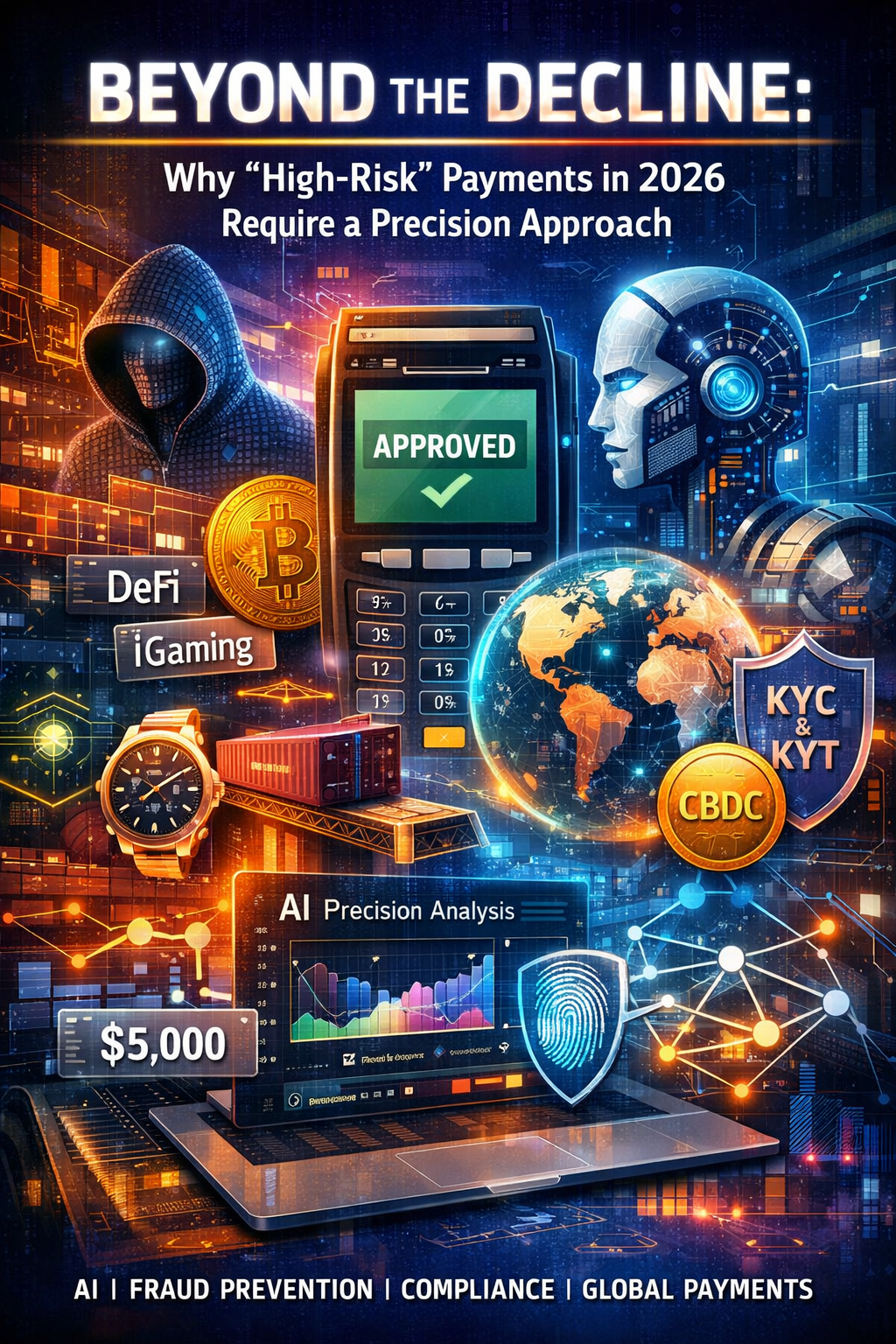
Beyond the Decline: Why “High-Risk” Payments in 2026 Require a Precision Approach
 Chloe Johnson5 min read·Just now
--
In the rapidly evolving landscape of global commerce, the term “high-risk” has undergone a profound transformation. As we move through 2026, the binary classification of merchants as either “safe” or “risky” is no longer sufficient. The digital economy has expanded into specialized niches — from decentralized finance (DeFi) gateways and high-ticket digital collectibles to cross-border iGaming and telemedicine — where traditional banking filters often fail. For businesses operating in these sectors, the primary challenge is no longer just securing an account; it is navigating a sophisticated ecosystem where a single blunt-force decline can result in permanent customer churn and lost lifetime value.
The shift toward a precision approach in high-risk payment processing is driven by the realization that “risk” is rarely a static attribute. In 2026, risk is dynamic, influenced by real-time geopolitical shifts, changing regulatory frameworks, and the increasingly sophisticated methods used by synthetic identity fraudsters. A precision approach moves away from broad-spectrum blocking and toward granular, data-driven decision-making. This evolution is essential for survival in an era where consumers expect frictionless checkouts, regardless of whether they are purchasing a cup of coffee or a high-value crypto-asset.
The Erosion of the Traditional “High-Risk” Label
For decades, the payments industry relied on Merchant Category Codes (MCCs) to dictate the level of scrutiny applied to a business. If you fell into a specific category — such as adult entertainment, travel, or nutraceuticals — you were automatically funneled into high-fee, high-scrutiny channels. However, by 2026, the boundaries between industries have blurred. A retail platform might now offer embedded insurance (high-risk), or a gaming app might feature a secondary market for skins (high-risk). When legacy processors apply old-school filters to these hybrid models, they often inadvertently trigger false positives, declining legitimate transactions from high-value customers.
The cost of these false declines is staggering. In a precision-led environment, processors must distinguish between a transaction that is “risky” due to potential fraud and one that is “complex” due to its regulatory nature. Precision processing involves using machine learning models that understand the nuances of specific sub-verticals. For instance, a $5,000 transaction in a luxury watch marketplace should not be flagged the same way as a $5,000 transaction in a standard e-commerce store. Understanding the “DNA” of the transaction — user behavior, device fingerprints, and historical patterns — is the only way to maintain high authorization rates without opening the floodgates to chargebacks.
Adaptive Regulatory Compliance and Global Variability
One of the most significant hurdles in 2026 is the fragmented nature of global regulation. While the European Union’s updated frameworks might favor certain digital assets, other jurisdictions are tightening controls on cross-border capital flight. A “precision approach” means having a payment stack that is geographically aware and hyper-localized. It is no longer enough to have a one-size-fits-all compliance engine. High-risk merchants now require “smart routing” technologies that send transactions to acquiring banks with the highest likelihood of approval based on the specific region, currency, and local regulations.
Furthermore, the rise of Central Bank Digital Currencies (CBDCs) and regulated stablecoins has added a new layer of complexity. Precision in 2026 involves the seamless orchestration of fiat and digital value. Merchants need to be able to accept “high-risk” digital payments while ensuring that the “Know Your Transaction” (KYT) protocols are as rigorous as traditional “Know Your Customer” (KYC) standards. This level of detail ensures that businesses can tap into emerging markets without falling foul of anti-money laundering (AML) directives that have become increasingly punitive.
The Role of Artificial Intelligence in Risk Mitigation
In 2026, AI is no longer a buzzword; it is the central nervous system of payment precision. Earlier iterations of fraud detection relied on “if-then” rules which were easy for sophisticated bad actors to circumvent. Today, Generative AI and neural networks analyze millions of data points in milliseconds to predict the intent behind a transaction. Precision processing uses these insights to implement “Step-Up Authentication” only when absolutely necessary. Instead of forcing every customer through a cumbersome 3D Secure process, the system only interrupts the flow when the risk score exceeds a specific, data-backed threshold.
This surgical accuracy is particularly vital for managing chargebacks — the perennial enemy of high-risk merchants. Precision tools can now identify “friendly fraud” (where a legitimate customer disputes a valid charge) by analyzing social data and past purchase history. By identifying these patterns before the transaction is even finalized, or by providing robust evidence automatically during the dispute phase, precision systems protect the merchant’s bottom line and their reputation with acquiring banks.
Beyond the Decline: Building Sustainable Partnerships
The move toward precision is also a move toward transparency. In the past, high-risk merchants were often kept in the dark about why their authorization rates were dropping or why their accounts were suddenly terminated. In 2026, the relationship between a high-risk merchant and their payment partner must be a collaborative one. This involves real-time dashboards that provide deep dives into “decline codes.” Knowing that a transaction failed because of a technical timeout versus a lack of funds or a suspected fraud allows a merchant to optimize their checkout flow and recover lost revenue.
Precision also means flexibility in settlements. High-risk businesses often struggle with liquidity due to long holding periods or “rolling reserves” imposed by banks. A precision-oriented processor looks at the actual risk profile of the merchant’s current performance rather than an industry average. If a merchant demonstrates low chargeback ratios and high compliance standards through real-time monitoring, a precision partner can offer more favorable settlement terms, unlocking the capital needed for the business to scale.
Conclusion: The Competitive Edge of Granularity
As we look toward the remainder of 2026 and beyond, it is clear that the “High-Risk” label is becoming a badge of complexity rather than a mark of exclusion. The businesses that thrive will be those that embrace precision over-generalization. By integrating advanced AI, localized compliance engines, and transparent data analytics, merchants can turn their payment stack from a cost center into a strategic advantage. In a world where every basis point of authorization matters, precision is the only path to sustainable growth.
The era of the “blanket decline” is over. The future belongs to those who can look at a transaction, understand its context, and say “yes” when the rest of the world says “no.”
#HighRiskPayments #FinTech2026 #PaymentProcessing #DigitalEconomy #FraudPrevention #MerchantServices #CrossBorderTrade #AIinFinance #EcommerceGrowth #ComplianceTech