Best Market Timing Tools for Traders and Long-Term Investors
 a14 min read·1 hour ago
--
Successful investing is not only about choosing the right asset. It is also about choosing the right time. A strong company can deliver weak returns if bought at the wrong price during a risky market phase. A good commodity trade can fail if entered during a volatile reversal window. A promising crypto setup can become painful if risk sentiment suddenly changes. This is why market timing matters for both traders and long-term investors.
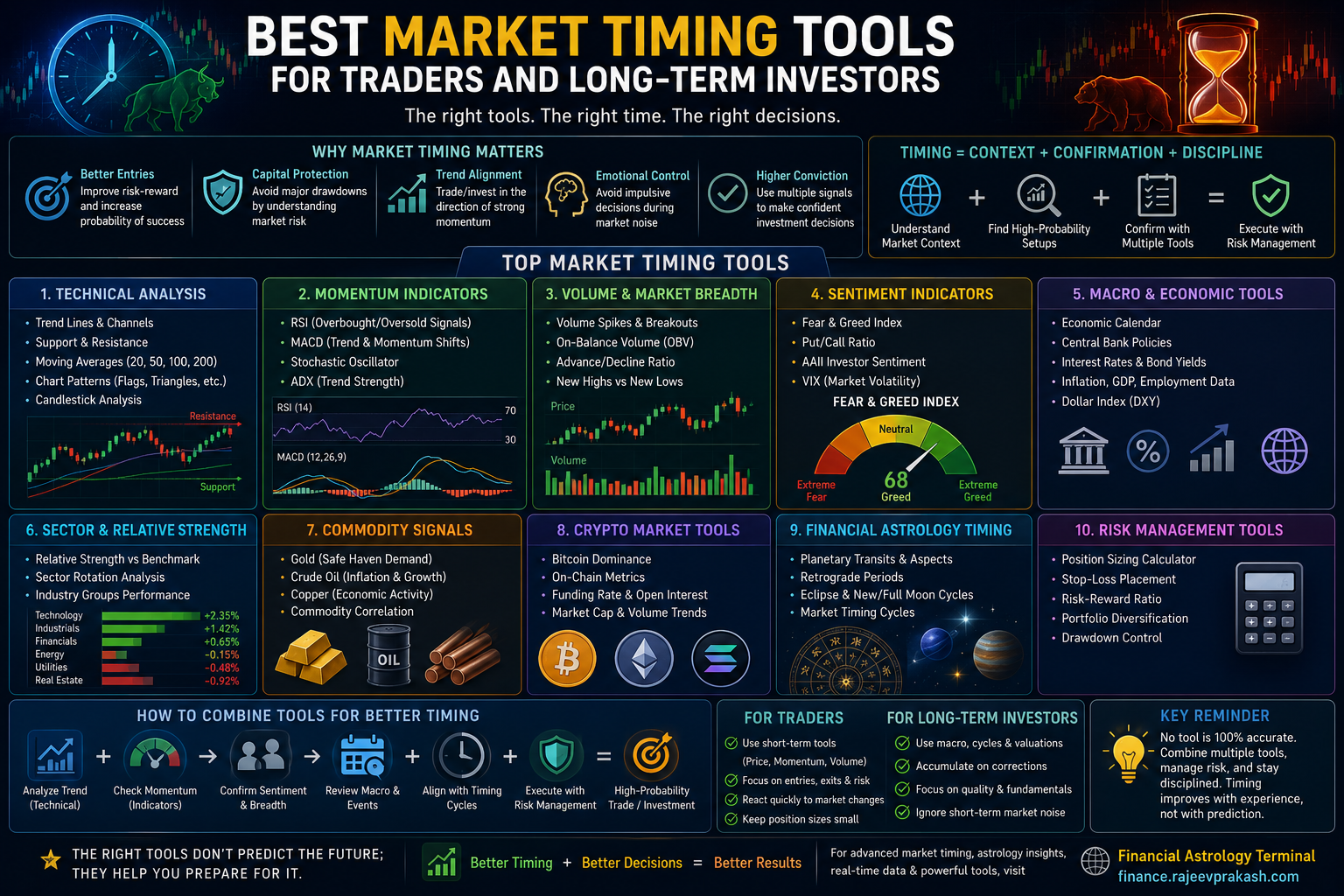
Market timing does not mean guessing the exact top or bottom. It means using tools, data, price behavior, sentiment, macro signals, and timing cycles to understand when the market may offer better risk-reward. Traders use timing to plan entries, exits, stop-losses, and short-term opportunities. Long-term investors use timing to accumulate quality assets, rebalance portfolios, avoid emotional buying, and reduce exposure during high-risk periods.
The best market timing tools help investors answer practical questions. Is the broader market strong or weak? Is the asset near support or resistance? Is volatility rising? Are investors confident or fearful? Are bond yields helping or hurting equities? Are commodities sending inflation signals? Is the dollar strengthening? Is the timing window favorable or risky?
A smart investor does not depend on one tool alone. The best decisions come from combining multiple signals. Price shows what the market is doing. Volume shows participation. Sentiment shows investor psychology. Macro data shows the economic environment. Financial astrology adds a timing layer. Risk management decides how much capital should be exposed.
What Are Market Timing Tools?
Market timing tools are systems, indicators, dashboards, charts, calendars, and analytical frameworks that help investors decide when to enter, exit, hold, reduce, or avoid a position. These tools do not guarantee profit. Instead, they help investors improve decision quality.
Some tools are technical, such as moving averages, support and resistance, RSI, MACD, volume, and trendlines. Some are sentiment-based, such as market mood indicators, fear and greed gauges, volatility indexes, and market breadth. Some are macro-based, such as bond yields, interest rate expectations, inflation data, and currency movement. Some are event-based, such as earnings calendars, economic calendars, IPO calendars, and central bank meeting schedules. Some are cycle-based, including financial astrology, lunar phases, planetary transits, and historical market rhythm.
A trader may use market timing tools daily or even intraday. A long-term investor may use them weekly or monthly. The frequency differs, but the purpose remains the same: to avoid random decisions and improve timing awareness.
Good tools help investors become patient. They show when the market is not offering a good opportunity. They also help investors act when conditions become favorable.
Why Market Timing Matters for Traders
Traders depend heavily on timing. A trader may have the correct direction but still lose money if the entry is poor. For example, buying a breakout too early may result in a false move. Shorting a weak stock after a sharp fall may lead to a quick bounce. Entering before major data releases may expose the trader to unnecessary volatility.
Market timing tools help traders avoid these mistakes. They help identify trend direction, momentum strength, volatility conditions, support zones, resistance levels, and confirmation signals. They also help traders manage risk by deciding where to place stop-losses and when to book profits.
For short-term traders, timing is often more important than long-term valuation. A stock may be overvalued but still rise for several days because momentum is strong. A commodity may look fundamentally weak but still bounce sharply from support. A crypto asset may move quickly because sentiment improves.
Traders need tools that tell them when probability is improving. They do not need certainty. They need a framework that supports disciplined action.
Why Market Timing Matters for Long-Term Investors
Long-term investors may not trade frequently, but timing still matters. Buying a quality company at an extremely high valuation can reduce future returns. Entering during a market-wide panic without a plan can create emotional stress. Investing all capital at once before a correction can limit flexibility.
Market timing tools help long-term investors accumulate assets more intelligently. They can identify broad corrections, valuation zones, improving sentiment, sector rotation, and macro shifts. They can also help investors avoid chasing euphoria.
For example, a long-term investor may like a technology stock. Instead of buying after a sharp rally, they can use moving averages, valuation tools, market mood indicators, and macro signals to wait for a better entry. If the broader market is weak but the stock approaches a strong support zone, they may accumulate gradually. If the market is extremely overbought, they may wait.
Long-term investors do not need perfect timing. They need better timing. Even small improvements in entry price and risk awareness can improve long-term returns.
Market Dashboard
A market dashboard is one of the most useful timing tools for both traders and investors. It brings key market data into one place. A strong dashboard may include indices, sector performance, commodities, forex, crypto, volatility, market breadth, watchlists, news, and technical levels.
The main value of a dashboard is context. Investors can quickly understand whether the market is risk-on or risk-off. They can see whether technology, banking, energy, metals, or defensive sectors are leading. They can check whether gold is rising due to fear, crude oil is moving due to supply concerns, or the dollar is strengthening because of macro pressure.
A market dashboard prevents investors from looking at one asset in isolation. A stock may look strong, but if the index is weak and sector breadth is poor, the trade may be risky. A commodity may look attractive, but if the dollar is rising sharply, the setup may need caution.
For traders, the dashboard helps with daily planning. For long-term investors, it helps with portfolio awareness. A good dashboard is the starting point for disciplined market timing.
Watchlist Tools
A watchlist is a focused list of assets that an investor wants to track. It may include stocks, commodities, crypto, forex pairs, indices, ETFs, and bonds. A watchlist helps investors prepare before opportunities appear.
Without a watchlist, investors often chase random market moves. They see a stock rising on social media and enter too late. They notice gold breaking out after the move has already happened. They buy crypto during emotional spikes. A watchlist solves this problem by keeping attention on selected assets.
A strong watchlist should include price, percentage change, trend, volume, support, resistance, alerts, and key notes. It should be organized by asset class or strategy. For example, one section may include long-term stock ideas. Another may include commodities. Another may include crypto. Another may include forex pairs.
Watchlist tools are powerful because they turn market observation into preparation. They help investors wait for the right level rather than act impulsively.
Support and Resistance Tools
Support and resistance are basic but powerful timing tools. Support is a price area where buyers may enter. Resistance is a price area where sellers may appear. These levels help investors define risk and opportunity.
For traders, support and resistance can guide entries, exits, and stop-losses. If a stock approaches support and shows buying interest, a trader may watch for a bounce. If an index approaches resistance and momentum weakens, the trader may avoid fresh buying or book profit.
For long-term investors, support zones can help plan accumulation. A strong company may become attractive if it falls near a long-term support area. Resistance zones can help investors avoid buying after a stretched rally.
Support and resistance work best when combined with volume, trend, and market mood. A support level with rising volume and improving sentiment is more meaningful than a level with weak participation. A resistance breakout with strong volume is more convincing than a low-volume move.
Moving Averages
Moving averages help investors understand trend direction. Common moving averages include the 20-day, 50-day, 100-day, and 200-day moving averages. A price trading above key moving averages often signals strength. A price trading below them may signal weakness.
Short-term traders may use the 20-day or 50-day moving average to identify momentum. Long-term investors may use the 100-day or 200-day moving average to understand broader trend health.
Moving averages also act as dynamic support or resistance. During an uptrend, a stock may repeatedly bounce near a moving average. During a downtrend, it may fail near the same moving average.
However, moving averages should not be used blindly. A stock can move above a moving average briefly and then fail. This is why confirmation matters. Investors should check volume, market trend, sector strength, and sentiment before acting.
RSI and Momentum Indicators
The Relative Strength Index, or RSI, is a popular momentum indicator. It helps investors understand whether an asset may be overbought or oversold. A high RSI may suggest strong momentum or excessive optimism. A low RSI may suggest weakness or excessive fear.
Traders use RSI to identify possible reversals, divergences, and momentum shifts. Long-term investors may use it to avoid buying when an asset is extremely stretched or to watch for opportunity when fear becomes excessive.
However, RSI is often misunderstood. An overbought reading does not always mean the asset will fall. Strong assets can remain overbought for a long time. An oversold reading does not always mean the asset will rise. Weak assets can remain oversold during a downtrend.
RSI works best when combined with support, resistance, trend, volume, and market mood. It should be used as a guide, not as a standalone signal.
MACD
MACD, or Moving Average Convergence Divergence, helps investors study momentum shifts and trend changes. It compares moving averages and can signal when momentum is improving or weakening.
Traders often use MACD crossovers, histogram changes, and divergences to identify possible entry or exit points. Long-term investors may use MACD on weekly charts to understand broader trend changes.
MACD is useful because it can show when momentum is starting to shift before price movement becomes obvious. However, like all indicators, it can give false signals in sideways markets.
For better results, investors should use MACD with trend structure and price levels. If MACD turns positive near support during improving market mood, the signal becomes stronger. If MACD turns negative near resistance during weak sentiment, caution may increase.
Volume Analysis
Volume shows participation. A price move with strong volume is more reliable than a move with weak volume. When price rises with high volume, it may show strong buying interest. When price falls with high volume, it may show strong selling pressure.
Traders use volume to confirm breakouts and breakdowns. A breakout with weak volume may fail. A breakdown with high volume may signal serious weakness.
Long-term investors can also use volume to study institutional interest. If a quality stock begins rising with strong volume after a long consolidation, it may suggest accumulation. If a stock falls on heavy volume after bad news, investors should study whether the decline signals deeper risk.
Volume is one of the most important market timing tools because it confirms whether money is actually moving behind the price.
Market Breadth Indicators
Market breadth shows how many stocks are participating in a market move. A market rally led by only a few large stocks may be weaker than it appears. A rally supported by broad participation is often healthier.
Breadth indicators include advance-decline data, new highs versus new lows, sector participation, and percentage of stocks above moving averages. These tools help investors understand the strength behind an index move.
For traders, breadth can confirm whether the day supports aggressive buying. For long-term investors, breadth can reveal whether a bull market is broadening or narrowing.
Weak breadth during rising indices is a warning sign. Strong breadth during a recovery is a positive sign. Market breadth helps investors avoid being misled by headline index levels.
Volatility Index
Volatility indicators, such as the VIX in U.S. markets, help investors understand fear and uncertainty. Rising volatility usually means risk is increasing. Falling volatility often means the market is calmer.
Traders use volatility to adjust position size and stop-loss levels. In high-volatility environments, wider price swings are normal, so smaller positions may be safer. In low-volatility environments, breakouts may develop more gradually.
Long-term investors use volatility to identify emotional extremes. Very high volatility can create panic-driven opportunities. Very low volatility can create complacency and hidden risk.
Volatility should not be feared. It should be respected. A good timing process includes volatility awareness before every decision.
Market Mood and Sentiment Tools
Sentiment tools help investors understand whether the market is driven by fear, greed, confidence, or caution. A Market Mood Index, fear and greed indicator, put-call ratio, news sentiment, and social media trend analysis can all provide useful sentiment signals.
Sentiment is important because short-term price movement often depends on psychology. When investors are greedy, markets may rise beyond fair value. When investors are fearful, quality assets may become undervalued.
Traders use sentiment to identify momentum and reversal setups. Long-term investors use it to avoid emotional buying and panic selling.
Extreme sentiment should be treated carefully. Extreme greed can continue for some time, and extreme fear can deepen before reversal. Therefore, sentiment should always be combined with price confirmation.
Economic Calendar
An economic calendar is an essential timing tool. It shows upcoming events such as inflation data, employment reports, GDP releases, central bank meetings, interest rate decisions, manufacturing data, retail sales, and speeches from policymakers.
Traders must know when major events are scheduled because markets can become volatile around data releases. Entering a trade just before an important inflation report can be risky. Forex and bond markets are especially sensitive to economic data.
Long-term investors also benefit from economic calendars. Central bank decisions, inflation trends, and employment data can influence sector performance, bond yields, currency movement, and equity valuations.
A market timing process should always include event awareness. Sometimes the best decision is to wait until major data is released.
Earnings Calendar
For stock investors, the earnings calendar is very important. Earnings reports can cause sharp moves in individual stocks and sectors. A company may rise or fall based on revenue, profit, margins, guidance, and management commentary.
Traders often avoid entering large positions immediately before earnings unless they have a specific event strategy. Long-term investors use earnings to evaluate whether the company’s fundamentals remain strong.
Earnings season can also influence sector mood. If major technology companies report strong results, the Nasdaq may benefit. If banks report weak credit trends, financial stocks may face pressure.
A good timing tool should help investors track earnings dates, expected results, and post-earnings price reactions.
Bond Yields and Interest Rate Tools
Bond yields are major timing signals for equities, commodities, forex, and crypto. Rising yields can pressure growth stocks because future earnings become less valuable. Falling yields may support technology and long-duration assets.
Interest rate expectations also affect banks, real estate, commodities, and currencies. If markets expect rate cuts, risk assets may improve. If markets expect higher rates for longer, equities may face pressure.
Traders should track yields daily, especially when trading indices, technology stocks, gold, and forex. Long-term investors should track yield trends because they affect valuation and asset allocation.
Bond yields are one of the most important macro timing tools. Ignoring them can lead to incomplete analysis.
Currency and Dollar Index Tools
Currency movement reveals global capital flow and macro pressure. The U.S. Dollar Index is especially important because it affects commodities, emerging markets, and global liquidity.
When the dollar strengthens, gold and commodities may face pressure. Emerging market currencies may weaken. Global risk appetite may reduce. When the dollar weakens, commodities, equities, and risk assets may benefit.
Forex pairs such as EUR/USD, USD/JPY, GBP/USD, and USD/INR can help investors understand regional and global trends. For Indian investors, USD/INR matters because currency movement affects imports, exports, foreign investor flows, and inflation.
Currency tools are essential for multi-asset timing.
Commodity Timing Tools
Commodities offer important market signals. Gold reflects fear, inflation concerns, and safe-haven demand. Crude oil reflects energy demand, supply risk, and inflation pressure. Copper reflects industrial growth. Silver combines precious metal and industrial characteristics.
Traders use commodity charts to find opportunities. Long-term investors use commodities to understand the macro environment.
For example, rising crude oil may support energy stocks but hurt airlines and transport companies. Rising gold may suggest fear or falling real yields. Falling copper may suggest global growth concerns.
Commodity timing tools help investors connect asset classes and avoid narrow thinking.
Crypto Timing Tools
Crypto markets are highly sensitive to liquidity, risk appetite, regulation, and sentiment. Bitcoin and Ethereum often act as leading indicators for broader crypto mood.
Crypto timing tools include trend charts, volume, market capitalization, Bitcoin dominance, volatility, on-chain data, funding rates, and sentiment indicators. Traders use these tools for short-term setups. Long-term crypto investors use them to avoid buying during emotional spikes.
Because crypto trades continuously, investors should be careful with position size. A timing tool can help, but risk management is essential.
Crypto is useful to track even for traditional investors because it often reflects speculative appetite in global markets.
Financial Astrology Timing Tools
Financial astrology adds a time-cycle layer to market analysis. It studies planetary transits, retrogrades, lunar phases, eclipses, conjunctions, and other celestial cycles that may align with changes in market psychology and volatility.
The practical use of financial astrology is not blind prediction. It is timing awareness. A difficult timing window may suggest caution if the market is already overbought. A supportive timing window may suggest opportunity if price is near support and sentiment is improving.
Financial astrology can be combined with technical analysis, market mood, and macro signals. For example, if gold is near support during a favorable timing window and volume begins improving, investors may watch closely. If an index is near resistance during a volatile planetary phase, traders may manage risk more carefully.
This timing layer can help investors prepare for sensitive periods.
AI and Quantitative Tools
Artificial intelligence and quantitative models are becoming more popular in market timing. These tools can analyze large amounts of data, detect patterns, study correlations, and generate signals based on historical behavior.
AI tools may track news sentiment, earnings language, price movement, volatility, social media data, and macro changes. Quantitative tools may test strategies using historical data.
However, investors should not blindly trust AI signals. Models can fail when market conditions change. Data quality matters. Overfitting can create misleading confidence.
AI is useful when combined with human judgment, risk management, and market context. It should support decisions, not replace thinking.
Risk Management Tools
No timing tool is complete without risk management. Even the best timing signal can fail. Risk management tools include stop-loss planning, position sizing, portfolio allocation, exposure limits, trailing stops, and profit booking rules.
Traders need risk management on every trade. Long-term investors need it through diversification, staged buying, rebalancing, and cash management.
A timing tool may say conditions are favorable, but risk management decides how much to invest. This is the difference between intelligent investing and emotional speculation.
Protecting capital is more important than proving a forecast right.
How to Combine Market Timing Tools
The best approach is to combine tools rather than depend on one indicator. A strong timing setup may include a positive broad market trend, improving breadth, strong sector performance, price above moving averages, supportive volume, favorable sentiment, manageable volatility, and a clear risk-reward level.
For long-term investors, a good setup may include attractive valuation, strong fundamentals, market correction, improving technical structure, and supportive macro conditions.
For financial astrology users, timing windows can be added as another layer. When time, price, sentiment, and risk align, probability improves.
No tool should work alone. Confirmation creates confidence.
Conclusion
Market timing tools help traders and long-term investors make better decisions. They do not predict the future with certainty, but they improve preparation, discipline, and risk awareness. A trader can use them to plan entries, exits, and stop-losses. A long-term investor can use them to accumulate quality assets, avoid emotional buying, and manage portfolio exposure.
The best tools include market dashboards, watchlists, support and resistance, moving averages, RSI, MACD, volume, market breadth, volatility indicators, sentiment tools, economic calendars, earnings calendars, bond yields, currency tools, commodity signals, crypto indicators, AI models, and financial astrology timing cycles.
A smart investor understands that no single tool is enough. Price shows reality. Volume shows participation. Sentiment shows psychology. Macro data shows the environment. Financial astrology shows timing sensitivity. Risk management protects capital.
When these tools work together, investors can make more confident, balanced, and disciplined decisions.
To explore smarter market timing tools, financial astrology insights, live signals, risk windows, watchlists, and multi-asset market intelligence, visit the : https://finance.rajeevprakash.com/