The crypto market in 2026 is no longer a playground for pure speculation, but it has become infrastructure for the global financial system. Stablecoins are processing over $10 trillion in monthly transactions, outpacing Visa. Real-world assets on-chain crossed $20 billion in tokenized value. AI-driven agentic commerce already logged 120 million on-chain transactions in Q1 2026 alone.
To all those exploring blockchain strategy, the message is clear that the most valuable trending crypto tokens in 2026 are those that are linked with actual utility, institutional demand, and the merger of AI with decentralized infrastructure.
It is a guide to breaking down each of the key categories of tokens worth watching with strategic context, specific examples of tokens, and an understanding of what is actually driving the value in this cycle.
What Makes a Crypto Token Valuable in 2026?
Not all tokens are created equal. The 2022 cycle was a lesson to the market that hype without fundamentals has a shelf life. The tokens that will command sustained attention share a few important characteristics in 2026:
- Revenue generation — fee-capture schemes, staking yield, or protocol revenue, which has the effect of establishing a floor for token value.
- Institutional engagement — regulated custody, ETF exposure, and conforming smart contract standards (such as ERC-3643) that enable capital at scale to enter.
- Real-world utility — tokens that drive infrastructure, not only narratives.
- Regulatory alignment — initiatives that are executed in the framework of the MiCA regulations in the EU or the US framework of the STABLE Act have a much lower risk of legal challenge.
Trending Crypto Token Categories in 2026
RWA Tokens (Real-World Asset Tokens)
Real-world asset tokens are blockchain-based representations of physical or traditional financial assets such as US Treasuries, bonds, real estate, private credit, and equities. They allow these assets to be traded 24/7, settled instantly, and used as composable collateral in DeFi protocols.
Tokenized RWAs surpassed $20 billion in on-chain value in early 2026, growing 38% in a single quarter. Analysts project this market could reach $100 billion by the end of 2026 and multiple trillions by 2030. BlackRock’s BUIDL fund crossed $500 million AUM. Ondo Finance expanded its platform to cover 200+ tokenized US stocks and ETFs on Solana, with TVL exceeding $2.5 billion.
The technology has matured alongside the capital, which is programmable compliance standards, institutional-grade oracle networks, and regulated custody solutions now make RWA tokenization viable at enterprise scale.
Businesses entering this space often rely on scalable infrastructure built through RWA tokenization platform development to securely tokenize assets and enable compliant, global investment access.
AI Tokens
The convergence of artificial intelligence and blockchain is generating the most significant infrastructure opportunity of this decade. AI needs decentralized compute, trusted data provenance, and autonomous payment rails. Blockchain provides all three.
Decentralized intelligence networks like Bittensor create open marketplaces for machine learning models where contributors are rewarded in TAO tokens based on the quality and utility of their AI outputs. With a capped supply of 21 million tokens and a halvening cycle mirroring Bitcoin’s scarcity model, TAO has attracted significant institutional attention.
Render Network (RNDR) takes a different approach, and it matches digital creators and AI developers with owners of unused GPU resources, allowing decentralized visual rendering and AI inference at a small fraction of the cost of centralized clouds.
The size of investment in this category indicates its potential, which is that, in 2026, about 40% of the total crypto VC is going into AI adjacent projects.
DePIN Tokens (Decentralized Physical Infrastructure)
DePIN networks use token incentives to crowdsource the deployment of real-world infrastructure such as wireless coverage, distributed storage, compute grids, and sensor networks. Instead of a corporation deploying capex, everyday contributors earn tokens by providing physical resources.
What makes DePIN compelling in 2026 is the shift from token-incentive speculation to actual revenue. Enterprise cloud buyers are now tapping DePIN networks for AI compute overflow, distributed storage contracts, and edge computing that generate real fees, not just inflationary rewards.
Key sectors within DePIN include:
- Decentralized storage — replacing cloud monopolies with distributed node networks
- Wireless connectivity — community-deployed hotspots providing cellular and IoT coverage
- AI compute — distributed GPU networks competing with AWS and Azure on cost
Stablecoins
Stablecoins are the utility layer that ensures that everything works. They are not speculative tools, but the protocols and governance tokens that drive stablecoin ecosystems are one of the most conviction long-term plays in crypto.
In Q1 2026, total stablecoin supply hit a $316.4 billion all-time high. Monthly transaction volume crossed $10 trillion, which is more than Visa and Mastercard combined. Businesses are using USDC and PYUSD for cross-border supplier payments. Fintech applications are deploying stablecoins as invisible settlement rails.
Regulatory clarity from the US STABLE Act and the EU MiCA framework has removed the legal ambiguity that previously deterred enterprise adoption. Stablecoin infrastructure is now a board-level consideration for any company with global payment flows.
Tokenized Securities / On-Chain Funds
The tokenization of equities, bonds, and fund structures is what major financial institutions describe as the most transformative development in capital markets since electronic trading.
Tokenized securities offer T+0 settlement (versus the legacy T+2 standard), 24/7 trading,
fractional ownership, and automated compliance which all compressing the cost and complexity of traditional market access. The ONDO–Chainlink partnership is a live example. Chainlink’s oracle infrastructure now powers real-time pricing for Ondo’s tokenized stocks (SPYon, QQQon, TSLAon), giving these instruments DeFi collateral utility across lending protocols.
The tokenized fund market crossed $17 billion in total market cap as of early 2026, with Franklin Templeton, BlackRock, and JPMorgan all issuing on-chain fund products. Explore tokenized securities development to understand how your institution can participate.
Gaming & Metaverse Tokens
Blockchain gaming has grown since the play-to-earn collapse of 2021. The new generation of Web3 titles competes on gameplay quality first, with blockchain as the ownership and monetization layer. Players genuinely own in-game assets as NFTs, trade them freely, and participate in game governance.
Gaming infrastructure tokens (such as those powering Layer-2 gaming chains) serve as indirect exposure to an entire ecosystem’s growth, which is a more durable thesis than betting on any individual game’s success.
Meme Tokens
Meme tokens occupy a specific, clearly defined role in 2026 portfolios like high-risk, high-reward, community-driven instruments with no fundamental floor. They continue to attract retail capital due to their social virality and asymmetric upside potential.
Governance Tokens
Governance tokens reflect ownership in decentralized protocols like voting rights in treasury allocation, fee parameters, protocol upgrades, and strategic direction. The most valuable governance tokens are profitable protocols that can drive on-chain revenue that can be sent to token holders or utilized in buybacks.
As DAO governance matures with professional delegate programs, conviction voting, and analytics tooling, reducing voter empathy, and governance tokens of category-leading DeFi protocols are becoming valued as equity in a business.
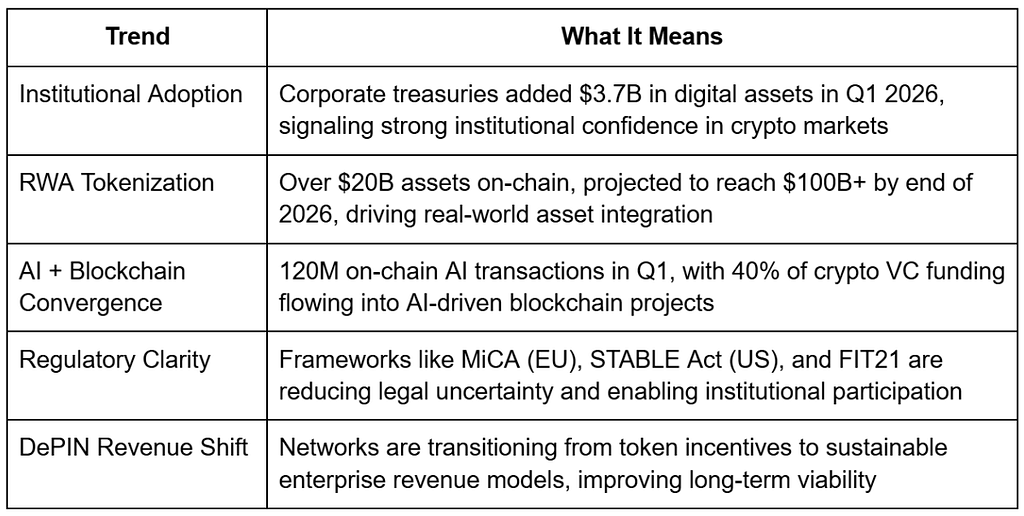
Key Trends Behind Trending Crypto Tokens in 2026
Top Crypto Tokens to Watch in Each Category
RWA: ONDO and LINK
ONDO (Ondo Finance) is the leading pure-play RWA tokenization protocol. Its TVL exceeded $2.5 billion in early 2026, with a platform covering 200+ tokenized US equities and ETFs across Solana and Ethereum. A $200 million capital partnership with State Street and Galaxy Asset Management signals that institutional backing is deepening. ONDO represents direct exposure to the tokenized securities thesis.
LINK (Chainlink) is the infrastructure layer that makes RWA tokenization trustworthy. As the dominant oracle network in crypto, Chainlink provides real-time price feeds, proof-of-reserve verification, and cross-chain interoperability (CCIP) for every major tokenized asset platform. In January 2026, a US spot Chainlink ETF began trading on NYSE Arca under the ticker CLNK. Every major RWA expansion from Ondo to BlackRock BUIDL to Aave Horizon that relies on Chainlink data infrastructure. LINK is the toll road of tokenized finance.
The Ondo–Chainlink partnership illustrates a broader pattern: RWA protocols and oracle networks are co-dependent. Understanding this infrastructure stack is essential for any business building token development services on top of tokenized assets.
AI: TAO and RNDR
TAO (Bittensor) is building the decentralized brain of the AI economy. Its subnet architecture (128+ active subnets as of 2026) allows specialized AI tasks like model training, inference, data validation, and image generation to run across a distributed, incentivized network. With a Bitcoin-mirrored supply cap of 21 million tokens and a halvening cycle, TAO combines AI utility with hard-money tokenomics. TAO has posted 87%+ gains in recent months, and is still ~59% below its all-time high, suggesting meaningful upside in a continued bull cycle.
RNDR (Render Network) transforms idle GPU capacity into a global supercomputer for AI inference, visual rendering, and machine learning workloads. It generated $38 million in monthly revenue as of early 2026, and the real earnings from real usage. RNDR’s Burn-Mint Equilibrium tokenomics tie token demand directly to network usage, creating a natural deflationary pressure as adoption grows.
DePIN: FIL and HNT
FIL (Filecoin) is the largest decentralized storage network in the world. It competes directly with Amazon S3 and Google Cloud Storage, distributing data across thousands of independent node operators. In 2026, Filecoin attracted enterprise storage contracts and is being evaluated as backup infrastructure for AI training datasets, which is a rapidly growing use case that connects the DePIN and AI narratives.
HNT (Helium) is the most tangible consumer DePIN product in existence. Helium Mobile now serves 120,000+ mobile subscribers using a community-deployed wireless network across major US cities. HNT token demand is tied directly to data credits consumed by network usage, making it one of the few crypto tokens with a genuinely usage-based demand mechanism.
What This Means for Investors & Businesses
For investors, 2026 is a reward of conviction, not diversification. The most robust structure that allocate 50% of crypto to BTC/ETH, weight 30% of holdings to the highest conviction category leaders (SOL, XRP, LINK), and put 20% of holdings in thematic bets in RWA, AI, and DePIN, which are in the infrastructure sectors with true revenue and institutional support.
In the case of businesses, especially founders and CTOs considering integrating Web3, the strategic lens varies. It is not about the tokens to hold but about the token standards and protocol layers to be constructed on. Companies investigating asset tokenization, cross-border payments, or decentralized AI services are advised to consider:
- What blockchain layer would best align with their compliance needs (Ethereum to support institutional RWA, Solana to support high-throughput consumer applications)
- What oracles and interoperability infrastructure (Chainlink CCIP is emerging as the institutional standard)
- Whether their token model is value captured by fee accrual, governance rights, or staking, and not by speculative demand alone.
- When considering a smart contract development or tokenization project, the categories listed below will govern the architecture decisions that will have the most significant impact in the next three to five years.
Conclusion
The most valuable trending crypto tokens in 2026 share one defining quality, and they are building the infrastructure layer of the next-generation internet and financial system. RWA tokens are bridging Wall Street and Web3. AI tokens are decentralizing intelligence. DePIN tokens are crowdsourcing the physical infrastructure that powers both. Stablecoins are settling the transactions. And governance tokens represent stakes in the protocols that govern it all.
For investors, this is a framework for separating signal from noise in a market that still generates enormous volatility. For founders and businesses, it is a roadmap for where to build.
The creation of a safe and scalable token ecosystem demands an in-depth understanding, and that is why several businesses partner with a reputable company that specializes in crypto token development to handle smart contracts, compliance, and deployment efficiently.
Best Crypto Tokens to Watch in 2026 for Long-Term Growth was originally published in Coinmonks on Medium, where people are continuing the conversation by highlighting and responding to this story.