Lets admit, we’ve all been there. You’re sitting on your couch, you hit the Netflix icon, and the home page with custom recommendation pops up in milliseconds. It feels like magic, but as engineers, we know “magic” is just a word for a very complex, highly optimized system working exactly as intended.
At Netflix, that system is powered by Java. And I’m not talking about the “legacy” Java 8 your bank might still be running. I’m talking about a cutting-edge, high-performance ecosystem using JDK 25, Virtual Threads, and a federated GraphQL architecture.
Let’s pull back the curtain on what happens from the moment you hit that home page to the moment the pixels start moving.
1. The Entry Point: The Federated GraphQL “Brain”
When your device sends a request to the Netflix home page, it doesn’t just hit a single database. It hits the API Gateway (historically powered by Zuul).
In the old days, we used REST for everything. But today, Netflix has moved toward a Federated GraphQL architecture. Think of the Gateway as a smart router. It takes your single request for “Home Page Data” and realizes that “Home Page” is actually a composite of dozens of different data points: your profile name, your “Continue Watching” list, the “Trending Now” trailers, and your personalized recommendations.
The Gateway uses a Domain Graph Service (DGS) framework — built as a specialized extension of Spring Boot 3 — to “fan out” this single request to thousands of microservices.
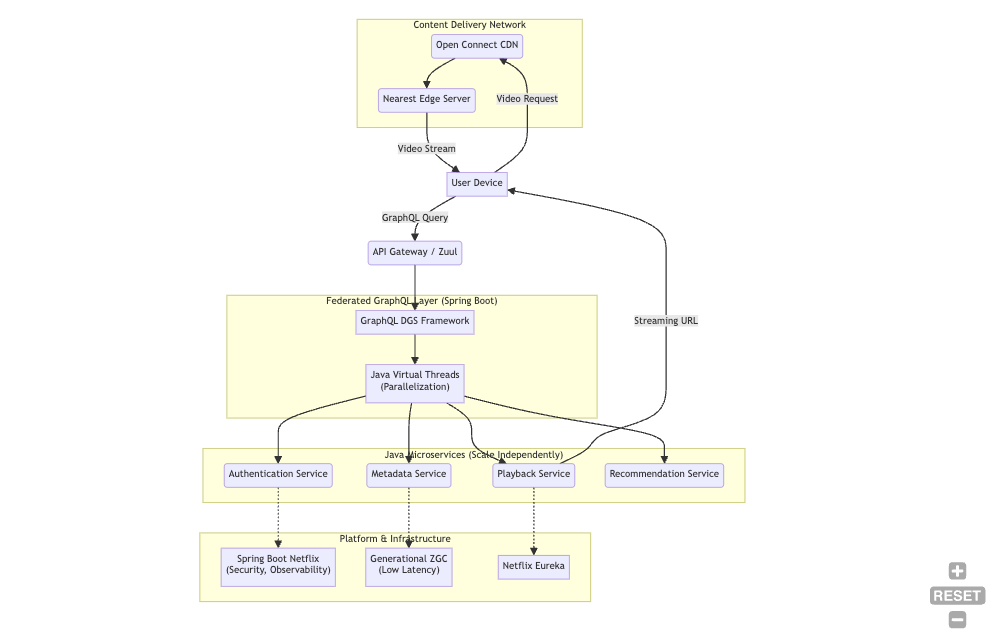
High-Level Architectural Flow
This diagram illustrates how the request travels from your remote control through our Java ecosystem and finally hands off to the hardware that actually moves the video bits.
2. Concurrency: Moving from RxJava to Virtual Threads
Netflix actually pioneered RxJava (Reactive programming) to handle high-concurrency “fan-outs.” It worked, but let’s be honest: it was a nightmare to debug. Stack traces were useless, and the code looked like functional spaghetti.
With the move to JDK 21, we’ve embraced Virtual Threads (Project Loom). In the new model, we’ve ditched complex reactive code for simple, synchronous-style code. Virtual threads are lightweight threads managed by the JVM, not the OS. You can spin up millions of them.
When the DGS needs to fetch movie metadata and artwork simultaneously, it doesn’t need a complex reactive chain. It just launches virtual threads. It’s cleaner, faster, and much easier for a Senior Dev to peer-review.
The Fan-Out Sequence
Here is how the Virtual Thread scheduler handles the parallel “heavy lifting” within the Java backend

3. The Performance Engine: Why Netflix Stick with Java
You’ll hear people say Java is slow or “memory-hungry.” At our scale, that’s just not true if you’re using modern tools. Netflix recently migrated the fleet from JDK 8 to JDK 17 and 21, and the results were massive:
- The “Free” 20% Win: By simply upgrading the JDK, we saw a 20% reduction in CPU time spent on Garbage Collection (GC) without changing a single line of application code.
- Generational ZGC: This is a game-changer. Old-school GC would cause “Stop-the-World” pauses that could last a second — long enough to trigger a timeout and crash a request. With Generational ZGC in JDK 21, those pauses dropped to near-zero.
4. Reliability and the “Chaos” Philosophy
At Netflix, we don’t try to prevent failure; we assume it’s happening right now. Servers crash, networks jitter. This is where Chaos Engineering and the Circuit Breaker pattern come in.
We use Netflix Eureka for service discovery so instances can find each other dynamically. But if a service — say, the Recommendation Service — becomes slow or unresponsive, we don’t want it to bring down the whole home page. We use a Circuit Breaker (like Hystrix or Resilience4j). If the error threshold is hit, the circuit “trips.” Instead of a spinning loading wheel, the user gets a “fallback” — maybe a generic “Trending Now” list instead of personalized picks.
The Circuit Breaker State Machine
This logic prevents a single failing service from causing a “cascading failure” across the entire 3,000-service mesh.

5. The Hand-off: Java Doesn’t Stream the Video
Here’s the plot twist: The Java backend doesn’t actually touch the video bits. Java’s job is the Control Plane. It handles the logic, the security, and the “handshake.” Once the Playback Service determines you’re authorized and sees where you are located, it sends your device a specific URL.
That URL points to Open Connect, Netflix’s custom Content Delivery Network (CDN). These are physical hardware boxes placed inside your local ISP’s data center. Your movie is streamed from a box maybe 10 miles away from your house, while our Java services move on to the next user.
The Bottom Line
We use Java because it has evolved. By combining Spring Boot 3, GraphQL, and JDK 21, we’ve built a system that is both developer-friendly and incredibly “hard to kill.”
As a principal engineer, my advice is simple: Don’t get distracted by the “language of the month.” If you want to scale to 270 million users, focus on your platform internals — upgrade your JDK, optimize your GC, and embrace the simplicity of virtual threads.
Enjoyed this deep dive? Staying updated on architectural shifts shouldn’t be a full-time job. At Knowledge Cafe, we act as your personal research team, filtering the fluff from the world’s top engineering blogs to bring you the insights needed to build the next generation of resilient systems.
Subscribe to Knowledge Cafe here
Behind the “Play” Button: How Netflix Powers 300 Million Subscribers with Modern Java was originally published in Level Up Coding on Medium, where people are continuing the conversation by highlighting and responding to this story.