Baidu's New AI Is Already Beating Top Models and Cost 94% Less to Build
ERNIE 5.1 hits the top of Chinese AI leaderboards while spending a fraction of what rivals do. Baidu calls it a "parameter efficiency" leap.
 By Jose Antonio LanzEdited by Guillermo JimenezMay 11, 2026May 11, 20264 min read
In brief
- Baidu says ERNIE 5.1 pre-training cost is just 6% of what comparable AI models spend
- Despite this, the model is ranked fourth globally on the LMArena Search leaderboard.
- Baidu compressed the model to roughly one-third the total parameters of its predecessor, ERNIE 5.0, without sacrificing flagship-level performance.
Baidu, China's equivalent of Google, officially released ERNIE 5.1 late last week, and the headline number is hard to ignore: The model cost roughly 94% less to train than comparable AI systems at the same scale.
To put that in perspective, training a frontier AI model typically costs several millions (if not billions) of dollars in compute. Baidu, which controls over 76% of China's search market and trades on Nasdaq as BIDU, is claiming it pulled off the same class of performance for about a twentieth of that.
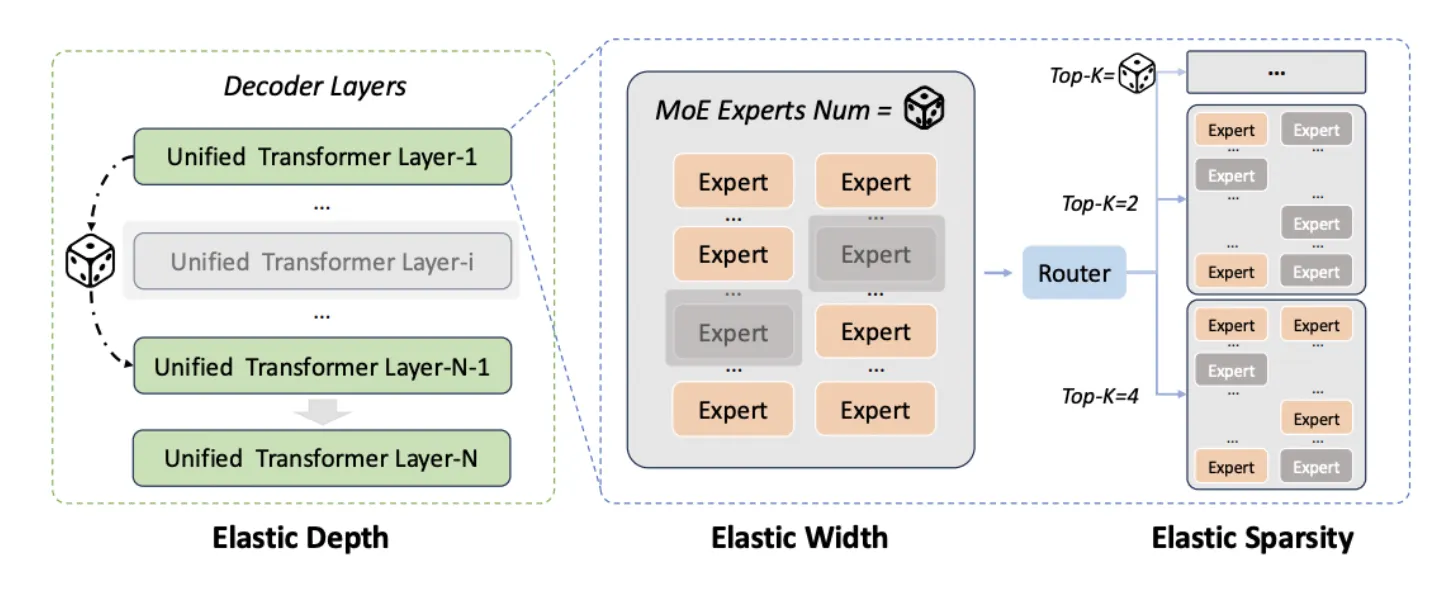
The trick is called "multi-dimensional elastic pre-training." Instead of building ERNIE 5.1 from scratch, Baidu extracted an optimized sub-network from its existing ERNIE 5.0 architecture—which it released in January 2026—and compressed it down. Total parameters dropped to about one-third of the original. Active parameters (the ones actually doing work during a conversation) were cut in half. The result is a leaner model that inherited the knowledge base of its larger parent without repeating the full training bill.
On LMArena Search Arena—a leaderboard where real users compare AI models on live web search tasks, scored by human preference—ERNIE 5.1 scored 1,223, landing fourth globally and first among all Chinese models. Its agentic capabilities—how well it handles multi-step tasks like filling spreadsheets or autonomously browsing the web—surpassed DeepSeek-V4-Pro, the previous Chinese benchmark-setter.
ERNIE may sound like an exotic name among western observers, but it’s actually a major model in China. Baidu launched Ernie Bot in August 2023, and the chatbot reached 100 million users in China by December of that year—faster than most Chinese rivals, though still slower than ChatGPT's global record two-month run to the same milestone.
The efficiency angle echoes what DeepSeek did to the AI industry in January 2025. When the Chinese startup released R1—a model that matched OpenAI's o1 at 98% lower query cost—it triggered a $600 billion wipeout in Nvidia's market value and forced every major AI lab to rethink whether throwing compute at problems was the only viable strategy. ERNIE 5.1 is a different kind of efficiency story—on the training side rather than inference—but the underlying message is the same: Chinese labs keep finding ways to do more with less.
The post-training pipeline is also worth noting. Baidu built a four-stage reinforcement learning system it calls MOPD (Multi-Teacher On-Policy Distillation). Rather than trying to teach every skill at once—which tends to cause "seesaw effects" where, for example, improving math performance tanks creative writing—Baidu trained specialist expert models in parallel for code, reasoning, and agentic tasks, then distilled all of them into a single unified model. A final online reinforcement learning stage handled open-ended conversations and creative output, preserving what the distillation process couldn't capture well.
In theory it should mean all skills are leveled in terms of proficiency, without one being prioritized over the other
On GPQA (Graduate-Level Google-Proof Q&A, a benchmark measuring whether a model can answer expert-level science questions that can't be Googled), ERNIE 5.1 approaches the performance of leading western closed-source models. On AIME26—the American Invitational Mathematics Examination adapted for 2026, which tests advanced problem-solving under competition conditions—the model scored 99.6% when using tool-assisted reasoning, trailing only Gemini 3.1 Pro.
Baidu says ERNIE 5.1 is already rolling out across more than 10 creative and agentic platforms in China, including AI roleplay platforms and short drama generation tools. The model is accessible at ernie.baidu.com and via API on Baidu's AI Cloud platform.
Baidu is hosting its annual Create 2026 developer conference on May 13–14 in Beijing, where it plans to showcase ERNIE's latest industrial applications. That event will be the next data point on how aggressively the company intends to push the model into enterprise and global markets.