Executive Summary Snapshot
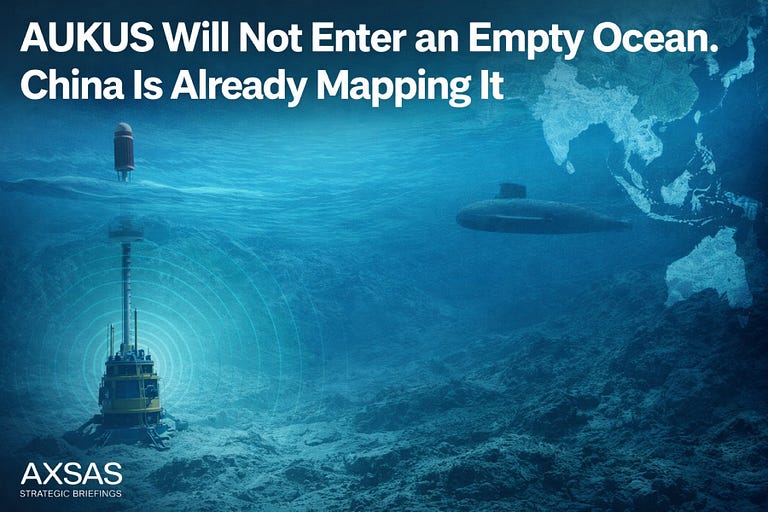
The device recovered in the Lombok Strait is not just an isolated intelligence incident. It points to a broader contest over the undersea environment itself. Public reporting indicates the system was a Chinese deep sea monitoring mooring designed to collect and relay data on temperature, depth, currents, sound, and nearby targets.[1] When set beside Reuters reporting on China’s wider ocean floor mapping and sensor activity across the Pacific, Indian, and Arctic Oceans, the implication is clear. Beijing is not only investing in platforms. It is investing in the environmental knowledge that gives undersea power its edge.[1][2]
For Australia, this is not peripheral. The Lombok Strait is one of the key deep water corridors linking the Indian and Pacific Oceans, and HMAS Stirling is set to host Submarine Rotational Force West from as early as 2027, with one United Kingdom and up to four United States nuclear powered submarines rotating through Western Australia.[3][4] AUKUS is therefore not only a fleet acquisition effort. It is also a route security problem. If an adversary is already building a better picture of the northern approaches before Australia fields its future force at scale, then the contest has already begun.[3][4]
Assessment Window
This assessment covers 2026 to 2029. That is the relevant period because it captures the early operational phase of Submarine Rotational Force West, the expansion of Australian undersea investment under the 2026 Integrated Investment Program, and the period in which China’s oceanographic and sensor activity is likely to continue shaping the battlespace before Australia’s sovereign AUKUS capability reaches full depth.[3][4][5]
Cause
The cause is not simply Chinese curiosity. It is a strategic push to make the undersea domain more transparent to Chinese forces and less forgiving to everyone else. Reuters reported that China has been conducting large scale ocean floor mapping and monitoring activity across multiple oceans, using research vessels and sensor deployments to gather data relevant to underwater navigation, concealment, sonar performance, and anti submarine operations.[2] The same reporting tied this directly to Beijing’s wider civil military fusion approach, where scientific work and military utility increasingly overlap.[2]
That wider pattern makes the Lombok device significant. Public reporting indicates the recovered system was capable of transmitting real time seabed and acoustic data through surface buoys.[1] In isolation, that can be described as research equipment. In strategic context, it looks like part of a wider effort to understand choke points, thermal layers, and subsea conditions along routes that allied submarines may later need to cross.[1][2]
Constraint
Australia’s current debate is still too platform centric. Public discussion of AUKUS usually sits on submarines, delivery schedules, shipyard capacity, workforce, and sustainment. Those are valid concerns, but they do not cover the full operating problem. Submarines do not move through abstract blue water. They move through mapped seabeds, sound channels, currents, choke points, and sensor fields.[2][3]
There is also a legal and political constraint. Dual use oceanographic systems sit in a grey zone between scientific activity and military preparation. That makes response slower and attribution softer. Indonesian authorities have reportedly been cautious while examining the device, and Chinese officials have argued that marine research equipment can drift into foreign waters because of malfunction or other causes.[1] That ambiguity is useful to Beijing because it allows strategic data collection to sit below the political threshold that would normally trigger a stronger pushback.[1][2]
A second constraint is investment balance. Australia’s 2026 Integrated Investment Program commits around $425 billion over the decade and stresses sovereign industrial resilience and stronger international industrial partnerships.[5] That is substantial. But if undersea investment remains weighted toward platforms without equal attention to seabed awareness, hostile sensor detection, persistent monitoring, and counter surveillance along the northern approaches, then a blind spot remains in the force being built.[5]
Consequence
The consequence is straightforward. Australia risks preparing submarines for an ocean that is already being prepared by someone else. One side is building boats. The other is building environmental awareness of the waters those boats will have to cross. That asymmetry gives the sensor builder an early edge in detection, tracking, concealment, and route prediction.[2][3]
This also reframes the AUKUS debate. The issue is not only whether Australia can eventually field and sustain a larger undersea force. The issue is whether the operating environment north of Australia will remain usable on acceptable terms once that force is available. If the Lombok Strait and surrounding approaches are increasingly studied, instrumented, and contested, then the strategic question shifts from fleet readiness alone to environmental access and route survivability.[1][2][3]
For Western Australia, that is immediate, not theoretical. HMAS Stirling will be one of the most sensitive undersea nodes in the wider Indo Pacific once Submarine Rotational Force West begins. Any sustained adversary effort to map and monitor the approaches through the Indonesian archipelago sits directly beside Australia’s future submarine posture.[3][4]
Strategic Outlook 2026 to 2029
Between 2026 and 2029, the most likely trajectory is not open confrontation over every device or survey vessel. It is the continued expansion of grey zone undersea battlespace preparation. China will almost certainly keep using research, survey, and monitoring activity to improve its picture of critical approaches and choke points. Regional states will continue to face legal ambiguity, technical complexity, and political caution when such systems are discovered. Australia and its allies will therefore face a widening gap if they do not place more emphasis on persistent undersea awareness, counter sensor capability, and protection of the northern maritime approaches during this period.[1][2][5]
Assessment
The Lombok incident is best understood as a warning about doctrine, not just espionage. Australia may still be thinking about undersea power mainly as a fleet problem, while China is increasingly treating it as an environment problem. That difference is central. AUKUS can deliver platforms, skills, and industrial uplift, but if the routes north are increasingly mapped and monitored by an adversary before Australia reaches full operational depth, then the strategic balance will be shaped long before the fleet is complete.[2][3][4]
About AXSAS Strategic Briefings
AXSAS Strategic Briefings assess defence industrial readiness, undersea competition, and strategic exposure through a cause, constraint, consequence lens. Each briefing is designed to move beyond announcement level commentary and focus on whether capability, access, and resilience are being built fast enough for the operating environment now emerging.
Footnotes
[1] ABC News, “Chinese undersea monitoring system identified after discovery near Lombok Strait,” 17 April 2026. Public reporting on the recovered 3.7 metre seabed system, its likely Chinese origin, sensor functions, and Indonesian examination.
[2] Reuters, “China is mapping the ocean floor as it prepares for submarine warfare with the U.S.,” 24 March 2026. Reporting on China’s wider mapping and monitoring effort across the Pacific, Indian, and Arctic Oceans and the military utility of oceanographic and seabed data.
[3] Australian Submarine Agency, “Submarine Rotational Force West Infrastructure Project.” States that from as early as 2027 AUKUS partners will have a rotational presence at HMAS Stirling of one United Kingdom and up to four United States nuclear powered submarines.
[4] Australian Submarine Agency, “Submarine Rotational Force West,” updated 2 October 2024. Sets out the purpose and structure of Submarine Rotational Force West and confirms its role in building Australia’s future sovereign nuclear powered submarine capability.
[5] Australian Department of Defence, “2026 National Defence Strategy and 2026 Integrated Investment Program.” States that Australia is investing around $425 billion over the decade and places sovereign industrial resilience and accelerated capability at the centre of the program.
AUKUS Will Not Enter an Empty Ocean. China Is Already Mapping It was originally published in DataDrivenInvestor on Medium, where people are continuing the conversation by highlighting and responding to this story.