Au Capital Mgmt: AI-Driven Capital Management Explained
 Capital Mgmt9 min read·Just now
--
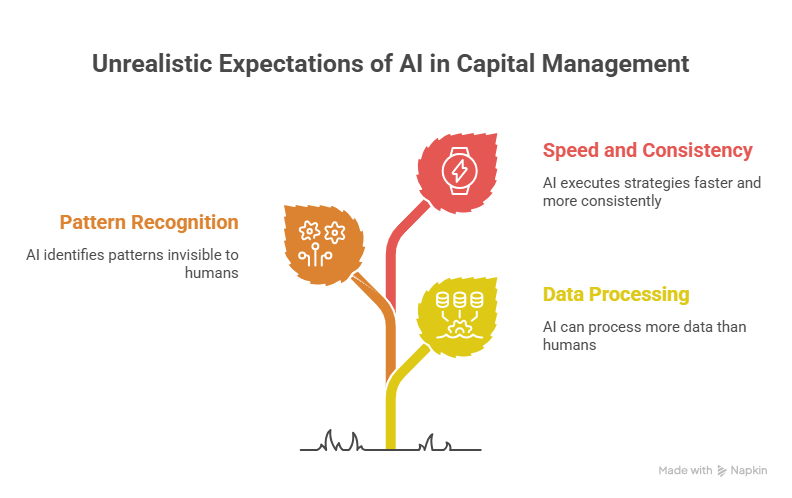
Artificial intelligence has transformed numerous industries over the past decade, from healthcare to transportation to entertainment. Financial markets represent one of the most promising frontiers for AI application, where machine learning algorithms can process vast amounts of data, identify patterns invisible to human analysts, and execute strategies with speed and consistency that manual trading cannot match. Understanding how AI-driven capital management actually works separates realistic expectations from science fiction hype.
Understanding AI in Financial Markets
AI in capital management encompasses several distinct technologies working together to analyze markets, generate trading signals, manage risk, and execute positions. Machine learning algorithms learn from historical data to identify patterns that predict future price movements. Natural language processing analyzes news, earnings reports, and social media sentiment to gauge market psychology. Deep learning networks process complex, non-linear relationships between multiple variables that traditional analysis cannot capture.
The fundamental advantage AI provides is processing capacity. Human analysts can monitor dozens of stocks or currencies. AI systems can simultaneously analyze thousands of instruments across multiple timeframes, identifying opportunities and risks that would overwhelm human cognitive capacity. This scale enables diversification and opportunity capture impossible through manual analysis.
Speed represents another critical advantage. AI systems can react to market events in milliseconds, executing trades before human traders even recognize what happened. In markets where prices adjust almost instantaneously to new information, this speed advantage can be decisive for certain strategies.
However, AI isn’t magic. It’s a tool that requires proper design, training, and oversight to function effectively. Poorly designed AI systems can lose money faster than human traders. The algorithms are only as good as the data they’re trained on and the objectives they’re optimized for. Understanding these limitations is as important as understanding the capabilities.
How Machine Learning Analyzes Markets
Machine learning algorithms identify patterns in historical data and use those patterns to make predictions about future price movements. The process begins with training data consisting of price histories, volume, volatility, and any other relevant variables the system designer considers important.
Supervised learning trains algorithms on labeled data where outcomes are known. The system learns to recognize patterns that preceded specific price movements in historical data. For example, it might learn that certain combinations of volume spikes, price levels, and indicator readings tend to precede upward moves. Once trained, the algorithm applies these learned patterns to current market data to generate trading signals.
Unsupervised learning finds patterns in data without predetermined labels. These algorithms cluster similar market conditions together, identifying regime changes or recurring market states that might not be obvious to human observers. This approach can discover relationships and patterns that human analysts wouldn’t think to look for.
Reinforcement learning takes a different approach by learning through trial and error. The algorithm tests different trading strategies, receives rewards for profitable actions and penalties for losses, and gradually learns which actions work best in different market conditions. This approach mimics how human traders learn through experience, but compressed into much shorter timeframes.
The critical challenge in all machine learning approaches is avoiding overfitting, where algorithms learn patterns specific to historical data that don’t generalize to future markets. Proper validation using out-of-sample data and ongoing monitoring of live performance are essential to ensure algorithms maintain predictive power in changing market conditions.
Au Capital Mgmt’s Approach to AI Integration
Au Capital Mgmt integrates artificial intelligence into capital management through a hybrid approach combining algorithmic capabilities with human oversight and decision-making. This integration recognizes that AI excels at certain tasks while humans remain superior at others.
The platform uses AI for pattern recognition and data processing at scale. Algorithms continuously scan thousands of instruments across multiple markets, identifying technical patterns, momentum signals, and anomalies that might represent trading opportunities. This exhaustive scanning provides coverage no human analyst team could match.
Risk management represents another area where AI provides significant value. Algorithms monitor portfolio correlations in real-time, ensuring diversification doesn’t collapse during stress periods. They track exposure across positions, calculate value-at-risk under various scenarios, and alert traders when aggregate risk exceeds predetermined thresholds.
Execution optimization leverages AI to minimize market impact and slippage. Algorithms determine optimal order sizes, timing, and routing to achieve best execution prices while avoiding tipping off other market participants to large orders. This execution intelligence can save significant money on large positions.
However, Au Capital Mgmt maintains human oversight over strategic decisions. Humans define risk parameters, establish investment objectives, approve major strategy changes, and intervene during unusual market conditions where historical patterns might not apply. This hybrid approach captures AI advantages while maintaining the judgment, creativity, and adaptability that humans provide.
Educational resources help traders understand how AI systems generate signals and recommendations. Rather than treating algorithms as black boxes, the platform explains the logic behind AI decisions, building user confidence and enabling informed evaluation of algorithmic suggestions.
Natural Language Processing for Sentiment Analysis
Markets don’t trade purely on numerical data. News, earnings reports, regulatory announcements, and social media discussions all influence prices through their impact on trader psychology and expectations. Natural language processing enables AI systems to analyze this textual information at scale.
Sentiment analysis algorithms read thousands of news articles, press releases, and social media posts, extracting overall sentiment toward specific assets, sectors, or markets. Positive sentiment might predict near-term price increases as optimism attracts buyers. Negative sentiment could warn of selling pressure building before it manifests in price declines.
More sophisticated NLP goes beyond simple positive/negative classifications. It identifies specific topics discussed, relationships between entities, and changes in language that might signal shifting narratives. For example, increased mentions of regulatory concerns in earnings call transcripts might predict sector-wide pressure before it becomes obvious in price action.
Event detection identifies significant occurrences that markets might not have fully processed. Algorithms can flag unusual announcements, detect inconsistencies between stated plans and actual behavior, or identify emerging trends in social media discussions that precede mainstream awareness.
The challenge in NLP-driven trading is separating signal from noise. Social media contains massive amounts of manipulation, misinformation, and random commentary that adds no predictive value. Distinguishing genuine sentiment shifts from coordinated manipulation requires sophisticated filtering and source credibility assessment.
Deep Learning and Complex Pattern Recognition
Deep learning neural networks excel at finding complex, non-linear patterns in high-dimensional data. Traditional statistical approaches struggle when relationships between variables are intricate and interactive. Deep learning can learn these complex relationships through layers of abstraction.
In market analysis, deep learning might discover that certain combinations of technical indicators, fundamental metrics, sentiment readings, and macroeconomic conditions predict price movements, but only when specific secondary conditions are also present. These multi-layered conditional relationships would be nearly impossible for humans to identify and track manually.
Convolutional neural networks, originally developed for image recognition, can analyze price charts as images, identifying visual patterns that predict future movements. These networks learn to recognize head-and-shoulders patterns, triangles, and other formations without being explicitly programmed with their characteristics.
Recurrent neural networks and LSTM networks specialize in sequential data like time series. They maintain memory of previous states, allowing them to recognize patterns that unfold over time. This temporal awareness is crucial for markets where current prices depend on path, not just current conditions.
The computational requirements for deep learning are substantial. Training large neural networks requires powerful hardware and significant electricity. This cost must be justified by performance improvements over simpler approaches. Au Capital Mgmt balances sophistication with practicality, employing deep learning where it provides clear advantages while using simpler models where appropriate.
Risk Management Through AI
AI-driven risk management provides capabilities beyond traditional rule-based approaches. Machine learning algorithms can identify risk factors that human risk managers might miss and respond to changing conditions faster than manual oversight allows.
Correlation monitoring tracks how different positions interact in real-time. AI systems detect when seemingly diversified positions become correlated during stress periods, warning of concentration risk before it materializes in losses. This dynamic correlation analysis adapts to changing market regimes rather than relying on static historical assumptions.
Scenario analysis evaluates how portfolios would perform under various market conditions, including historical crashes, hypothetical stress scenarios, and gradual shifts in market character. AI can run thousands of scenarios continuously, identifying vulnerabilities that might only become apparent in specific, rare conditions.
Position sizing optimization uses reinforcement learning to determine optimal capital allocation across strategies and instruments. The algorithms learn from experience which positions sizes maximize risk-adjusted returns given current volatility and correlation environments.
Anomaly detection identifies unusual patterns in positions, markets, or system behavior that might indicate problems requiring human investigation. This could include detecting execution quality degradation, identifying potential data errors, or flagging suspicious price action that might indicate manipulation.
Au Capital Mgmt’s risk management AI works alongside traditional risk controls rather than replacing them. Hard limits on position sizes, leverage, and drawdowns remain in place regardless of algorithmic recommendations. AI enhances human risk management rather than operating autonomously.
The Limitations and Risks of AI Trading
AI in capital management isn’t a guaranteed path to profits. Several significant limitations and risks require acknowledgment and management.
Data quality determines algorithm effectiveness. Machine learning systems trained on poor quality data produce poor quality predictions. Ensuring clean, accurate, representative training data is essential but challenging. Historical data might not include conditions that will occur in the future, limiting how well algorithms generalize.
Market adaptation means that patterns AI systems exploit may stop working once enough market participants employ similar algorithms. This adaptive market hypothesis suggests that any edge erodes over time as it becomes known and arbitraged away. Continuous research and development are necessary to maintain algorithmic advantages.
Black swan events create conditions outside algorithmic training data. AI systems optimized for normal market conditions can fail catastrophically during unprecedented events. The 2020 COVID crash, the 2008 financial crisis, and similar events contain patterns that wouldn’t appear in typical training datasets.
Regulatory risk affects algorithmic trading as authorities worldwide develop rules governing AI in financial markets. Requirements for explainability, testing, and oversight might constrain certain algorithmic approaches. Compliance costs can erode profitability from AI strategies.
Over-optimization and overfitting remain constant risks. Algorithms can find patterns in historical data that represent statistical noise rather than genuine predictive relationships. These spurious patterns fail in live trading despite impressive backtest results. Rigorous validation processes are essential but don’t eliminate this risk entirely.
Combining AI with Human Judgment
The most effective approach to AI in capital management combines algorithmic strengths with human capabilities. This hybrid model uses AI for tasks where it excels while retaining human oversight for judgment and creativity.
AI handles data processing, pattern recognition, and execution. Algorithms scan markets continuously, identify opportunities, and execute trades with optimal timing and routing. Humans would be overwhelmed performing these tasks manually at the required scale and speed.
Humans provide strategic direction, intuition about unprecedented situations, and ethical oversight. They define objectives, establish constraints, evaluate algorithmic performance, and intervene during unusual conditions where historical patterns might not apply.
This division of labor requires clear communication between human and machine. Au Capital Mgmt emphasizes transparency in how algorithms generate recommendations. Traders understand the logic behind AI signals, enabling informed decisions about when to follow algorithmic guidance and when human judgment should override.
Continuous feedback loops improve both AI and human performance. Algorithms learn from outcomes of trades they recommend. Humans learn from observing which algorithmic signals prove most reliable. This co-evolution enhances overall capital management effectiveness.
The Future of AI in Capital Management
AI capabilities in financial markets continue advancing rapidly. Several trends will likely shape how AI-driven capital management evolves over coming years.
Increased personalization will tailor AI strategies to individual risk preferences, time horizons, and financial goals. Rather than one-size-fits-all approaches, algorithms will optimize portfolios for specific client objectives and constraints.
Quantum computing could eventually provide computational power enabling analysis currently impossible. Quantum algorithms might solve optimization problems, simulate market dynamics, or identify patterns that classical computers cannot detect within practical timeframes.
Improved explainability will make AI decision-making more transparent and understandable. As regulators and users demand clearer explanations of algorithmic recommendations, AI systems will need to provide intuitive justifications for their signals beyond just mathematical optimization.
Multi-agent systems where different AI algorithms interact, compete, and cooperate might emerge. This ecosystem approach could prove more robust than single-algorithm systems while capturing diverse perspectives on market opportunities.
Final Thoughts
AI-driven capital management represents a powerful evolution in how financial markets are analyzed and traded. The technology provides genuine advantages in processing capacity, pattern recognition, execution speed, and risk monitoring that human analysts cannot match at scale.
However, AI is a tool requiring proper application, not a magic solution guaranteeing profits. Success requires understanding both capabilities and limitations, combining algorithmic strengths with human judgment, and maintaining rigorous oversight of system performance.
Au Capital Mgmt provides infrastructure enabling traders to benefit from AI capabilities while maintaining control over their capital management decisions. The platform emphasizes education and transparency, ensuring users understand how AI systems work and when to trust their recommendations.
Your success with AI-driven approaches depends on realistic expectations, continuous learning, and disciplined application of technology within comprehensive capital management frameworks. AI enhances human decision-making but doesn’t replace the need for strategy, risk management, and psychological discipline.
AI-driven trading involves significant technological and financial risks. Past algorithmic performance does not guarantee future results. This article is educational and does not constitute financial or investment advice.