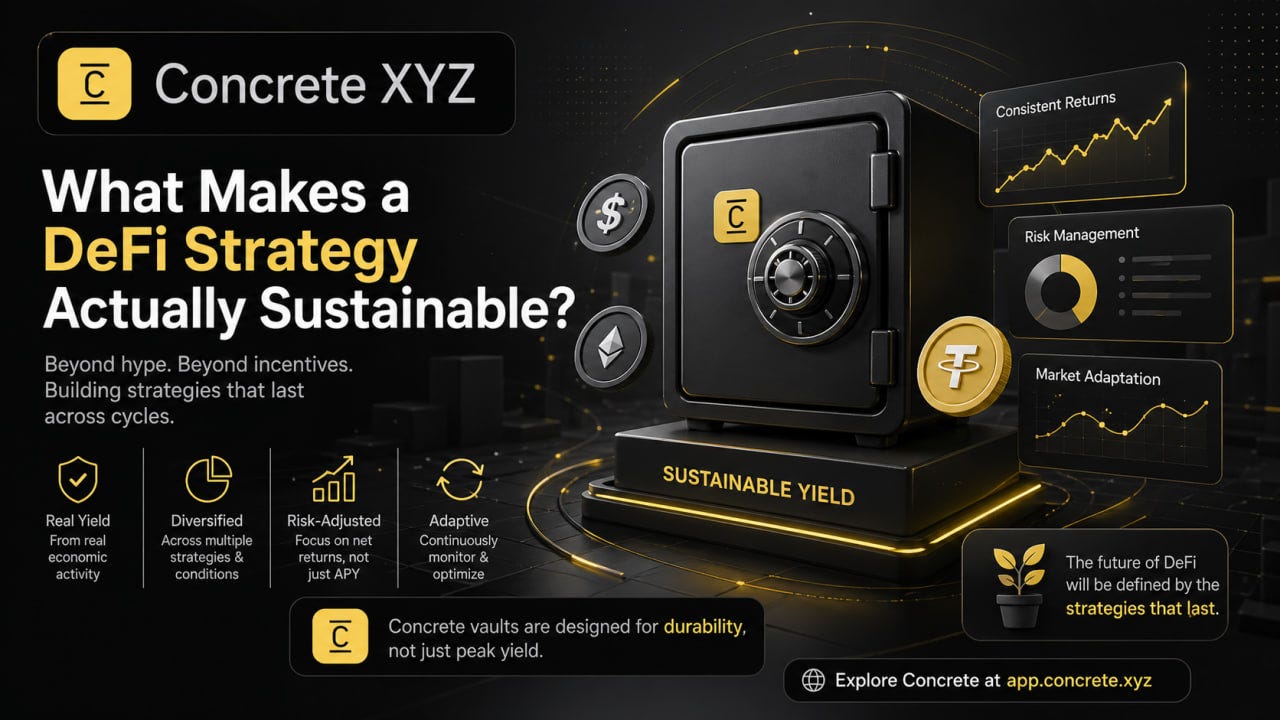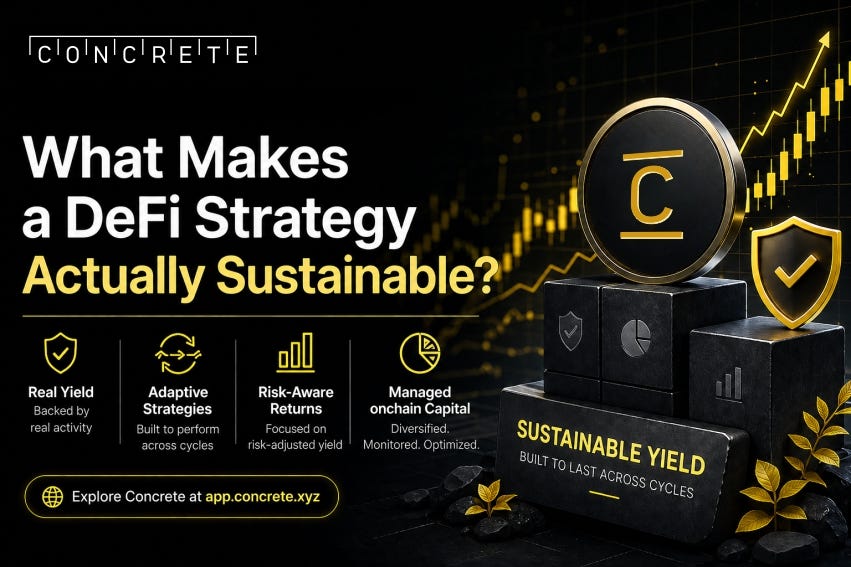
𝗪𝗵𝗮𝘁 𝗔𝗰𝘁𝘂𝗮𝗹𝗹𝘆 𝗠𝗮𝗸𝗲𝘀 𝗮 𝗗𝗲𝗙𝗶 𝗦𝘁𝗿𝗮𝘁𝗲𝗴𝘆 𝗟𝗮𝘀𝘁?
 rjsrams3 min read·Just now
--
If you’ve been in DeFi long enough, you’ve seen the pattern.
A new protocol launches.
APY looks insane.
Capital rushes in.
Then a few weeks later:
Yields drop.
Liquidity moves.
Everyone looks for the next thing.
Same cycle. Over and over.
So the real question isn’t “where’s the highest yield?”
It’s: what actually lasts?
The Problem With Most Strategies
A lot of DeFi strategies look great at the start.
High APY.
Strong inflows.
Plenty of attention.
But most of them rely on one thing:
incentives.
When those incentives slow down or disappear, the strategy weakens.
Capital leaves.
Yield collapses.
That’s why many opportunities don’t survive beyond the initial phase.
What “Sustainable” Really Means
A sustainable strategy isn’t the one with the highest return this week.
It’s the one that can keep working over time.
That usually means:
- returns that are consistent, not extreme
- less reliance on short-term incentives
- ability to perform across different market conditions
It’s about durability, not hype.
Real Yield vs Temporary Yield
Not all yield comes from the same place.
Some comes from real activity:
- trading fees
- lending demand
- arbitrage
Others come from emissions or rewards.
The difference matters.
Incentive-driven yield can be high, but it rarely lasts.
Activity-driven yield tends to be lower — but more stable.
Over time, stability often wins.
Why Market Conditions Matter
Some strategies only work in perfect conditions.
High volatility.
High volume.
Strong liquidity.
When those conditions change, performance drops.
Sustainable strategies are different.
They don’t rely on a single scenario.
They adapt.
The Hidden Costs
This is where things get overlooked.
Even a “good” strategy can degrade over time because of:
- gas fees
- rebalancing costs
- slippage
- changing correlations
On paper, everything looks fine.
In reality, returns slowly shrink.
What Better Strategy Design Looks Like
As DeFi matures, the focus is shifting.
From finding opportunities
to managing them properly.
That includes:
- diversifying across strategies
- adjusting over time
- focusing on net returns
- keeping capital efficiently deployed
This is where DeFi starts to feel less like chasing yield,
and more like managing capital.
Where Vaults Come In
Vaults help turn this into a system.
Instead of constantly moving funds manually,
they handle:
- allocation
- rebalancing
- compounding
The goal is simple:
keep capital working, consistently.
Concrete Vaults and Sustainability
Concrete vaults are built with this in mind.
They don’t focus on peak APY.
They focus on:
- sustainable yield sources
- structured allocation
- adapting to changing conditions
- reducing reliance on short-term incentives
It’s less about chasing the highest return,
more about maintaining it.
A Practical Example
Take something like a stable yield strategy.
Around ~8.5% might not look exciting compared to 20%+ farms.
But if it’s:
- consistent
- risk-aware
- built on real activity
It can outperform volatile strategies over time.
Because it actually lasts.
The Bigger Shift
DeFi is evolving.
From:
chasing short-term yield
To:
building long-term strategies.
From:
numbers on a dashboard
To:
systems that manage capital.
Closing Thought
The highest APY gets attention.
But the strategies that last build results.
Explore Concrete → https://app.concrete.xyz/