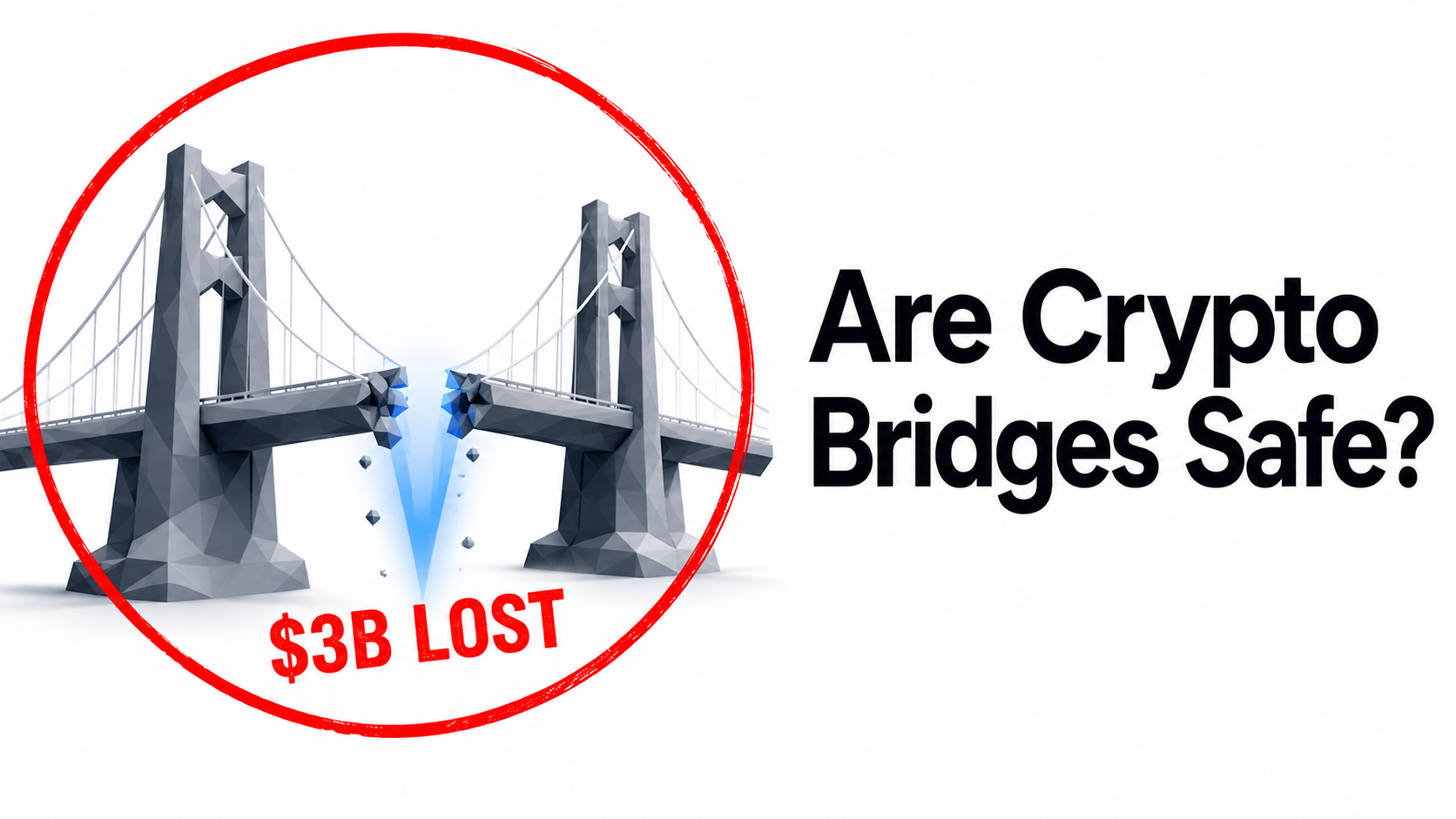
Are Crypto Bridges Safe? The $292M KelpDAO Hack Proved They’re Not. Here’s What to Use Instead.
 Blueice Finance8 min read·Just now
--
Last updated: May 2026. This guide covers the KelpDAO/LayerZero exploit, why bridge hacks keep happening, and safer alternatives for moving crypto between blockchains.
If you’ve ever used a crypto bridge to move tokens from one blockchain to another, this article answers the question you’re probably already asking: is it safe?
The short answer: not as safe as you think. And the $292 million KelpDAO exploit on April 18, 2026 proved exactly why.
But this article isn’t just another news story about the hack. You can read those anywhere. This is the guide that tells you what to do instead — how to move crypto between blockchains without exposing yourself to the structural risks that keep causing nine-figure disasters.
What Happened to KelpDAO (The 2-Minute Version)
On April 18, 2026, North Korea’s Lazarus Group exploited KelpDAO’s cross-chain bridge, powered by LayerZero’s messaging infrastructure. They stole 116,500 rsETH — approximately $292 million — in under an hour.
This was not a coding bug. The smart contracts worked exactly as designed. The attackers compromised the data servers that a single verifier relied on to confirm cross-chain transactions. They fabricated a transaction that never happened on the source chain, and the bridge released the funds on the destination chain.
KelpDAO paused its contracts 46 minutes later. Two follow-up attacks totaling another $100 million were blocked. But the $292 million was already gone.
The fallout: → Over $13 billion in DeFi TVL was withdrawn within 48 hours → Aave, SparkLend, and Fluid froze their rsETH markets → rsETH holders on 20+ Layer 2 networks were left holding tokens with no backing → The Arbitrum Security Council froze over 30,000 ETH of the attacker’s downstream funds → Protocols representing approximately $2 billion in TVL have since migrated away from LayerZero to Chainlink CCIP
After weeks of blaming KelpDAO for the configuration, LayerZero issued a public apology admitting it “made a mistake” by allowing its verifier to operate as a single point of failure. Analysis found that 47% of all active LayerZero applications were using the same vulnerable setup.
Sources: Chainalysis, CoinDesk, Halborn, The Market Periodical, CoinPaper
Why Crypto Bridges Keep Getting Hacked (The Pattern)
The KelpDAO hack was the largest DeFi exploit of 2026. It was not the first. Here is the pattern:
→ Ronin Bridge (2022): $624 million stolen → BNB Bridge (2022): $570 million stolen → Wormhole (2022): $325 million stolen → KelpDAO/LayerZero (2026): $292 million stolen → Drift Protocol (2026): $285 million stolen → Nomad (2022): $190 million stolen → Harmony Horizon (2022): $100 million stolen
Total: over $3 billion lost to bridge exploits since 2021.
The problem is structural. Every bridge works on the same principle: lock tokens on Chain A, release equivalent tokens on Chain B. The security of this process depends on how the bridge verifies that a real action happened on Chain A before releasing funds on Chain B.
Most bridges outsource that verification to a small group of validators, external networks, or relay systems. These intermediaries become the single point of attack. Compromise the verifier, and you compromise the bridge.
As 1inch co-founder Sergej Kunz said after the KelpDAO exploit: “Anything that can go wrong will go wrong, and bridge hacks are a perfect example.”
The Risk You’re Taking Every Time You Use a Bridge
Even when nothing gets hacked, you’re paying for the trust infrastructure that bridges require.
Hidden costs: → Validator and relayer fees → Gas on both source and destination chains → Slippage on any required swaps at either end → Liquidity pool premiums → Time delays (some bridges take 10–30 minutes)
The wrapped token risk: When you bridge tokens the traditional way, you often receive wrapped versions on the destination chain — IOUs backed by the tokens locked in the bridge contract. If the bridge is hacked, those wrapped tokens become worthless. That is exactly what happened with rsETH: holders on 20+ networks owned tokens whose backing had been drained.
The contagion risk: When rsETH lost its backing, it didn’t just affect KelpDAO users. Aave, SparkLend, Fluid, Compound, Euler, and at least 9 other protocols were impacted because they had accepted rsETH as collateral. One bridge failure cascaded across the entire DeFi ecosystem.
What to Use Instead: Cross-Chain DEX Aggregators
Here is what most people don’t know: you don’t need a bridge to move value between blockchains.
A cross-chain DEX aggregator works differently. Instead of locking tokens and minting IOUs, it routes your swap through DEXes and liquidity sources across chains. The routing engine finds the optimal path, you confirm, and you receive native tokens on the destination chain. No wrapped IOUs. No single contract holding hundreds of millions.
Here is what that looks like:
→ You connect your wallet. Nobody takes custody. → You pick the token you have on one chain. → You pick the token you want on another chain. → The route intelligence engine scans 60+ blockchains simultaneously. → It shows you four options: Fastest. Cheapest. Safest. Recommended. → You choose which priority matters right now. → You confirm. The swap settles in seconds. → You receive native tokens, not wrapped versions. → You get a receipt: exact route, exact fee, exact time. Permanent. On-chain. → Your keys never leave your wallet.
Why this is safer than a traditional bridge:
→ No single contract holding hundreds of millions that can be drained in one exploit → No single verifier deciding whether your transaction is legitimate → No wrapped tokens that lose value if the underlying bridge is hacked → Route intelligence evaluates the security profile of each path, not just the price → Self-custodial throughout — you never hand your tokens to an intermediary
How to Move Crypto Between Chains Safely: The Checklist
If the KelpDAO hack taught the industry one lesson, it is that you should never blindly trust a bridge. Here is a practical safety checklist for anyone moving tokens between blockchains in 2026:
1. Ask: am I receiving native tokens or wrapped tokens? Wrapped tokens are IOUs backed by a bridge contract. If that contract is drained, your tokens lose their value. Native tokens exist independently on the destination chain. Always prefer native.
2. Ask: how many verifiers does this path rely on? After the KelpDAO hack, anything less than 3-of-3 verification should be treated as high risk. 47% of LayerZero apps were using single-verifier setups. Don’t be the 48th.
3. Ask: can I see and choose my own route? If the system picks the route and doesn’t show alternatives, you can’t assess the risk. Route transparency is a security feature.
4. Ask: do I keep custody throughout? If you deposit into a custodial system to bridge, you’re adding counterparty risk on top of bridge risk. Self-custodial swaps eliminate that layer.
5. Ask: do I get a verifiable receipt? An on-chain receipt of every step proves the system worked as claimed. No receipt means no accountability.
6. Ask: what happens to my tokens if this bridge gets hacked tomorrow? If the answer involves wrapped tokens backed by a single contract, your risk is real. If you hold native tokens in your own wallet, you’re protected.
Bridge vs Cross-Chain DEX Aggregator: The Comparison
TRADITIONAL BRIDGE: → Your tokens: locked in a single contract (the honeypot) → Verification: 1 to 3 validators (the single point of failure) → What you receive: wrapped tokens (IOUs) → If the bridge is hacked: your wrapped tokens become worthless → Route choice: none. the bridge picks the path. → Custody during transfer: the bridge holds your tokens → Receipt: none or minimal → Speed: 10 to 30 minutes typical → Recent losses: $3+ billion since 2021
CROSS-CHAIN DEX AGGREGATOR: → Your tokens: routed, never locked in a single pool → Verification: distributed across multiple DEXes and liquidity sources → What you receive: native tokens on the destination chain → If one path has an issue: route intelligence picks a different path → Route choice: Fastest, Cheapest, Safest, Recommended — you choose → Custody during transfer: you hold your keys throughout → Receipt: on-chain, permanent, verifiable → Speed: seconds → Recent losses from this model: structurally different — no single honeypot
Frequently Asked Questions
Q: Is it safe to use a crypto bridge in 2026? It depends on which bridge and how it’s configured. After the KelpDAO hack, any bridge using a single verifier should be considered high risk. Bridges using multi-verifier setups (3-of-3 or higher) are safer but still carry structural risks because they concentrate assets in a single contract. Cross-chain DEX aggregators offer an alternative that avoids the single-contract honeypot model entirely.
Q: What is wrapped rsETH and why did it lose value? rsETH is KelpDAO’s liquid restaking token. When bridged to Layer 2 networks via LayerZero, users received wrapped versions. Those wrapped tokens were backed by rsETH locked in the bridge contract on Ethereum. When the attacker drained that contract, the wrapped tokens on 20+ networks lost their backing.
Q: What is a cross-chain DEX aggregator? A tool that routes token swaps across multiple blockchains by scanning DEXes and liquidity sources on both the source and destination chains. Instead of locking and minting, it finds the optimal swap path and settles in one transaction. Examples include aggregators that support 60+ blockchains with route intelligence showing multiple path options.
Q: How do I know if I’m getting native tokens or wrapped tokens? Check the token contract address on the destination chain. Native USDC on Arbitrum has a different contract address than bridged/wrapped USDC. Block explorers like Etherscan and Arbiscan show the token’s origin. Cross-chain DEX aggregators that deliver native tokens will specify this in the route information.
Q: Can I still use LayerZero-based bridges? LayerZero has banned single-verifier configurations and is migrating to minimum 3-of-3 or 5-of-5 verification. These changes reduce but don’t eliminate the structural risks of the bridge model. Multiple major protocols (KelpDAO, Solv Protocol) have already migrated to Chainlink CCIP as an alternative.
Q: What is the safest way to move crypto between chains in 2026? Use a self-custodial cross-chain DEX aggregator with route intelligence. Verify that you’re receiving native tokens, not wrapped versions. Choose your own route based on your priority (speed, cost, or safety). Get a receipt for every transaction. Keep your keys throughout.
The Bottom Line
The KelpDAO hack was not an anomaly. It was the predictable result of a bridge architecture that concentrates hundreds of millions of dollars in a single contract, verified by a single point of failure, issuing wrapped tokens that collapse when the underlying system is compromised.
$3 billion has been lost to bridge hacks since 2021. The model keeps failing for the same structural reasons.
The alternative already exists. Cross-chain DEX aggregators route swaps across 60+ chains, deliver native tokens, let you choose your own route, keep your keys in your wallet, and give you a receipt for every transaction. No single-contract honeypot. No wrapped IOUs. No single verifier.
The question is not whether bridges will be hacked again. They will. The question is whether you’ll still be using one when it happens.
Any token. Any chain. 3 clicks. Your route. Your control.
Keywords: crypto bridge safe, KelpDAO hack explained, LayerZero exploit, bridge hack 2026, cross-chain bridge alternative, how to move crypto between chains safely, wrapped tokens risk, bridge vs DEX aggregator, safe cross-chain swap, cross-chain DEX aggregator 2026, bridge hack protection, DeFi security 2026
Sources: Chainalysis (chainalysis.com/blog/kelpdao-bridge-exploit-april-2026), CoinDesk (coindesk.com), Halborn (halborn.com/blog/post/explained-the-kelp-dao-hack-april-2026), The Market Periodical (themarketperiodical.com), CoinPaper (coinpaper.com), CCN (ccn.com), CryptoPotato (cryptopotato.com), TechTarget (techtarget.com), Cybernews (cybernews.com)