
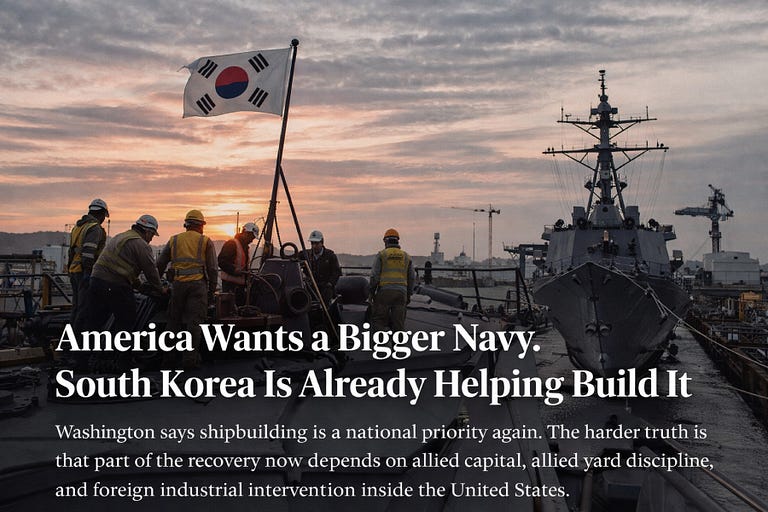
Washington says shipbuilding is a national priority again. The harder truth is that part of the recovery now depends on allied capital, allied yard discipline, and foreign industrial intervention inside the United States.
America wants a bigger navy.
That part is not in doubt.
What is increasingly in doubt is whether America can rebuild naval scale fast enough on domestic industrial terms alone.
That is the real significance of Hanwha’s latest move into the United States. Reuters reported this week that Hanwha Defense USA and Hanwha Philly Shipyard won their first U.S. Navy subcontract, working with Vard Marine US on the Next Generation Logistics Ship program. Reuters also reported that since acquiring Philly Shipyard in December 2024, Hanwha has invested more than $200 million to expand the yard’s workforce, capabilities, and capacity.[1]
Taken on its own, that looks like one contract.
Taken in context, it looks like something larger.
America’s maritime recovery is no longer only a story about American money and American yards. It is increasingly a story about whether allied capital and allied production methods can revive a shipbuilding base that has fallen too far behind its own strategic demands. Even the Chief of Naval Operations said this month that direct foreign investment is “breathing life back into the Foundry.”[2]
That is not a normal line for a navy that still sees itself as the foundation of maritime primacy.
It is an admission that the industrial gap has become too large to ignore.
Cause
The cause is straightforward.
American naval ambition has outrun American shipbuilding performance.
The United States is trying to close a strategic gap at the same time China is widening its own maritime advantage in scale. The Pentagon’s most recent China military power report said the PLA Navy already had a battle force of more than 370 ships and submarines and projected it would grow to 395 by 2025 and 435 by 2030.[3] Against that backdrop, the U.S. Navy’s preferred force structure goal has moved to 381 battle force ships, while the actual fleet stood at 296 ships in January 2025.[4]
That mismatch is not theoretical.
It is already visible in the production record. GAO reported in February 2025 that in fiscal year 2020 the Navy expected to have a 313 ship battle force by 2025. In its fiscal year 2025 shipbuilding plan, it projected only 287 ships by 2025, or 26 fewer than previously planned.[5] The same GAO report found that between fiscal years 2019 and 2023, private industry delivered only 4 of 11 planned Virginia class submarines and 7 of 15 planned Arleigh Burke destroyers.[6]
This is not just a matter of being a little slow.
It is a structural failure to convert strategic demand into industrial output.
GAO put an even sharper number on that failure. It found that private industry delivered seven new battle force ships in fiscal year 2023, but would need to deliver roughly 13 ships a year for 30 years to meet the Navy’s optimal fleet size goal under the current plan.[7]
That is why foreign intervention in the industrial base is now becoming thinkable.
Washington has not reduced the strategy.
It has not accepted the timeline.
So it is moving toward the third option.
Bring in outside capital, outside yard management, and outside production discipline to try to accelerate recovery.
That is where South Korea enters the picture.
Reuters reported in November 2025 that the United States and South Korea released details of a deal that included $150 billion in Korean investment in the American shipbuilding sector.[8] Reuters then reported in March 2026 that South Korea’s parliament passed legislation to implement a wider $350 billion strategic U.S. investment package, including that same $150 billion shipbuilding component and a new state backed investment corporation with 2 trillion won in initial capital.[9]
That is not symbolic diplomacy.
It is allied balance sheet power being directed into the American maritime industrial base.
Constraint
This is where the argument gets harder.
Foreign capital can relieve pressure.
It cannot erase the underlying weakness.
The first constraint is legal. Reuters reported in May 2025 that foreign shipyards are prohibited from building U.S. Navy vessels under the Byrnes Tollefson Amendment.[10] That means the solution is not simple outsourcing of naval production overseas. It is a more complicated model in which foreign owners, foreign capital, and foreign shipbuilding methods are inserted into yards on U.S. soil.
That distinction is important.
Washington still wants American built ships.
What it increasingly appears willing to accept is that American yards may need outside industrial rescue to produce them at the rate strategy now demands.
The second constraint is that the rescue effort itself is still early. Reuters reported that Hanwha saw its early U.S. Navy repair work as strategically valuable partly because it would teach the company how to navigate U.S. Navy requirements and position itself for future opportunities.[10] In other words, even a sophisticated Korean shipbuilder is still climbing the American learning curve. This is not a switch that flips from weak to strong overnight.
The third constraint is labour and process. Reuters reported that Hanwha’s executives said U.S. shipyards had not faced enough competition, facilities were old, and the industry lacked technicians. The company said it was trying to modernise facilities, train workers, and apply production processes that could build the same ship in roughly two thirds of the time, or less, than a U.S. yard.[10]
That is not just a boast.
It is an implicit criticism of the domestic baseline.
And Washington clearly understands the scale of the problem. The Navy announced in March 2026 that its new Alabama “factory of the future” would combine $900 million in Navy funding with $1.5 billion in private capital, for more than $2.4 billion in total investment, to mass produce components for Virginia class and Columbia class submarines at a 2.2 million square foot site expected to create up to 1,000 jobs.[11]
That is a serious intervention.
It is also evidence that the existing industrial base cannot recover without major external capital, process reform, and time.
The fourth constraint is strategic narrative. Washington wants to present naval recovery as national restoration. That story becomes harder to sustain when foreign investment is openly described by the CNO as a source of life for the industrial base.[2] The recovery may still be real. But it is less purely domestic than the rhetoric suggests.
The fifth constraint is timing. Shipbuilding crises are not solved by press releases. They are solved by repeatable execution across suppliers, labour pools, facilities, and long cycle contracts. Even if Hanwha succeeds in Philadelphia, even if Korean investment continues to flow, and even if Alabama scales fast, the United States is still trying to fix this after the strategic pressure has already accelerated.
That is the central problem.
China’s naval rise is not waiting for America’s industrial rehabilitation.
Consequence
If this is the shape of the recovery, the consequences are strategic, not merely commercial.
The first consequence is that American maritime power becomes more openly coalition built in industrial form, not just coalition supported in operations. Washington has long relied on allies for basing, logistics, and combat support. What is changing now is that it may increasingly rely on allied money, allied management, and allied production logic to recover shipbuilding scale itself.[1][2][8][9][10]
The second consequence is that South Korea’s strategic value rises well beyond the Korean Peninsula. Seoul is no longer only a frontline ally facing North Korea and balancing China. It is also becoming a source of industrial capacity that may matter directly to whether the United States can restore naval mass on a meaningful timeline.[1][8][9][10]
The third consequence is that the myth of purely sovereign U.S. industrial recovery becomes harder to sustain. A navy can still sail under one flag while depending on a broader industrial coalition behind it. That is not necessarily weakness. But it is not the old model either. It suggests that maritime primacy may now depend on coalition industry as much as coalition warfighting.
The fourth consequence is that deterrence against China becomes more dependent on whether Washington can industrialise fast enough, not just whether it can budget enough. The United States can announce fleet goals, but if China is already above 370 ships and submarines and moving toward 435 by 2030 while the U.S. industrial base is underdelivering its own plans, then the relevant contest is not only doctrinal or operational. It is industrial and temporal.[3][4][5][6][7]
The fifth consequence is that this precedent will not remain confined to shipbuilding. Once Washington accepts allied capital and allied industrial methods as part of the answer in one strategically central sector, the logic can spread. Munitions, naval systems, autonomy, repair, and sustainment could all move further toward a model in which trusted allies are not just customers or partners but co architects of U.S. defence production resilience.
That would be a profound change.
Not because America would be weaker than its allies.
Because America would be more dependent on them than its political culture still likes to admit.
Conclusion
America still wants the bigger navy.
That part is not uncertain.
What is uncertain is whether the domestic base can rebuild fast enough on domestic terms alone.
That is why Hanwha’s first Navy subcontract matters more than it first appears. It is not just another contract at another yard. It is evidence that the American maritime rebuild is already leaning on allied capital, allied ownership, and allied process discipline to regain tempo.[1]
Washington can still call that a success.
In one sense, it is.
A larger navy built faster through allied industrial cooperation is better than a larger navy promised and never delivered.
But it also means the strategic picture has changed.
This is no longer only a story of national industrial recovery.
It is a story of strategic necessity forcing the United States to accept that the road back to maritime scale may run through Philadelphia, Alabama, and Korean balance sheets at the same time.
America wants a bigger navy.
The sharper question is whether it can still build one as a purely American industrial act, or whether the comeback already depends on allies in ways Washington has not yet fully admitted.
Footnotes
[1] Reuters reported on 30 March 2026 that Hanwha Defense USA and Hanwha Philly Shipyard won their first U.S. Navy subcontract on the Next Generation Logistics Ship program and that Hanwha has invested more than $200 million in Philly Shipyard since acquiring it in December 2024.
[2] In remarks to the Submarine Industrial Base Council on 10 March 2026, the Chief of Naval Operations said direct foreign investments are “breathing life back into the Foundry.”
[3] The Pentagon’s 2024 China military power report said the PLA Navy had a battle force of over 370 ships and submarines and projected it would grow to 395 by 2025 and 435 by 2030.
[4] A Congressional Research Service update said the U.S. Navy had 296 battle force ships as of 27 January 2025 and noted the Navy’s preferred force structure objective had moved to 381 ships.
[5] GAO reported in February 2025 that the Navy had planned in fiscal year 2020 to have a 313 ship battle force by 2025, but in its fiscal year 2025 shipbuilding plan projected only 287 ships by 2025, or 26 fewer than previously planned.
[6] GAO also found that from fiscal years 2019 through 2023 private industry delivered only 4 of 11 planned Virginia class submarines and 7 of 15 planned Arleigh Burke destroyers.
[7] GAO further reported that private industry delivered seven new battle force ships in fiscal year 2023 but would need to deliver roughly 13 ships per year for 30 years to meet the Navy’s optimal fleet size goal under the current plan.
[8] Reuters reported in November 2025 that the United States and South Korea released details of a deal including $150 billion in Korean investment in the American shipbuilding sector.
[9] Reuters reported in March 2026 that South Korea’s parliament passed legislation to implement a $350 billion strategic U.S. investment package, including $150 billion for shipbuilding cooperation and a state backed investment corporation with 2 trillion won in initial capital.
[10] Reuters reported in May 2025 that Hanwha Ocean said foreign shipyards are prohibited from building U.S. Navy vessels under the Byrnes Tollefson Amendment, and that the company was trying to modernise U.S. facilities, train workers, and transplant production processes to improve efficiency.
[11] The Navy announced in March 2026 that its new Alabama “factory of the future” would combine $900 million in Navy funding with $1.5 billion in private capital, for more than $2.4 billion total investment, at a 2.2 million square foot site expected to create up to 1,000 jobs producing submarine components.
America Wants a Bigger Navy. South Korea Is Already Helping Build It was originally published in DataDrivenInvestor on Medium, where people are continuing the conversation by highlighting and responding to this story.
