Amazon unveils Vulcan, its first robot with tactile sensing for warehouses
The new robotic system can feel what it's handling, process roughly 75% of warehouse items, and work at speeds comparable to human employees.
Share
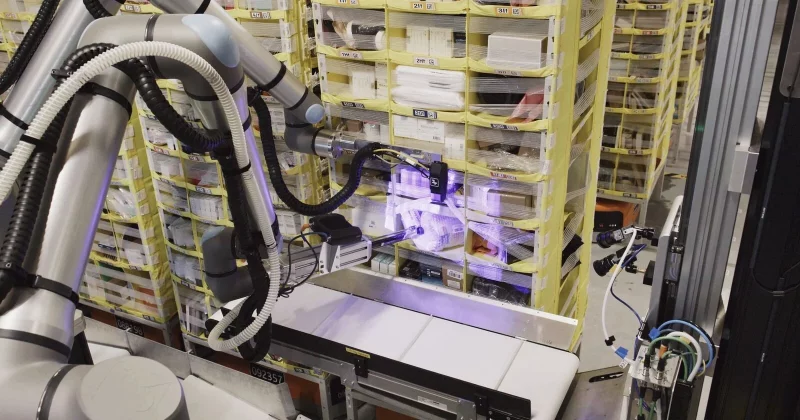
Add us on Google by Editorial Team Jun. 5, 2026Amazon unveiled Vulcan, its first robotic system equipped with tactile and force-sensing capabilities, at the “Delivering the Future” event in Dortmund, Germany on May 7, 2025. Unlike previous vision-only systems, Vulcan can detect physical contact and measure the force it applies in real time, letting it pick up, move, and stow a wide variety of items without crushing, dropping, or otherwise mangling them.
What Vulcan actually does
Vulcan uses force-feedback sensors to understand what it’s touching. The robot can feel whether it has a solid grip on something, adjust its squeeze in real time, and adapt its approach based on physical feedback rather than just visual cues.
The system uses arms supplied by Universal Robots, the Denmark-based robotics firm that Teradyne acquired in 2015. Those arms, combined with Amazon’s proprietary AI layer, give Vulcan the dexterity to handle approximately 75% of items found in fulfillment centers at speeds on par with human workers.
AdvertisementDuring initial testing, Vulcan processed over 12,000 customer orders. The system is currently operational at testing sites in Spokane, Washington, and Hamburg, Germany.
Vulcan can only handle objects weighing up to roughly 8 pounds (3.6 kg), and it struggles with some round items.
The brains behind the bot
Development was led by Aaron Parness, Amazon’s director of robotics AI. Vulcan improves its performance through machine learning trained on physical force and touch data. Every time it picks up an item, it’s collecting information about grip pressure, object resistance, and surface texture.
Amazon has framed Vulcan as a complement to human workers, not a replacement. The company says the system is designed to relieve employees of physically demanding tasks like repeated stretching, bending, and heavy lifting.
What this means for investors and the industry
The partnership with Universal Robots is worth watching. Teradyne’s subsidiary has carved out a strong position in the collaborative robotics market, and a deep integration with Amazon’s fulfillment infrastructure could significantly boost demand for their hardware.
Amazon operates hundreds of fulfillment centers globally. If Vulcan can handle 75% of items at human-equivalent speeds, Amazon can meaningfully reduce per-unit fulfillment costs across those sites.
The 8-pound weight limit and difficulty with round objects suggest Vulcan is still a first-generation system. Investors should watch for expansion beyond the two current test sites in Spokane and Hamburg as a signal that the technology is ready for broader deployment.
Disclosure: This article was edited by Editorial Team. For more information on how we create and review content, see our Editorial Policy.