AIX Alpha: How System Capacity Scales Over Time?
 AIX Alpha Official3 min read·Just now
--
Understanding Growth, Limits, and Scalable Execution.
The Question Behind Growth
As confidence in a system increases, participation grows.
And with that comes a critical question:
Can the system scale?
Not just function —
but maintain performance as capital increases.
Why Scaling Is Difficult
Many systems perform well at smaller scale.
But as capital grows, challenges appear:
- Reduced liquidity efficiency
- Slower execution
- Increased market impact
- Strategy saturation
What works at a small size may not work at a larger one.
AIX Alpha’s Approach to Scalability
AIX Alpha is designed with scalability in mind from the beginning.
Not as an afterthought —
but as a core system requirement.
Where Capacity Is Managed
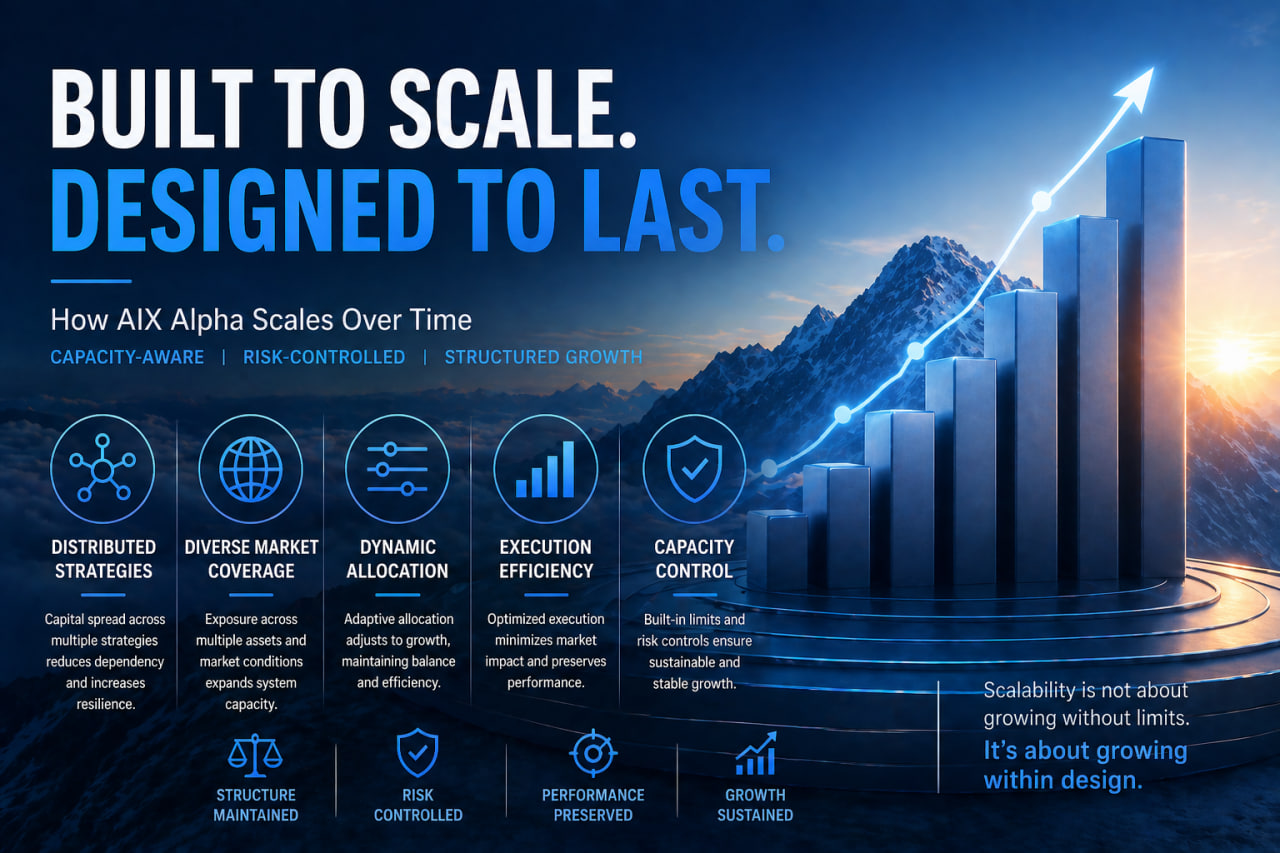
Scalability is controlled through multiple layers:
1. Strategy Distribution
Capital is not concentrated.
It is distributed across:
- Multiple strategies
- Different timeframes
- Diverse execution conditions
This reduces pressure on any single strategy.
2. Market Coverage
The system operates across:
- Multiple assets
- Different liquidity environments
- Diverse trading conditions
This expands the available capacity.
3. Dynamic Allocation Adjustment
As capital increases:
- Allocation is redistributed
- Exposure is balanced
- Strategies are scaled proportionally
The system adapts to size.
4. Execution Layer Optimization
Execution is designed to:
- Avoid excessive market impact
- Maintain efficiency
- Adjust to liquidity conditions
This helps preserve performance quality.
Not Infinite Scaling — Controlled Scaling
No system can scale infinitely without impact.
AIX Alpha acknowledges this.
The goal is not unlimited growth.
It is:
- Controlled expansion
- Managed capacity
- Sustainable scaling
What Happens When Capacity Is Approached
When system limits are approached:
- Allocation becomes more selective
- Execution slows in certain areas
- Risk constraints tighten
The system adjusts instead of forcing growth.
Why This Matters
Without scalability design:
- Performance degrades
- Risk increases
- Execution becomes inefficient
With scalability control:
- Structure is maintained
- Behavior remains predictable
- Growth stays stable
Scaling Without Breaking Structure
The key principle is simple:
Growth should not change how the system behaves.
AIX Alpha is designed to ensure that:
- Core logic remains intact
- Risk controls remain active
- Allocation structure remains balanced
The Role of Capacity Awareness
A scalable system is aware of:
- Its own limits
- Market conditions
- Execution constraints
This awareness allows it to:
- Adjust proactively
- Avoid stress points
- Maintain consistency
From Small System to Structured Platform
Scaling is not just about size.
It is about:
- Maintaining efficiency
- Preserving discipline
- Ensuring stability
What This Means for Users
Users are not participating in:
→ A fixed-size system
They are participating in:
→ A system designed to scale within controlled limits
Conclusion
Scalability is not about growing endlessly.
It is about growing intelligently.
AIX Alpha manages capacity through:
- Distributed strategies
- Dynamic allocation
- Controlled execution
- Defined system limits
ensuring that performance remains structured as the system expands.
What’s Next
In the next article, we will explore:
How liquidity affects execution — and how the system navigates different market depths.
AIX Alpha
Scalable by Design • Capacity-Aware • Built for Structured Growth