AIX Alpha: How Liquidity Shapes Execution Quality?
 AIX Alpha Official2 min read·Just now
--
Understanding Market Depth, Slippage, and System Efficiency.
The Hidden Layer of Execution
Most discussions about performance focus on:
- Strategy
- Signals
- Allocation
But there is another critical layer:
Liquidity
What Is Liquidity
Liquidity refers to how easily assets can be traded without significantly affecting price.
High liquidity:
- Trades execute smoothly
- Minimal price impact
Low liquidity:
- Execution becomes difficult
- Price may shift during trading
Why Liquidity Matters
Even a strong strategy can lose efficiency if:
- Execution causes price movement
- Orders cannot be filled properly
- Market depth is limited
This directly affects real performance.
AIX Alpha’s Approach to Liquidity
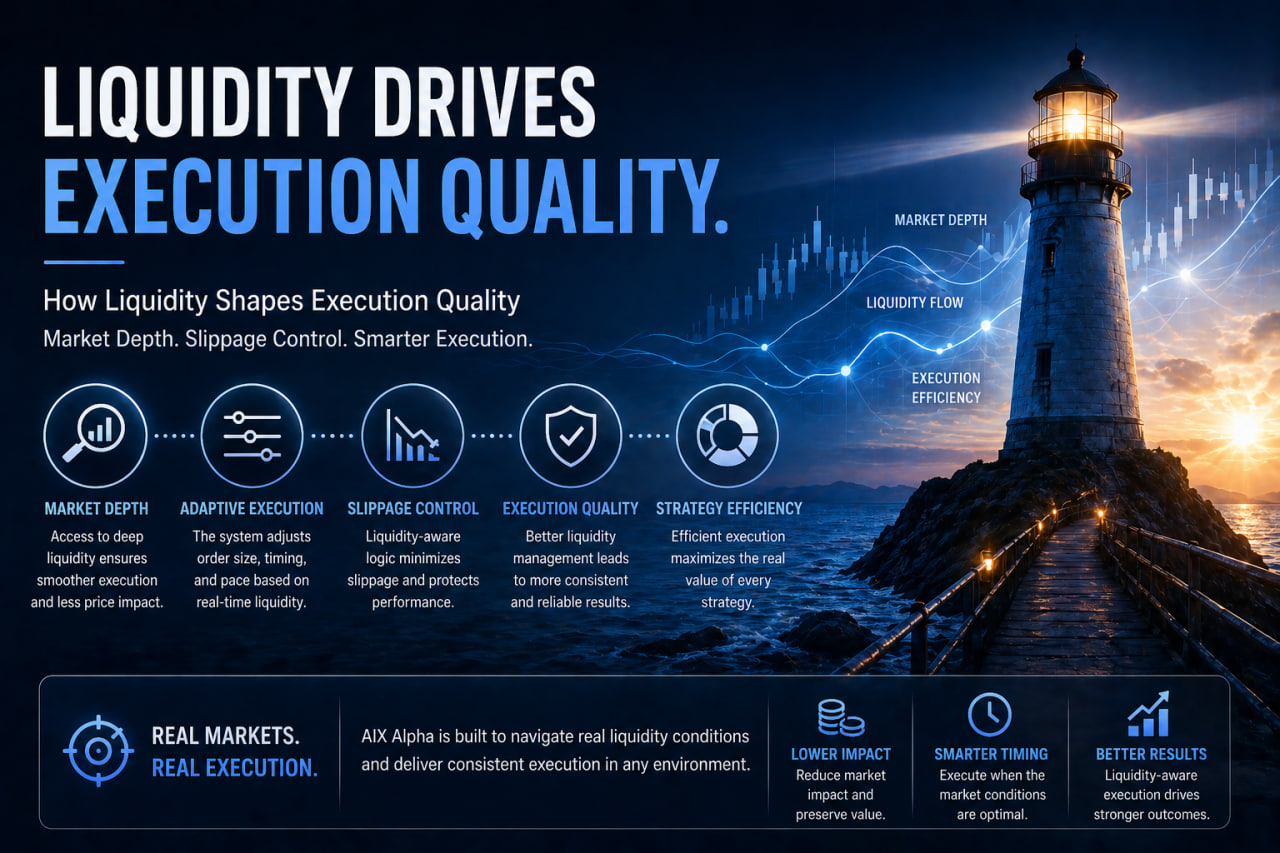
AIX Alpha integrates liquidity awareness into its execution design.
It does not treat the market as infinite.
Where Liquidity Is Managed
1. Asset Selection
The system prioritizes:
- Markets with sufficient depth
- Tradable environments
- Reliable execution conditions
This reduces structural friction.
2. Position Sizing
Trade size is adjusted based on:
- Market depth
- Available liquidity
- Current conditions
This prevents excessive market impact.
3. Execution Distribution
Instead of concentrating trades:
- Orders are distributed
- Execution may be segmented
- Timing can be adjusted
This improves efficiency.
4. Adaptive Execution
Execution is not fixed.
The system adjusts:
- Speed of execution
- Size of orders
- Frequency of trades
based on real-time liquidity.
What Is Slippage
Slippage occurs when the execution price differs from the expected price.
This is more likely when:
- Liquidity is low
- Order size is large
- Markets move quickly
How the System Reduces Slippage
AIX Alpha minimizes slippage through:
- Controlled order sizing
- Adaptive execution timing
- Liquidity-aware decision-making
Not All Markets Are Equal
Different assets and conditions provide different levels of liquidity.
The system accounts for:
- Variation across assets
- Changing market depth
- Time-based liquidity shifts
Liquidity and Scalability
Liquidity is directly connected to system capacity.
As capital increases:
- Liquidity constraints become more relevant
- Execution must become more refined
This is why liquidity management is part of scalability design.
Efficiency Through Market Awareness
Execution quality depends on:
- Understanding market depth
- Adjusting behavior accordingly
- Avoiding unnecessary impact
Not Forcing Execution
This is critical.
The system does not:
- Force trades in poor conditions
- Chase execution when liquidity is weak
Instead, it:
- Waits
- Adjusts
- Selects better conditions
Why This Matters
Without liquidity awareness:
- Performance degrades
- Costs increase
- Risk becomes hidden
With liquidity-aware execution:
- Trades remain efficient
- Costs are controlled
- Results stay consistent
A More Realistic View of Markets
Markets are not frictionless.
A system must:
- Respect liquidity
- Adapt to depth
- Adjust execution
Conclusion
Liquidity is a critical factor in real-world execution.
AIX Alpha integrates liquidity awareness into its system design, ensuring that:
- Execution remains efficient
- Slippage is minimized
- Performance reflects real market conditions
What’s Next
In the next article, we will explore:
How transaction costs and fees impact performance — and how the system manages them.
AIX Alpha
Liquidity-Aware • Execution-Optimized • Built for Real Markets