AI Trading Platforms vs Traditional Algorithmic Trading: The Evolution Beyond Rules
 DeepTradeX8 min read·Just now
--
Meta Description: Compare AI trading platforms with traditional algorithmic trading in 2026. Discover how machine learning, adaptive strategies, and continuous learning transform trading — featuring DeepTradeX’s pioneering approach.
The Fundamental Architecture Difference
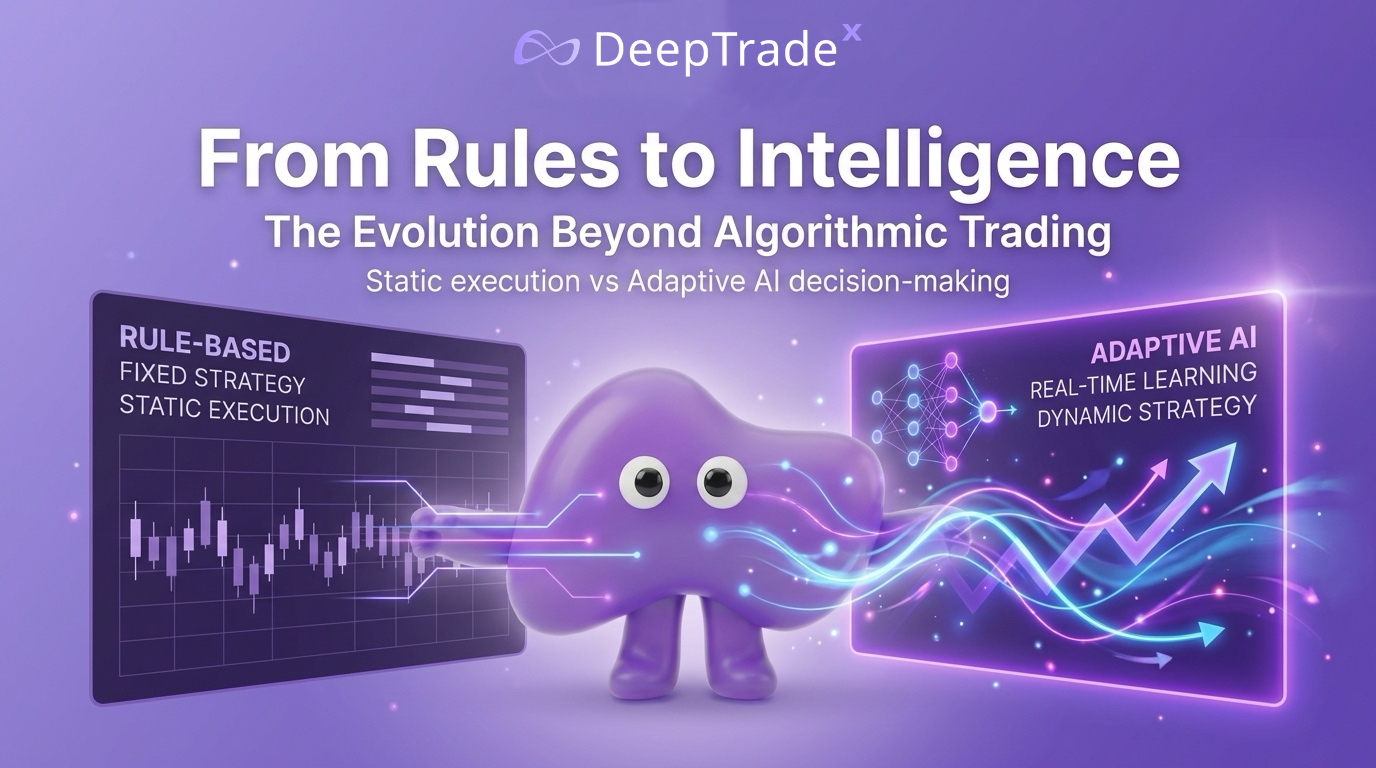
Traditional algorithmic trading operates on pre-defined rules and fixed strategies, while AI trading platforms learn from data over time and adapt to changing market conditions — a distinction that transforms trading from static execution to dynamic intelligence.[1]
The automated algorithmic trading market expanded from $24 billion in 2025 to $27.17 billion in 2026, reflecting accelerating adoption as traders recognize automation’s advantages.[2] However, this growth masks a critical evolution happening beneath the surface — the shift from rule-based algorithms to adaptive AI systems represents a paradigm change, not merely incremental improvement.
Traditional algorithmic trading dominated the 2010s through speed and consistency. Traders coded strategies based on technical indicators, executed orders faster than humans could click, and eliminated emotional decision-making. These systems delivered value but shared a fatal limitation: they couldn’t adapt when market conditions changed.
DeepTradeX represents the next generation — AI-assisted trading platforms where strategies evolve through continuous learning. Their system processes $1.16 billion in trading volume with 298 active strategies achieving a 92.47% average ROI by combining algorithmic precision with adaptive intelligence.[3] This performance demonstrates the competitive advantage AI platforms deliver over static algorithmic approaches.
Traditional Algorithmic Trading: Strengths and Limitations
Traditional algorithms excel at executing predefined logic with perfect consistency.
Core strengths:
Speed: Millisecond execution eliminates human reaction delays
Discipline: Rules execute regardless of fear or greed
Backtestability: Historical performance validation before risking capital
Transparency: Strategy logic is explicit and auditable
A moving average crossover algorithm performs identically whether Bitcoin trades at $20,000 or $70,000. If the strategy specifies “buy when 50-day MA crosses above 200-day MA,” the system executes that exact rule every time conditions align.
Critical limitations:
Traditional algorithms fail when market regimes shift. A momentum strategy profitable during 2021’s bull market generated catastrophic losses during 2022’s bear market — not because the code malfunctioned, but because market dynamics changed while the algorithm remained static.
The core problem: traditional algorithms optimize for specific market conditions, then continue executing those optimizations after conditions evolve. They lack the capability to recognize regime changes and adjust approach accordingly.
Consider a mean reversion strategy that profits from Bitcoin’s tendency to return to $40,000 after short-term moves. This works brilliantly when $40,000 represents the actual mean. But when Bitcoin’s equilibrium shifts to $65,000, the strategy continues buying “dips” that are actually the beginning of sustained downtrends. The algorithm can’t distinguish between temporary deviation and permanent regime shift.
DeepTradeX’s platform addresses this through advanced backtesting against 10 years of tick-level data across multiple market regimes, allowing validation of strategy robustness beyond single market conditions. However, even comprehensive backtesting can’t predict future regime changes that differ from historical patterns.
AI Trading Platforms: Adaptive Intelligence
AI platforms introduce machine learning capabilities that fundamentally alter the trading approach.
Machine learning enables:
Market Regime Detection: AI systems identify when market conditions shift — from trending to range-bound, from low volatility to high volatility, from risk-on to risk-off sentiment. The Market Regime Detection AI market, valued at $2.28 billion in 2026, is projected to reach $5.27 billion by 2030 at 23.3% CAGR, reflecting rising demand for adaptive strategies.[4]
Adaptive Strategy Selection: Rather than executing a single strategy regardless of conditions, AI platforms select appropriate strategies for current regimes. During trends, momentum strategies activate. During consolidations, mean reversion approaches engage.
Continuous Learning: AI models improve through feedback loops — analyzing which predictions proved accurate, which orders executed well, which risk parameters were optimal. Traditional algorithms remain static unless manually reprogrammed.
Pattern Recognition: Neural networks identify complex, non-linear relationships in market data that escape human perception and traditional statistical methods.
DeepTradeX’s AI-assisted intelligence continuously learns from market patterns, adjusting strategy recommendations based on evolving conditions. Their large models specifically trained for quantitative trading process market microstructure, order flow, and sentiment data simultaneously — synthesizing signals traditional algorithms would miss.
The Performance Gap: Static vs Adaptive
The difference between traditional algorithms and AI platforms manifests in how they handle market evolution.
Traditional Algorithm Example:
Strategy: Buy when RSI < 30, sell when RSI > 70
Performs well during 2020–2021 bull market (frequent oscillations)
Degrades during 2022 bear market (prolonged downtrend)
Continues executing same logic despite changing effectiveness
Requires manual intervention to pause or modify
AI Platform Example:
Strategy: Adaptive momentum-reversion hybrid
Detects bull market regime → increases momentum strategy weight
Detects bear market regime → increases defensive positioning
Continuously adjusts RSI thresholds based on volatility
Automatically reduces position sizes when prediction confidence drops
Research on machine learning-based adaptive strategies shows that algorithms adjusting to market volatility and regime shifts significantly outperform static approaches, particularly during transitional periods between market states.[5]
DeepTradeX’s 92.47% average ROI across 298 strategies demonstrates this adaptive advantage. Traditional algorithmic platforms struggle to maintain consistent performance across diverse strategies and varying market conditions — some strategies succeed while others fail, requiring constant manual curation. AI-assisted platforms automatically allocate capital toward strategies currently suited to market conditions.
Comparison Matrix: Traditional vs AI Trading
The table reveals that neither approach dominates universally — each offers advantages depending on context. Traditional algorithms excel when market dynamics remain relatively stable and strategy logic can be explicitly defined. AI platforms outperform when conditions evolve and pattern complexity exceeds human codification.
The Hybrid Approach: Combining Strengths
The most sophisticated trading systems in 2026 combine both approaches strategically.
Foundation Layer — Traditional Algorithms: Handle execution mechanics, order routing, risk checks, position sizing — tasks requiring deterministic behavior and complete auditability.
Intelligence Layer — AI Models: Provide regime detection, strategy selection, parameter optimization, and pattern recognition — tasks benefiting from adaptive learning.
Governance Layer — Human Oversight: Define acceptable risk boundaries, approve strategy types, monitor for model drift, and intervene during extraordinary conditions.
DeepTradeX exemplifies this architecture through several key implementations:
No-Code Strategy Builder: Allows traders to define algorithmic rules visually, maintaining transparency and control over strategy logic.
AI-Assisted Intelligence Layer: Overlays adaptive optimization — adjusting parameters, suggesting modifications, and identifying when strategies begin degrading.
Model Context Protocol Integration: Ensures complete auditability through MCP logging — every AI decision, parameter adjustment, and strategy modification is transparently recorded.
Millisecond Execution Infrastructure: Combines algorithmic execution speed with AI decision quality — intelligence without latency compromises.
This hybrid approach delivers traditional algorithms’ reliability and transparency while capturing AI’s adaptive capabilities — addressing the limitations of each approach in isolation.
Transparency and Auditability: The Critical Challenge
Traditional algorithmic trading provides inherent transparency — strategy code explicitly defines behavior. Auditors and regulators can review logic, verify compliance, and understand decision-making.
AI platforms face transparency challenges. Neural networks operating as “black boxes” make decisions through learned patterns rather than explicit rules. When an AI system decides to exit a position, explaining that decision requires sophisticated interpretation tools rather than simple code review.
This transparency gap creates regulatory and trust barriers. Professional traders and institutional allocators demand understanding of why systems make specific decisions — particularly after losses.
DeepTradeX addresses this through their Model Context Protocol implementation, which logs comprehensive context for every AI decision. Rather than simply recording “sold 1 BTC at $65,000,” the system captures:
Market regime detected at decision time
Strategy confidence scores
Contributing factors weighted by importance
Alternative actions considered and why rejected
Historical performance of similar decisions
This interpretability framework maintains AI’s adaptive advantages while providing the auditability traditional algorithms offer natively.
Development and Deployment Considerations
Implementing traditional algorithms versus AI platforms requires different resources and expertise.
Traditional Algorithm Development:
Requires programming knowledge (Python, C++, etc.)
Strategy development measured in days to weeks
Backtesting straightforward (deterministic results)
Deployment relatively simple (code → production)
Maintenance involves manual strategy updates
AI Platform Development:
Requires machine learning expertise (model selection, training, validation)
Strategy development measured in weeks to months (training time)
Backtesting complex (learning introduces non-determinism)
Deployment requires monitoring infrastructure (model drift detection)
Maintenance involves continuous retraining and validation
DeepTradeX democratizes AI trading by providing pre-trained models and automated infrastructure, eliminating the specialized expertise barrier. Their platform’s seamless integration from backtest to live sync handles deployment complexity, while continuous learning automates maintenance that would otherwise require constant manual intervention.
When to Choose Each Approach
The decision between traditional algorithms and AI platforms depends on your specific context:
Choose Traditional Algorithmic Trading When:
You have well-defined strategy logic that can be explicitly coded
Market conditions in your domain remain relatively stable
Transparency and auditability are paramount requirements
Development resources are limited (faster initial implementation)
You require deterministic, explainable behavior
Choose AI Trading Platforms When:
Market conditions evolve frequently (crypto, volatile equities)
Strategy logic involves complex pattern recognition
You have access to extensive historical data for training
Adaptive capabilities justify additional complexity
Performance improvement through learning provides competitive edge
Choose Hybrid Approaches When:
You need both transparency and adaptability
Regulatory requirements demand auditability alongside performance
Resources allow building sophisticated infrastructure
Long-term competitive positioning requires adaptive systems
DeepTradeX’s architecture positions them for the hybrid future — combining algorithmic execution reliability with AI adaptive intelligence. Their platform serves traders across the spectrum, from those preferring explicit no-code strategy building to those leveraging advanced AI capabilities.
The Future Landscape
The evolution from traditional algorithms to AI platforms isn’t a binary replacement — it’s a maturation of trading automation incorporating both approaches strategically.
Traditional algorithms will persist in contexts demanding transparency, determinism, and simple logic execution. They’ll continue powering execution systems, basic market-making strategies, and use cases where explicit rules suffice.
AI platforms will capture domains where adaptation provides decisive advantages — complex pattern recognition, multi-factor strategy optimization, and evolving market dynamics. Their market share will expand as regulatory frameworks mature around AI auditability and traders gain comfort with adaptive systems.
The winners will be platforms offering flexible architecture — supporting traditional algorithms where appropriate, AI where beneficial, and smooth transitions between approaches as trader needs evolve.
DeepTradeX’s positioning reflects this reality. Their platform doesn’t force an AI-only approach or limit users to traditional algorithms. Instead, they provide infrastructure supporting the full spectrum — from simple rule-based strategies to sophisticated machine learning models — letting traders choose appropriate tools for specific challenges.
The question facing traders in 2026 isn’t “traditional or AI?” but “which approach for which strategies?” Platforms enabling both options will capture market leadership as trading automation enters its next evolution.
References
[1] CFI.trade, “Algo Trading vs AI Trading: What Are the Core Differences?” 2026. “AI trading learns from data over time, algorithmic trading operates on pre-defined rules”. https://cfi.trade/en/educational-articles/trading-essentials/what-are-the-core-differences-between-ai-trading-and-algorithmic-trading
[2] Yahoo Finance, “Automated Algo Trading Market Report 2026,” 2026. “Market projected to expand from $24B in 2025 to $27.17B in 2026”. https://finance.yahoo.com/news/automated-algo-trading-market-report-090200043.html
[3] DeepTradeX, “AI-Assisted Trading-powered Cryptocurrency Trading Platform,” 2026. “Processes $1.16B volume with 298 strategies achieving 92.47% ROI through adaptive AI intelligence”. https://deeptradex.ai
[4] Research and Markets, “Market Regime Detection Artificial Intelligence Market,” 2026. “Market valued at $2.28B in 2026, projected to reach $5.27B by 2030 at 23.3% CAGR”. https://www.researchandmarkets.com/reports/6215704/market-regime-detection-artificial-intelligence
[5] Preprints.org, “Machine Learning-Based Adaptive Time Series Momentum Strategies,” 2026. “ML techniques based on volatility significantly outperform static approaches during regime transitions”. https://www.preprints.org/frontend/manuscript/e38aed12caca9928007874b47dd2740b/download_pub