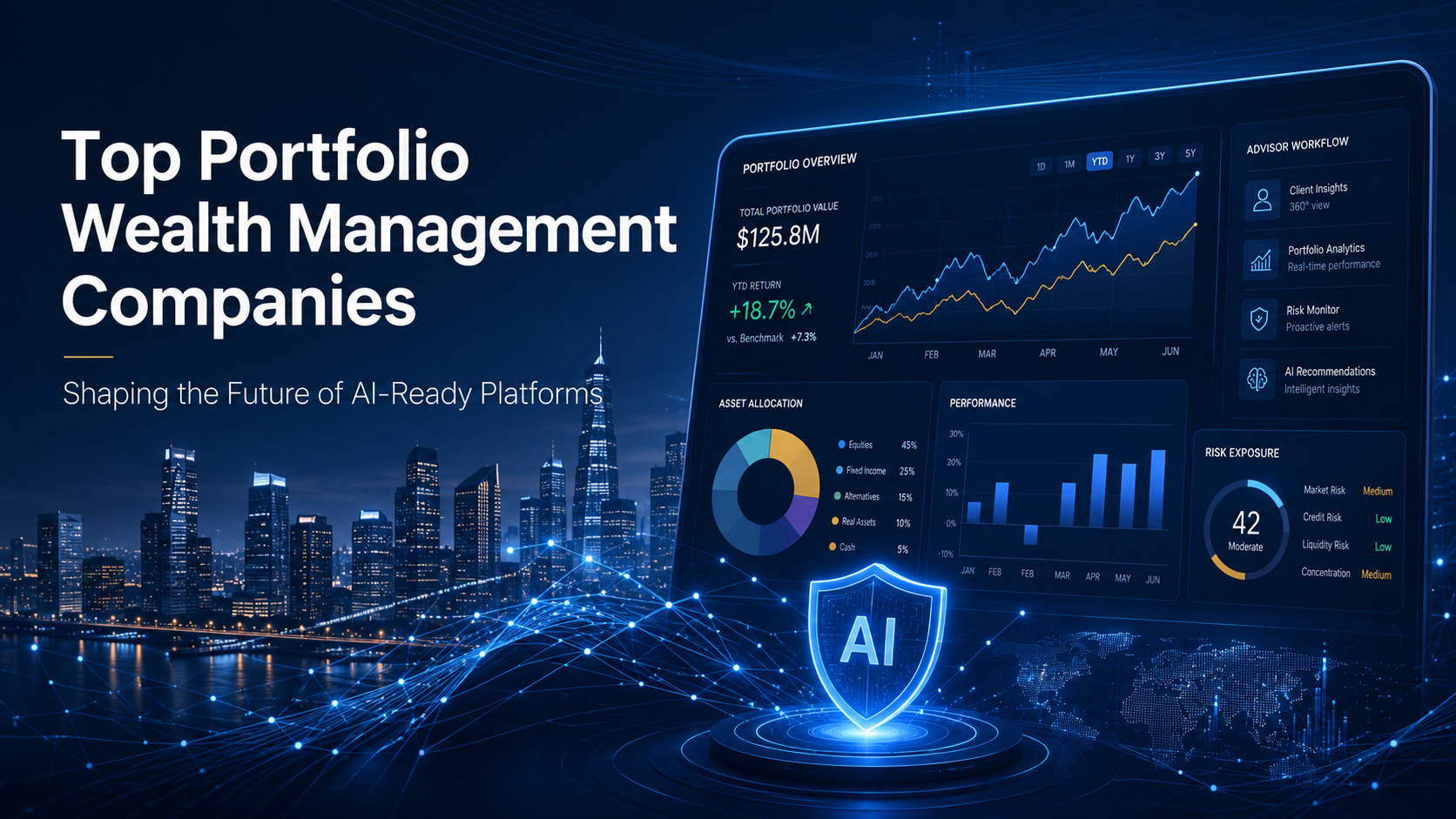
AI Portfolio Management Is Becoming the Next Big WealthTech Battleground
 Yash8 min read·Just now
--
Wealth management is entering a new phase.
For years, digital investing platforms focused on automation. Robo-advisors helped investors open accounts faster, answer risk questionnaires, receive model portfolios, and rebalance automatically.
That was useful, but it was still limited.
The next generation of portfolio management platforms is not just about automation. It is about intelligence.
Wealth firms now want platforms that can understand investor behavior, process real-time market data, forecast risk, personalize portfolio insights, support advisors, and meet compliance expectations at scale.
That shift is creating a new category of AI-powered portfolio management platforms.
And it is also changing how wealth firms think about technology partners, infrastructure, data ownership, and production readiness.
A recent article by GeekyAnts on building production-ready AI portfolio management platforms for wealth firms explores this transition in detail, especially from the perspective of architecture, real-time data pipelines, compliance, legacy integrations, and the build-versus-buy decision.
But GeekyAnts is not the only company connected to this broader WealthTech shift. Several companies are shaping different parts of the AI portfolio management ecosystem, from enterprise risk infrastructure to advisor platforms and automated investing.
The bigger story is not about one company.
It is about how the entire wealth management industry is moving from static portfolio tools to intelligent, production-ready financial platforms.
Why AI Portfolio Management Is Becoming More Important
Traditional portfolio management software was built around records, reports, and rules.
It helped firms track holdings, generate performance reports, rebalance accounts, and manage advisor workflows. These systems were important, but many were not designed for real-time personalization or AI-native decision support.
Today, wealth firms are dealing with a different set of expectations.
Clients want more transparency. Advisors want better insights. Firms want scalable operations. Regulators expect governance. Product leaders want modern platforms that can connect with data, compliance, risk, and client-facing experiences.
AI can support this shift, but only when it is implemented carefully.
A production-ready AI portfolio management platform needs more than a model. It needs clean data, secure integrations, explainable outputs, governance workflows, monitoring, and a clear role for human oversight.
This is where many firms struggle.
It is relatively easy to create a prototype that generates portfolio summaries or risk insights. It is much harder to build a platform that can handle real investor money, complex asset classes, compliance checks, advisor workflows, and thousands of portfolios in production.
From Robo-Advisors to AI-Native Wealth Platforms
Robo-advisors made investing more accessible by automating basic portfolio decisions.
But most early robo-advisory systems were rule-based. They used static questionnaires, fixed allocation models, and scheduled rebalancing logic.
AI-native platforms are different.
They can continuously analyze market movement, investor profiles, portfolio drift, tax opportunities, risk exposure, client goals, and advisor feedback. Instead of reacting only after thresholds are crossed, these systems can help identify patterns earlier and support more personalized recommendations.
The key difference is intent.
A robo-advisor automates a process.
An AI portfolio management platform supports better decision-making.
That does not mean AI should replace advisors. In wealth management, trust still matters. Human judgment still matters. Accountability still matters.
The strongest platforms will likely use AI to support advisors, not remove them.
What Production-Ready AI Really Means in Wealth Management
The phrase “production-ready” gets used often in tech, but in wealth management it carries real weight.
A production-ready AI portfolio platform must be reliable enough to operate in regulated environments. It must handle sensitive financial data securely. It must explain recommendations clearly. It must integrate with existing systems. It must support auditability. It must scale without breaking the advisor or client experience.
In simple terms, production readiness means the platform can move beyond a demo.
It can survive real data, real users, real compliance reviews, and real operational pressure.
For wealth firms, this usually means building around a few core layers.
The first layer is data infrastructure. Without reliable portfolio, market, client, transaction, and risk data, AI outputs become unreliable.
The second layer is intelligence. This includes predictive analytics, risk forecasting, portfolio recommendations, and personalized insights.
The third layer is compliance and governance. AI decisions need oversight, audit trails, explainability, and access controls.
The fourth layer is integration. Most wealth firms already use CRMs, custodians, reporting systems, planning tools, trading systems, and legacy platforms. AI needs to fit into that ecosystem.
The fifth layer is user experience. Advisors and clients need insights that are understandable, useful, and easy to act on.
Without these layers, AI remains a feature.
With them, it becomes a platform.
Companies Shaping the AI Portfolio Management Space
The AI portfolio management ecosystem is not owned by one type of company. It includes financial technology giants, data platforms, advisor software providers, automated investment platforms, and product engineering firms.
Each company approaches the problem from a different angle.
BlackRock Aladdin Wealth
BlackRock’s Aladdin Wealth is one of the most recognized names in investment technology.
Its strength is in risk analytics, portfolio oversight, investment management workflows, and enterprise-grade infrastructure. For large financial institutions, platforms like Aladdin show how portfolio management is becoming more connected, data-driven, and scalable.
The important lesson from BlackRock’s role in this space is that wealth management technology is moving toward deeper integration between risk, portfolio construction, advisor workflows, and client personalization.
AI in this context is not just about generating text or summaries. It is about helping advisors and institutions understand portfolios more holistically.
Addepar
Addepar has become an important platform for wealth managers that need better visibility across complex client portfolios.
Its focus on data aggregation, analytics, and reporting makes it relevant in an AI-driven wealth management world because AI depends heavily on clean and connected data.
For high-net-worth and ultra-high-net-worth clients, portfolios are often spread across asset classes, custodians, currencies, private investments, and legal entities. That complexity makes unified data infrastructure essential.
Addepar’s role in the market highlights one of the biggest truths about AI in wealth management: before firms can build intelligent recommendations, they need trusted data.
Envestnet Tamarac
Envestnet Tamarac is closely associated with advisor workflows, portfolio reporting, trading, billing, CRM, and client management.
This matters because AI portfolio management is not only a data problem. It is also a workflow problem.
Advisors need tools that fit naturally into how they already serve clients. If AI insights sit outside the daily workflow, adoption becomes difficult.
Platforms like Envestnet Tamarac show how wealthtech is moving toward more connected advisor operations, where trading, reporting, client communication, and portfolio management can work together more efficiently.
In the AI era, that connected workflow becomes even more important.
Orion
Orion is another major WealthTech platform focused on financial advisors, portfolio accounting, planning, CRM, trading, compliance, and AI.
Its Denali AI direction reflects a broader trend in the industry: advisors do not simply need more disconnected tools. They need intelligence that connects data, workflows, and insights across the firm.
This is one of the most important themes in modern wealth management technology.
AI becomes more useful when it is embedded into the full advisor ecosystem rather than added as a separate chatbot or standalone dashboard.
For firms trying to scale, this kind of connected intelligence can help reduce operational friction and improve decision-making.
Betterment
Betterment is widely known for digital investing and automated portfolio management.
Its move toward advisor-focused tools, tax-aware investing, direct indexing, and personalized portfolio capabilities shows how automated investing platforms are evolving beyond simple robo-advisory models.
This is especially relevant because personalization is becoming one of the strongest themes in wealth management.
Investors increasingly expect portfolios that reflect their goals, tax situations, preferences, and life stages. Automated investing platforms that can combine efficiency with personalization may become more important over time.
Betterment’s direction shows that the future of digital wealth is not just low-cost automation. It is more customized, tax-aware, and advisor-friendly portfolio management.
GeekyAnts
GeekyAnts fits into this landscape from a product engineering and platform-building perspective.
While companies like BlackRock, Addepar, Envestnet, Orion, and Betterment operate established platforms, GeekyAnts’ article focuses more on how wealth firms can think through building or modernizing their own AI portfolio management systems.
That perspective is useful because many wealth firms are not simply choosing one vendor and calling the problem solved.
They may need to modernize legacy systems, connect fragmented data sources, build custom advisor experiences, integrate compliance workflows, or develop AI layers around existing infrastructure.
This is where product engineering partners become relevant.
The key takeaway is not that every firm should build everything from scratch. It is that wealth firms need a clear strategy around what to build, what to buy, and what to modernize.
The Build, Buy, or Modernize Decision
One of the biggest strategic questions for wealth firms is whether to build, buy, or modernize their AI portfolio management platform.
Buying can help firms move faster. Established platforms already provide mature capabilities, integrations, and proven workflows.
Building gives firms more control over data, user experience, AI models, and long-term differentiation.
Modernizing can be the most practical path for firms that already have valuable systems but need to make them more AI-ready.
There is no single answer for every firm.
A large bank may need a custom architecture that connects to internal risk, compliance, and client data systems. A growing RIA may prefer established WealthTech platforms that reduce operational complexity. A fintech startup may build its own intelligence layer to differentiate on user experience.
The best decision depends on data maturity, compliance needs, speed-to-market pressure, technical capability, and competitive strategy.
The Real Challenge Is Not AI. It Is Integration.
Many wealth firms do not fail because AI is impossible.
They fail because AI has to work inside messy real-world systems.
Client data may live in one place. Portfolio data may live in another. Compliance workflows may be manual. Reporting may depend on legacy software. Advisor notes may be unstructured. Market data may arrive from multiple sources.
AI cannot deliver reliable insights if the underlying architecture is fragmented.
This is why the infrastructure conversation matters so much.
Before firms chase advanced AI features, they need to ask practical questions.
Is the data clean?
Can the platform access real-time portfolio information?
Are compliance rules built into the workflow?
Can advisors understand why a recommendation was made?
Can the system be audited?
Can the AI layer integrate with existing tools?
Can the platform scale across thousands of accounts?
These questions are less exciting than AI demos, but they determine whether the platform can survive production.
Why Human Oversight Still Matters
AI portfolio management should not be treated as a fully autonomous replacement for financial advisors.
Investment decisions involve context, trust, risk appetite, personal goals, tax situations, market uncertainty, and regulatory responsibility.
AI can help advisors identify patterns, summarize portfolios, detect risk, generate insights, and improve client communication. But human review remains important, especially when decisions affect real money.
The strongest AI systems in wealth management will likely be advisor-centric.
They will make advisors faster, better informed, and more scalable.
They will not remove accountability from the process.
Final Thoughts
AI portfolio management is becoming one of the most important areas in WealthTech.
The companies shaping this space are approaching the problem from different directions.
BlackRock Aladdin Wealth represents enterprise investment technology and risk infrastructure.
Addepar highlights the importance of unified portfolio data.
Envestnet Tamarac shows the value of connected advisor workflows.
Orion reflects the rise of AI-powered advisor ecosystems.
Betterment shows how automated investing is becoming more personalized and tax-aware.
GeekyAnts adds a useful product engineering perspective on what it takes to build or modernize production-ready AI portfolio management platforms.
Together, these companies point toward the same future.
Wealth management platforms are moving from static reporting and rule-based automation to intelligent, connected, and personalized systems.
But the winners will not be the firms that simply add AI features.
They will be the firms that build trusted platforms around data, compliance, explainability, integration, advisor workflows, and production-grade architecture.
In wealth management, AI will only matter if people can trust the system behind it.