AI-Driven Payments Orchestration: The Invisible Engine Powering Modern Finance
How artificial intelligence is quietly reshaping global money movement, reducing friction, and redefining payment intelligence at scale
 Christine Soliman6 min read·Just now
--
In today’s digital economy, money does not move in a straight line. It travels through a complex web of banks, gateways, processors, fraud engines, card networks, alternative payment methods, and compliance layers. Every transaction is a decision tree happening in milliseconds.
Yet, most users never see this complexity.
They simply click “Pay Now” and expect instant success.
Behind that simplicity lies one of the most transformative shifts in fintech today: AI-driven payments orchestration.
This is not just an upgrade to payment systems. It is a complete rethinking of how transactions are routed, optimized, and secured in real time using intelligence rather than static rules.
And quietly, it is becoming the backbone of modern financial infrastructure.
The Hidden Complexity Behind Every Payment
Every time a customer completes a transaction, a silent battle takes place behind the scenes.
A single payment might need to decide:
- Which payment gateway offers the highest success rate in that region
- Whether a card should be routed through Visa, Mastercard, or a local rail
- If fraud risk is high based on behavioral signals
- Whether currency conversion should happen at checkout or settlement
- Which acquiring bank is least likely to decline the transaction
- How to reduce processing cost without affecting approval rates
Traditional systems rely on fixed routing rules. These rules are static, manually configured, and slow to adapt. They often fail when conditions change, such as:
- A sudden drop in bank uptime
- Regional outages in payment processors
- Changes in fraud patterns
- Shifts in cross-border approval rates
The result is predictable:
- Higher transaction failures
- Lost revenue
- Poor customer experience
- Increased operational overhead
This is where AI begins to change everything.
What Is AI-Driven Payments Orchestration?
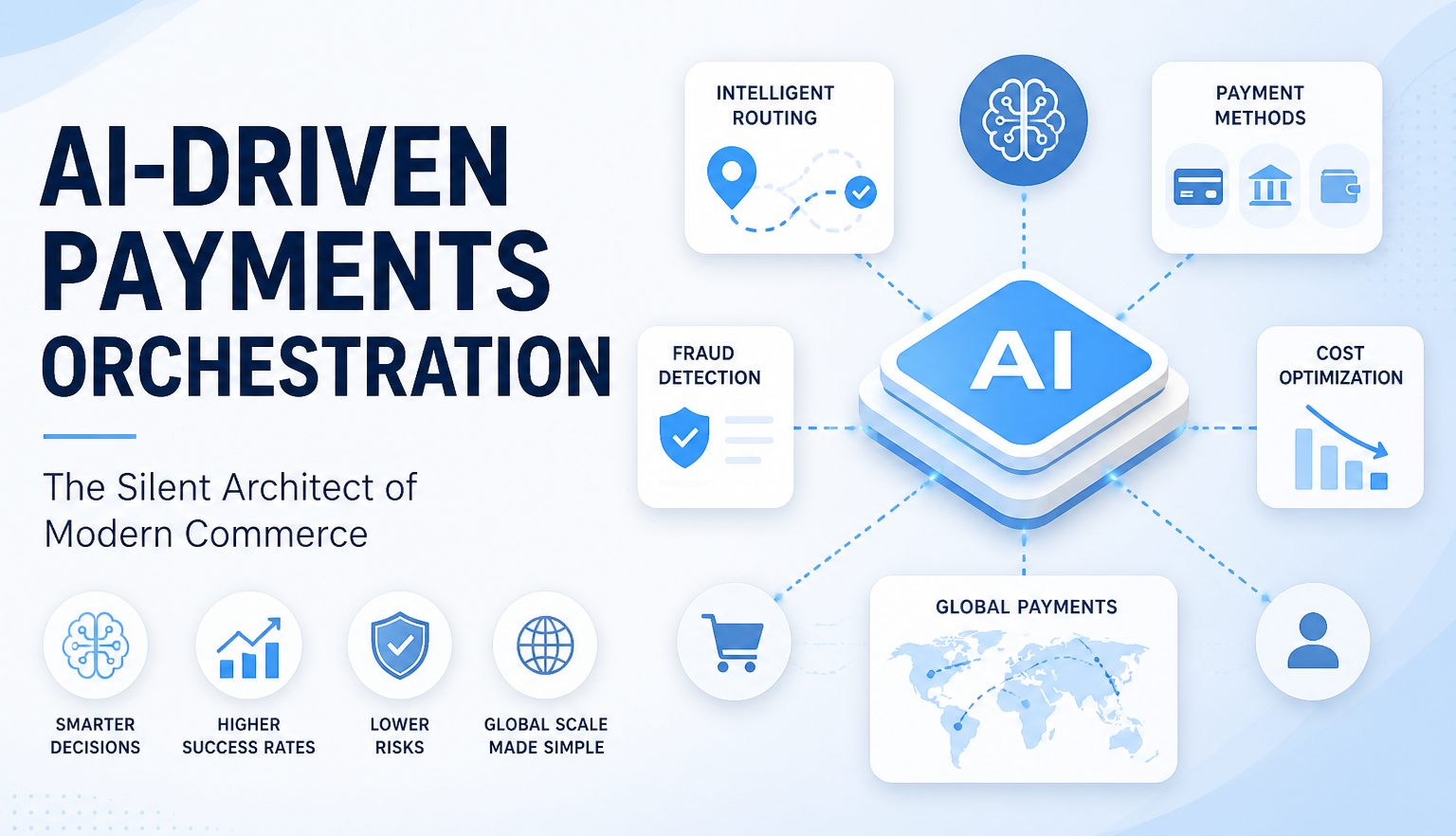
At its core, AI-driven payments orchestration is the use of machine learning models to dynamically route, optimize, and manage payment transactions across multiple providers in real time.
Instead of relying on static rules, the system learns from millions of transactions and continuously improves decision-making.
It acts like a financial traffic controller powered by intelligence.
In simple terms, it answers one question for every transaction:
“What is the best possible path for this payment to succeed at the lowest cost and highest speed?”
Unlike traditional orchestration layers, AI-based systems adapt continuously based on:
- Transaction success and failure rates
- Geographic performance of payment providers
- Fraud probability scoring
- Time-of-day patterns
- Merchant category behavior
- Currency and cross-border trends
This turns payment infrastructure from a rigid system into a self-optimizing network.
How AI Payments Orchestration Actually Works
To understand its power, it helps to break down the process into layers.
1. Data Ingestion Layer
The system collects real-time and historical data from:
- Payment gateways
- Banks and acquirers
- Fraud detection systems
- Customer behavior analytics
- Device and location signals
This creates a unified intelligence layer.
2. Decision Engine (AI Core)
This is where machine learning models analyze patterns such as:
- Which routes have the highest approval rates
- Which processors are fastest for specific regions
- Which transactions are high-risk
- Which payment methods convert better for certain user segments
The system continuously learns from:
- Approved vs declined transactions
- Chargeback data
- Latency patterns
- Cost variations
3. Smart Routing Layer
Based on predictions, the system dynamically routes transactions.
For example:
- A US card payment might go through Processor A for speed
- A European transaction might be routed to Processor B for higher approval rates
- A high-risk transaction might be routed through additional fraud screening
This happens in milliseconds.
4. Feedback Loop
Every transaction outcome feeds back into the AI model.
This creates a continuous improvement cycle:
- Success improves routing weights
- Failures trigger recalibration
- Emerging fraud patterns update risk scoring
Over time, the system becomes more accurate than any human-configured rule engine.
Why AI Is Transforming Payment Orchestration
The shift from rule-based systems to AI-driven orchestration is not incremental. It is structural.
Here is what is changing:
• Higher Authorization Rates
AI identifies optimal routes that maximize approval probability.
• Lower Transaction Costs
Smart routing reduces dependency on expensive processors.
• Reduced Payment Failures
Fallback logic is automated and predictive, not reactive.
• Improved Fraud Detection
Behavioral patterns are analyzed in real time.
• Better Customer Experience
Faster checkouts with fewer declines.
Key Advantages of AI Payments Orchestration
- Real-time decision-making across multiple providers
- Automatic failover during outages
- Dynamic cost optimization
- Predictive fraud prevention
- Region-specific routing intelligence
- Continuous learning from transaction data
- Reduced dependency on manual rule configuration
Real-World Use Cases
AI-driven payments orchestration is already reshaping multiple industries.
1. E-commerce Platforms
Large online retailers use AI routing to:
- Increase checkout success rates
- Reduce cart abandonment
- Optimize international payments
Even a 1% improvement in authorization can translate into millions in revenue.
2. Subscription Businesses
For SaaS and streaming platforms:
- AI reduces involuntary churn caused by failed payments
- Smart retry logic improves renewal rates
- Payment methods are optimized per user behavior
3. Fintech and Neobanks
Digital banks leverage orchestration to:
- Route transactions across global acquiring networks
- Reduce FX costs
- Improve debit and credit card success rates
4. Travel and Hospitality
Airlines and hotel platforms benefit from:
- Cross-border payment optimization
- Multi-currency routing intelligence
- Reduced booking failures during peak demand
The Strategic Shift: From Payments to Intelligence Layer
The most important transformation is conceptual.
Payments are no longer just infrastructure.
They are becoming an intelligence layer for commerce.
In the traditional model:
- Payments = Transaction processing
In the AI-driven model:
- Payments = Data-driven optimization engine
This shift means companies are no longer just processing payments. They are learning from every transaction to improve future outcomes.
Over time, this creates a compounding advantage:
- Better data → Better routing
- Better routing → Higher success
- Higher success → More data
This feedback loop becomes a competitive moat.
Challenges in AI-Driven Orchestration
Despite its benefits, implementing AI in payments is not simple.
Some key challenges include:
- Data fragmentation across providers
- Regulatory compliance across regions
- Latency constraints in real-time decisioning
- Model explainability for financial audits
- Integration complexity with legacy systems
Additionally, financial decisions must be both fast and trustworthy, which makes model governance critical.
The Future of Payments Orchestration
The next evolution of this space will likely include:
1. Fully Autonomous Payment Networks
Systems that self-configure without human intervention.
2. Predictive Payment Routing
Not just reacting to failures, but predicting them before they happen.
3. Embedded AI Compliance
Real-time regulatory checks integrated into transaction flow.
4. Cross-Platform Intelligence Sharing
Networks of payment systems sharing anonymized performance insights.
5. Conversational Payment Systems
AI agents that manage payment optimization through natural language commands.
Eventually, payment systems may behave less like infrastructure and more like adaptive financial organisms.
Conclusion: The Quiet Revolution in Motion
AI-driven payments orchestration is not a visible revolution.
Users do not see it.
They do not interact with it directly.
But they feel its impact every time a payment succeeds instantly instead of failing, every time checkout feels seamless, and every time cross-border transactions just work.
Behind the scenes, intelligence is replacing rigidity.
Static rules are giving way to adaptive learning.
And payment infrastructure is evolving into something far more powerful:
A self-optimizing financial decision system that improves with every transaction it processes.
In the coming years, the companies that win will not be those with the most payment integrations.
They will be the ones with the smartest orchestration intelligence.
Because in the future of payments, success will not be about processing transactions.
It will be about orchestrating intelligence at scale.