The fix isn’t a better prompt. It’s microservices for AI — sub-agents, nano models, and the discipline of giving the main model less to do.

A product manager files a one-line ticket: “Add a fallback message when customers ask about international shipping.” On a normal app, that’s twenty minutes. On a production AI customer-support agent, six hours later you’re untangling why refund tickets are suddenly being routed to the wrong department, why the assistant’s tone has gone formal, and why it’s hallucinating tracking numbers it didn’t have yesterday.
You didn’t change the data. You didn’t touch the model. You added one line to a system prompt.
Welcome to Prompt Fragility — the phenomenon where a small, semantically-trivial change to a prompt causes large, unpredictable failures across an LLM-driven system. It’s not a bug in the model. It’s a structural property of how most teams are building these systems, and it’s the hidden tax behind why so many AI products clear demo quality but stall before production.
This is fixable. The fix has nothing to do with writing a better prompt.
Why does one new instruction break the whole prompt?
Because the model isn’t just answering the new question. It’s also routing the user’s intent across multiple flows, reasoning over your business data, calling the right tools in the right order, validating its own output against a schema, deciding what to do on the next turn, and remembering the last twelve messages. When you add one instruction, you change the surface area of all of those simultaneously.
A March 2026 study from Palo Alto Networks Unit 42 fuzzed open and closed LLMs by rewriting the same intent in semantically-equivalent ways. The finding wasn’t subtle: meaning-preserving rewrites caused content filters to misclassify 97–99% of fuzzed prompts as benign, and one open-weight model evaded its own safety policy on 75 of 100 attempts. Same intent. Different words. Different model behavior.
If a tiny change in user input destabilizes the model, what do you think a tiny change in your system prompt does?
Recent evaluations show LLM accuracy can drop by up to 54% under prompt perturbation, and the direction of those drops is unpredictable — bigger models don’t always help, and the failures don’t correlate with parameter count. This is what production teams are now calling prompt regression, and the response has been an entire emerging tooling category: prompt versioning, golden test sets, CI/CD for prompts. Tools like Promptfoo, used internally at OpenAI and Anthropic, exist because production prompts now have to be tested like production code.
But testing catches regressions. It doesn’t prevent them. Prevention requires a different architecture.
What’s actually breaking inside the agent?

The breakage isn’t really about the prompt. It’s about asking one model to do five jobs at once.
A single LLM in a typical production agent is simultaneously routing the user’s intent, reasoning over the underlying data, calling the right tools in the right order, validating that its output matches a schema, deciding what to do on the next turn, and managing conversation history. Five or six distinct cognitive tasks. One context window.
Multi-agent research has documented exactly what goes wrong when you do this. Specialized-agent pipelines outperform single-agent baselines by significant margins — one essay-grading study showed 26.6 and 10.8 percentage point improvements when the work was split across content, structure, and language specialists. The paper named the failure modes that single agents suffer: attention dilution, task interference, and error propagation.
Translation: when a model is forced to think about six things at once, it thinks worse about all six. Adding a seventh concern — your new fallback instruction, your new tool, your new edge-case rule — doesn’t add a seventh of the complexity. It nonlinearly increases the chance that one of the other six jobs the model was already doing now misfires. That’s why a single-line change cascades into a full regression.
There’s also the token math, and the data is grim. Anthropic’s own engineering research notes that reasoning quality degrades nonlinearly when contexts exceed 100,000 tokens — the more you stuff in, the worse the model thinks about any of it. One published production case compressed its context from 140,000 tokens down to 6,000 through disciplined filtering, and saw latency drop from tens of seconds to single digits while accuracy climbed from 70% to over 90%. Anthropic’s guidance in Effective Context Engineering for AI Agents is blunt: “be thoughtful and keep your context informative, yet tight.” They cap tool responses at 25,000 tokens by default in Claude Code for exactly this reason. Context, in their framing, is now an attention budget — a finite resource you spend deliberately, not a junk drawer.
Most production systems are doing the opposite — dumping everything into the prompt and hoping the model figures it out. That’s the monolith pattern, and it’s what’s breaking.
What if we treated AI like microservices?
The fundamental answer is what teams now call Cognitive Decomposition — the deliberate fragmentation of a monolithic task into specialized sub-agents and smaller models. Anything in your system that can be done by a smaller model, a more specialized agent, or a deterministic function should be.
NVIDIA Research published a position paper titled Small Language Models Are the Future of Agentic AI that has aged into one of the most influential architectural arguments of the past 18 months. Their thesis has three pillars. First, SLMs are already powerful enough for most tasks an agent actually does — routing, classification, schema validation, formatting, intent extraction. These are not frontier-reasoning problems. Second, agentic systems are built on small, repetitive, specialized tasks with little variation; generalist frontier models are over-engineered for that. Third, SLMs run 10–50x cheaper per call, with lower latency and predictable behavior in constrained domains.
The infrastructure to act on this exists right now. NVIDIA’s Nemotron 3 Nano shipped in 2026 with a 1M-token context window for agentic workloads. Microsoft’s Phi-4 series brings advanced reasoning and multimodality at SLM scale. Anthropic’s Haiku 4.5 costs $1 per million input tokens.
Pair this with the cost data emerging from production teams: a multi-model routing strategy — roughly 70% of calls to cheap models, 10% to frontier — combined with prefix caching and state caching reduces total LLM spend by 60–80% while improving reliability. The economics are now lopsided enough that the monolith pattern is irrational on cost grounds alone.
The signal from the model labs themselves is unambiguous. In April 2026, Anthropic — the company that pioneered ultra-long context windows — announced the deprecation of 1M-token context betas effective April 30, capped their Message Batches API at 300,000 tokens, and explicitly framed infinite context as an anti-pattern. When the lab that ships the longest context in the industry tells you to stop using long context, the architectural debate is over.
The mental model: frontier models for frontier problems. Nano models for everything else.
How does decomposition actually work?
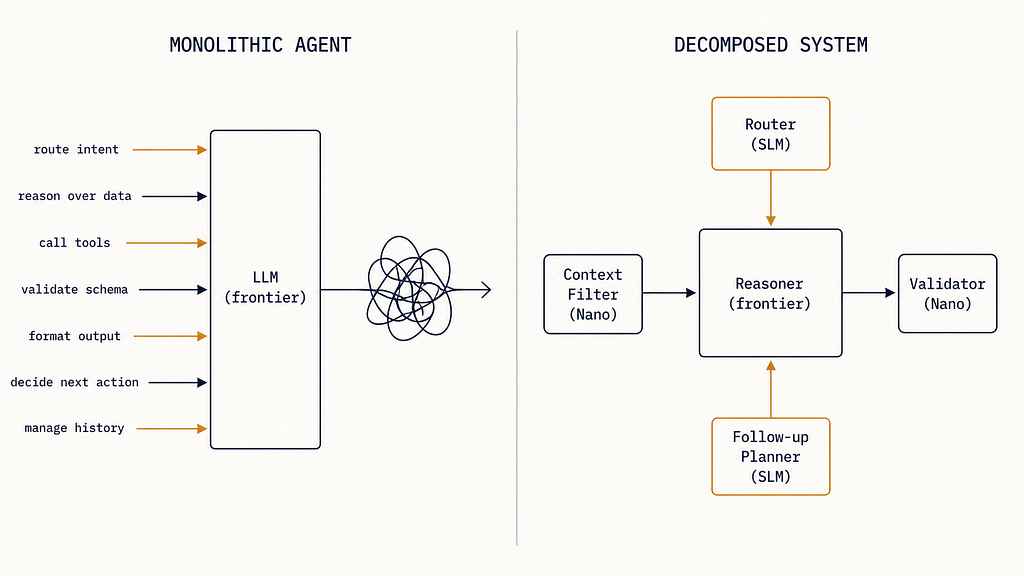
Three concrete decomposition wedges that any team can apply this quarter.
Move routing out of the main model. A nano-model classifier decides which sub-agent or which screen layout the user’s query targets. This is the single highest-leverage change in most systems. It removes the largest source of context bloat from the main reasoner — you no longer have to dump the full menu of options into every prompt.
There’s also a second-order architectural payoff most teams miss when they make this move: Network-Gapped UI. A dedicated routing service that only decides which screen layout to use never needs to see the user’s PII or financial data. The heavy reasoning model can stream populated UI directly to the client over AG-UI SSE, while the router sits safely outside the compliance boundary. Cognitive decomposition is one axis of the same idea — splitting work across compute boundaries. The other axis is Network Decomposition — splitting work across trust boundaries. For any team building AI products in regulated industries (fintech, healthcare, insurance, public sector), this is the architectural difference between a feature that ships and a procurement-blocker that doesn’t. And the regulatory direction in 2026 is sharpening this pressure: in March and April, the US CDC, the UK’s Competition and Markets Authority, Singapore’s IMDA, and the EU AI Act Service Desk all issued guidance that explicitly calls for the kind of trust-boundary separation, auditability, and human-in-the-loop oversight that a Network-Gapped architecture provides natively.
Move validation out of the main model. Schema validation, format checking, JSON structural integrity — none of these require reasoning. A nano-model, or even a deterministic function, handles them post-hoc. This eliminates an entire class of “the model returned malformed JSON” failures without any prompt change.
Move follow-up decisions out of the main model. When a user clicks something in a generative UI, what query should fire next? That’s a contained decision: read the element metadata, read the current screen state, read the conversation history, build a precise follow-up query. A small specialized agent handles this in tens of milliseconds. The main reasoner never has to make that decision and never has to carry the context required to make it.
These three moves all point at one underlying pattern teams call Context Quarantine: each sub-agent operates in its own isolated context, free from contamination by adjacent work. Picture an enterprise workflow that compiles board-member data across S&P 500 companies. A monolithic agent will conflate the employment history of an Apple executive with a Microsoft executive — the contexts smear together inside one window. A quarantine architecture spawns isolated sub-agents per company, each operating on a clean window. Modifications to one sub-agent’s logic have zero lateral impact on the others.
Each of these moves shrinks the main model’s responsibilities, shrinks its context window, and — most importantly — shrinks the surface area where Prompt Fragility can strike.
What does this look like in production?
The pattern looks similar across very different products.
A customer-support agent that used to route every ticket through one main model now uses a nano-classifier first: refunds, billing, shipping, technical, escalation. Each category routes to a specialized sub-agent with its own focused prompt. The main reasoner only ever handles the edge cases the classifier couldn’t pin down. Adding a new fallback instruction touches one sub-prompt, not fifteen.
A coding assistant that has to decide between Python, TypeScript, Go, and SQL no longer ships a 4,000-token system prompt with every language’s idioms baked in. A small intent-classifier picks the language and tool, then routes the actual code generation to a specialized prompt for that language. New language support becomes a sub-agent, not a global prompt revision.
A RAG system decouples retrieval ranking, citation validation, and answer generation into three separate calls — two of them on nano models. The frontier model only sees the final, ranked, validated context. Hallucinations drop, citations stay aligned, and the team can tune retrieval without touching the answer prompt.
A generative UI system is the case I’ve lived inside personally. In our own work building generative UI in production, three sources of context kept swelling the main agent’s prompt at once — the full element catalog, every example screen layout, and the full instruction set — so we built a filtering layer that prunes all three per-query before the main reasoner ever sees the prompt: only the relevant elements, only the relevant examples, only the instruction sections the routing decision activates. The more differentiated move came when we kept hitting the same regression on element clicks. We pulled that responsibility out entirely: when a user clicks an element, a dedicated small-model agent reads the element data, screen state, and conversation history, and produces a precise follow-up query. The main reasoner never sees the click — it just gets a clean question. Both moves directly shrank the surface area where Prompt Fragility could land in our system.
Every line of context you don’t put in the main agent’s prompt is a line that can’t break it. That’s the rule.
The compounding effect is significant across all of these products. Teams that decompose typically see their main system prompt drop by 50–80% in token count, their per-query cost drop by 60–80%, and — the part that actually matters — their prompt regression incidents drop sharply, because there are simply far fewer surfaces where a one-line change can cascade.
The shift
The next eighteen months of production AI will not be won by teams writing better prompts. The frontier-model arms race has obscured a more important shift: the discipline that’s rising in 2026 is architectural — context engineering, agent decomposition, multi-model routing, specialized SLMs handling the bulk of the work and frontier models reserved for what only they can do.
The infrastructure is here. The economics are lopsided. The research consensus is converging.
Stop trying to make one model do everything. Start treating your AI like microservices — across cognitive load, and across trust boundaries.
Frequently Asked Questions
What is Prompt Fragility?
Prompt Fragility is the phenomenon where small, semantically-trivial changes to a prompt cause large, unpredictable failures across an LLM-driven system. It happens because a single model is being asked to handle multiple cognitive tasks at once — routing, reasoning, formatting, validation, and decision-making — and the surface area of failures grows nonlinearly with each added responsibility.
Why do small prompt changes break LLM agents?
Because in monolithic agent designs, every responsibility — routing, reasoning, schema validation, action selection — shares the same prompt context. Adding even one instruction shifts how the model balances all the others. Recent research shows accuracy can drop up to 54% under semantically-equivalent prompt perturbations, and the direction of failure is unpredictable.
What are SLMs and nano models, and when should you use them?
Small Language Models (SLMs) and nano models — like NVIDIA’s Nemotron 3 Nano, Microsoft’s Phi-4, or Anthropic’s Haiku 4.5 — are smaller, cheaper, faster models designed for specialized, repetitive tasks. NVIDIA’s position paper argues they’re sufficient, suitable, and economical for the bulk of agentic work. Use them for routing, validation, formatting, and any decision that doesn’t require frontier reasoning.
How do you decompose a single AI agent into sub-agents?
Identify every cognitive responsibility your main model is currently carrying. Then move out anything that can be done by a smaller model, a specialized agent, or a deterministic function — typically routing, validation, formatting, and follow-up-query generation. Reserve the frontier model for the actual reasoning. This pattern reduces prompt context dramatically, lowers cost 60–80%, and eliminates most prompt-fragility cascades.
Why does decomposing your AI agent also improve data privacy?
Because cognitive decomposition naturally separates the work into stages with different data needs. A routing or screen-selection agent only needs to know what the user is asking — not the underlying customer data. By running that lightweight agent on a different network layer than the heavy reasoning model, you keep PII and regulated data out of services that don’t need to see it. The architectural pattern is sometimes called Network Decomposition or Network-Gapped UI, and for regulated industries it’s the difference between a generative UI system that ships in healthcare and one that doesn’t.
If this resonates — what’s the worst Prompt Fragility war story you’ve shipped through? Drop it in the comments. I’m collecting examples for a follow-up piece on production prompt regression patterns.
Added One Line to Your Prompt and Everything Broke? You’re Hitting Prompt Fragility. was originally published in Level Up Coding on Medium, where people are continuing the conversation by highlighting and responding to this story.