Every serious frontend team eventually has the same meeting.
Someone opens the app. Someone clicks a table. Someone says:
Can we just make this behave like Excel?
That innocent sentence is how your simple table becomes sorting, filtering, editing, resizing, pinning, grouping, validation, CSV export, formulas, charts, server data, theming, accessibility, and a migration plan nobody wants to own.
For years, AG Grid has been the default answer for this problem. It is mature, powerful, and widely adopted. That is not really up for debate.
But the better question in 2026 is not: Is AG Grid good?
The better question is: Is AG Grid still the fastest path for every modern React product?
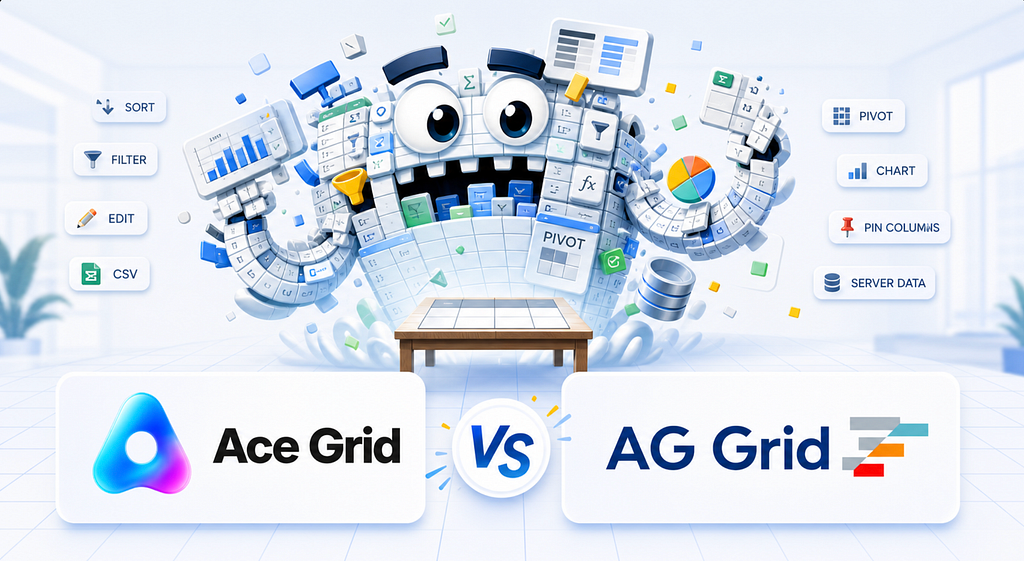
That is where Ace Grid comes in.
Ace Grid is a modern React data grid built around a simple idea: start free, migrate faster, and add Pro or Enterprise features only when your product actually needs them.
The problem with data grids
Most teams do not choose a grid once. They choose it again and again:
- when product asks for editing
- when customers ask for Excel-style workflows
- when design asks for better theming
- when backend says, please stop loading everything into the browser
- when enterprise buyers ask about licensing
- when the team realizes the old grid is everywhere
The hard part is not rendering rows. The hard part is surviving the second year of your grid decision.
AG Grid solves many of these problems. It has Community and Enterprise editions, rich docs, and a large ecosystem. According to AG Grid’s own pricing page, AG Grid Community is free, while AG Grid Enterprise is commercially licensed. AG Grid also documents deep enterprise features such as server-side row model, pivoting, charts, row grouping, and advanced filtering.
That is a strong product.
But it also means many teams are carrying a mature, complex grid platform when what they really need is:
- a clean React runtime
- a free core package
- migration helpers
- framework wrappers
- a clear path to paid spreadsheet and enterprise features
That is the opening for Ace Grid.
What is Ace Grid?
Ace Grid is a React-first data grid with a free Core runtime and paid Pro / Enterprise tiers.
The free package, @ace-grid/core, includes production grid basics:
- editing
- selection
- sorting
- filtering
- pagination
- search
- pinning
- column resizing
- virtualization
- CSV I/O
- theming
- schema-aware grid state helpers
npm install @ace-grid/core react react-dom
Basic usage:
import { Grid } from "@ace-grid/core";const rows = [
{ id: "1", data: { company: "HelioBank", segment: "Enterprise" } },
{ id: "2", data: { company: "Northstar AI", segment: "Strategic" } },
];
const columns = [
{ key: "company", title: "Company", editable: true },
{ key: "segment", title: "Segment", filterable: true },
];
export function CustomersGrid() {
return <Grid data={{ rows, columns }} layout={{ height: 520 }} />;
}
That is the pitch: start with the grid you need today, not the entire procurement story you may need next year.
The big difference: migration is a product feature
A lot of grid libraries say migration is easy. Usually that means: good luck, here is the API reference.
Ace Grid treats migration as a first-class workflow.
If you already use AG Grid, Ace Grid provides compatibility utilities through @ace-grid/compat-ag and @ace-grid/compat-core.
npm install @ace-grid/compat-ag @ace-grid/compat-core @ace-grid/core
Example:
import { translateAgGridToAce } from "@ace-grid/compat-ag";
import { Grid } from "@ace-grid/core";
const migration = translateAgGridToAce({
rowData,
columnDefs,
pagination: true,
});
export function MigratedGrid() {
return <Grid {...migration.props} />;
}That matters because most real migrations are not rewrites. They are phased conversions.
A practical migration path looks like this:
- Keep familiar rowData and columnDefs.
- Translate what can be translated.
- Report unsupported or manual work clearly.
- Move to native Ace Grid props when the page is stable.
- Add Pro or Enterprise features only where needed.
That is a calmer migration story than: replace every grid now and hope QA catches it.
React first, but not React only
Ace Grid is React-first, but teams rarely live in one framework forever.
Ace Grid supports wrapper packages for:
- Web Components: @ace-grid/wc
- Angular: @ace-grid/angular
- Vue: @ace-grid/vue
- Svelte: @ace-grid/svelte
This is important for companies with mixed frontends.
The React team can use the native React package. The Angular team can use the Angular wrapper. The Vue or Svelte team can still adopt the same grid system without inventing a second migration strategy.
That is not just a developer convenience. It is an architecture decision.
Where AG Grid is still strong
A serious comparison should not pretend AG Grid is weak.
AG Grid is a heavyweight for a reason. It documents deep Enterprise features such as server-side row model, pivoting, integrated charts, advanced filtering, Excel-style workflows, and row grouping.
AG Grid’s Server-Side Row Model documentation describes support for large datasets with server-side grouping, aggregation, pivoting, sorting, filtering, and lazy loading.
That is real enterprise power.
If your application already depends deeply on AG Grid Enterprise features, has stable licensing, and your team is productive, there may be no urgent reason to move.
But if you are starting a new React product, trying to reduce complexity, or planning a migration anyway, Ace Grid deserves a serious look.
Where Ace Grid feels different
Ace Grid is not trying to win by being AG Grid with a different logo.
The stronger angle is this:
Ace Grid is designed for teams that want a modern grid system with a faster migration path and a cleaner free-to-paid story.
The tiers are straightforward:
- Core: free production grid features
- Pro: spreadsheet workflows like formulas, validation, Excel I/O, grouping, tree data, and sparklines
- Enterprise: server row model, pivoting, charts, master-detail, and enterprise workflows
Pro example:
import { Grid } from "@ace-grid/pro";const license = {
appId: import.meta.env.VITE_ACE_GRID_APP_ID,
licenseKey: import.meta.env.VITE_ACE_GRID_LICENSE_KEY,
};
export function FinanceGrid() {
return (
<Grid
data={{ rows, columns }}
layout={{ height: 560 }}
formula={{ enabled: true }}
validation={{ enabled: true }}
license={license}
/>
);
}Enterprise example:
import { Grid } from "@ace-grid/enterprise";export function OperationsGrid() {
return (
<Grid
data={{ rows, columns }}
layout={{ height: 640 }}
charts={{ enabled: true }}
pivot={{ enabled: true }}
serverRowModel={{ enabled: true }}
license={license}
/>
);
}That gives teams a clean upgrade path: start with Core, adopt Pro when spreadsheet workflows become real, and adopt Enterprise when analytics and server-side data become real.
The real buyer question
The real question is not: which grid has the longest feature list?
The real question is:
Which grid helps my team ship faster without trapping us later?
For many teams, AG Grid is still the safe incumbent.
For teams building modern React products, migrating away from legacy grid code, or looking for a clearer free-to-paid path, Ace Grid is a compelling alternative.
Ace Grid’s strongest argument is not hype. It is this:
- Free Core for real product work
- AG Grid and MUI migration utilities
- React-first API
- Angular, Vue, Svelte, and Web Component wrappers
- Pro features for spreadsheet workflows
- Enterprise features for server data and analytics
- Docs and API reference in one portal
That is a practical story.
And practical stories win inside engineering teams.
Final take
AG Grid is established. It is powerful. It has earned its reputation.
Ace Grid is the newer bet: cleaner migration, modern React ergonomics, framework wrappers, and a tiered path that lets teams start smaller.
If you are choosing a grid today, do not just ask which one has more features.
Ask which one gives your team the shortest path from:
We need a better grid.
to:
It shipped.
That is the game Ace Grid is trying to win.
References
- Ace Grid docs
- Ace Grid API reference
- Ace Grid Core on npm
- Ace Grid public Core source
- AG Grid pricing and licensing
- AG Grid React key features
- AG Grid migration docs
- AG Grid Server-Side Row Model
- AG Grid pivoting
Ace Grid vs AG Grid: A Modern React Data Grid Alternative was originally published in Level Up Coding on Medium, where people are continuing the conversation by highlighting and responding to this story.