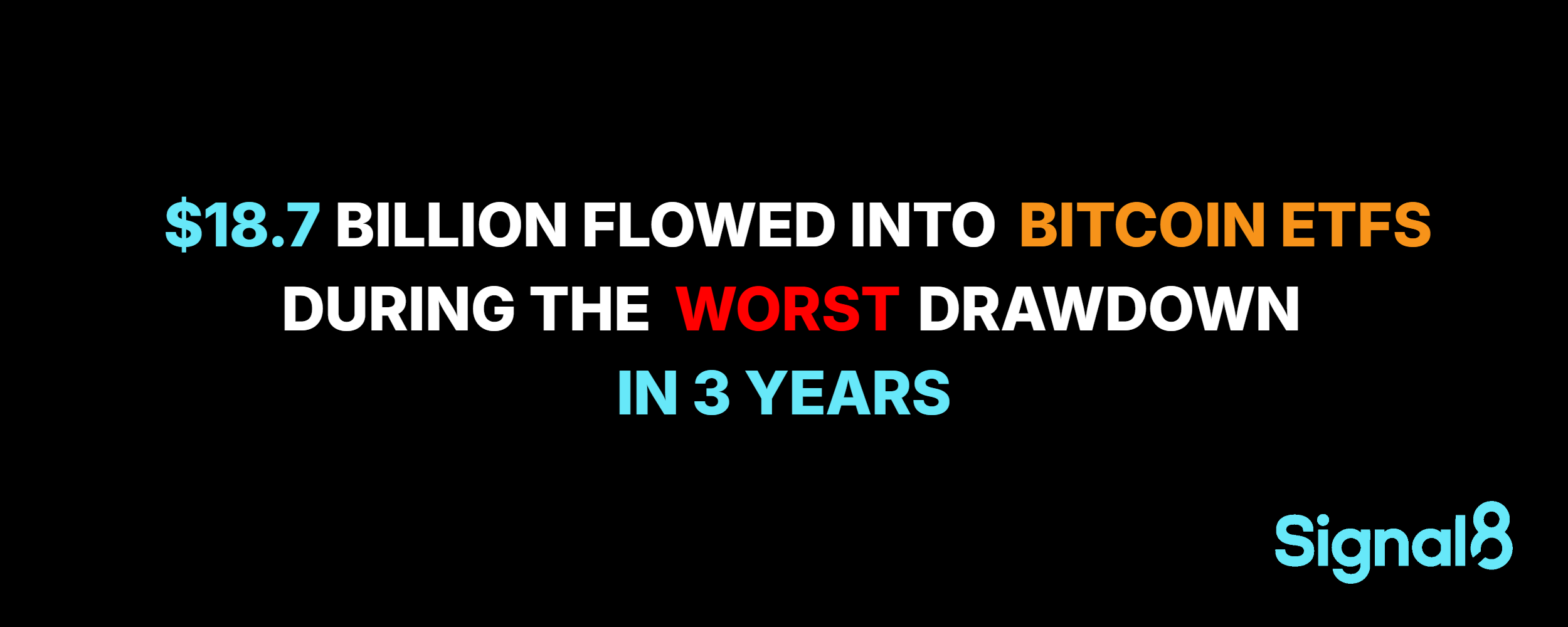
$18.7 billion flowed into bitcoin ETFs during the worst drawdown in 3 years
 Signal86 min read·1 hour ago
--
institutional accumulation in bitcoin ETFs shows floor-building pattern & the 13Fs have receipts.
The Setup
retail sent 100,000 $BTC to exchanges in a single week during february’s panic.
the fear & greed index hit 5 -the most extreme reading in the index’s history, lower than both FTX and Terra/Luna.
crypto twitter was writing obituaries.
bitcoin had dropped roughly 50% from its october 2025 high of $126,198. that’s not a correction, that’s a bear market print in the span of four months.
retail liquidated everything that wasn’t nailed down. while all that was happening,
@Mubadala- abu dhabi’s sovereign wealth fund — was quietly increasing its $IBIT position by 46% quarter-over-quarter to $631 million.
Susquehanna filed a 13F showing a multi-billion dollar IBIT stake. c itadel, millennium, and jane street all sat on nine-figure positions.
the Q4 2025 filings show the shape of it: while bitcoin was getting torched, the biggest names on wall street were either holding the line or adding.
in crypto terms: retail got rugged by their own emotions. sovereign wealth was catching the falling knife with both hands.
The Q1 2026 Flow Data
total spot bitcoin ETF inflows for Q1 2026: $18.7 billion. that’s not a typo. nearly $19 billion of capital entered bitcoin ETFs in a single quarter, with $IBIT capturing roughly $8.4 billion of it.
the path to get there was ugly. november through february were all net-outflow months for spot BTC ETFs as the drawdown accelerated. then march flipped. march 2026 alone printed ~$2.5 billion in net inflows — the recovery bid showing up right as retail selling exhausted itself.
blackrock’s $IBIT now holds roughly 799,000 BTC — about 3.8% of the total 21 million that will ever exist. one fund, one provider, less than three years old, sitting on 3.8% of the entire monetary asset.
the behavioral pattern here is textbook floor-building:
- bitcoin trades in the low-$60,000s in february
- short-term holders dump 100,000 BTC to exchanges in a single week (capitulation)
- fear & greed hits 5 — lowest reading ever recorded
- exchange reserves drop to 2.7 million BTC, a 7-year low (~13.5% of circulating supply)
- by late march, short-term holder exchange inflows collapse to 25,000 BTC/week — the lowest in the dataset
- ETF flows flip positive
- price stabilizes and starts grinding higher
this is the transfer mechanism that creates bottoms. weak hands sell to strong hands. retail sells at the lows, allocators buy at the lows. the floor gets built underneath the price while everyone’s too scared to notice.
if you’ve been around small-cap equities, you’ve seen this pattern before. it’s the same dynamic as insider cluster buying during a selloff — the people with the longest time horizons accumulate while sentiment is worst.
the difference is that with bitcoin ETFs, you can watch the flows in near-real-time instead of waiting for form 4s.
Goldman’s covered call filing — the quiet signal
on april 14, 2026, goldman sachs filed a registration statement with the SEC for the Goldman Sachs Bitcoin Premium Income ETF. form N-1A, post-effective amendment no. 717. you can read it on EDGAR.
the strategy: at least 80% of net assets in bitcoin-linked instruments (primarily spot bitcoin ETPs like $IBIT), then sell covered call options on those positions to generate income. the overwrite ratio ranges from 40% to 100% of the portfolio.
this is significant for reasons that have nothing to do with the fund’s eventual AUM.
goldman trimmed direct IBIT exposure in Q4 2025 and then filed to launch a derivative product on top of the spot ETFs in april 2026.
that’s not “goldman is bearish on bitcoin.” that’s “goldman is restructuring how it wants to hold bitcoin.” they’re moving from directional spot exposure to a packaged yield product they can sell to their wealth clients.
the same goldman whose wealth-management CIO said in 2021 that crypto was “not a viable investment” is now building covered call structures on spot bitcoin ETPs.
the product design tells you something about their outlook too. a covered call ETF makes the most money in a range-bound or slowly appreciating market. if they thought bitcoin was going to zero, they wouldn’t launch a fund that holds spot exposure.
if they thought it was going to moon vertically, the covered call structure would cap their upside. they’re building a product for “bitcoin goes up slowly and we clip yield along the way.” that’s a mature market thesis. that’s floor-building.
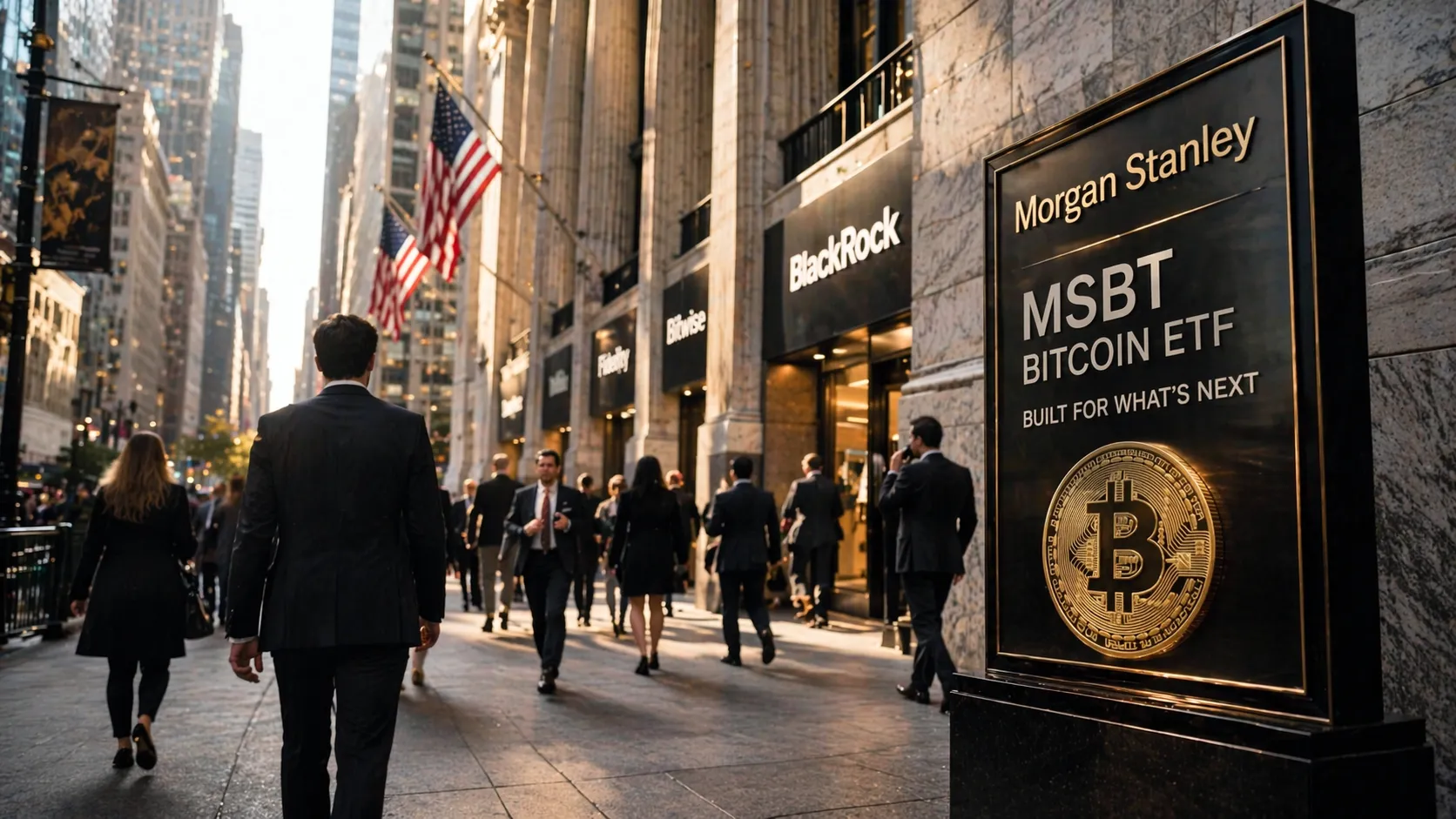
morgan stanley entered the bitcoin ETF space on april 8, 2026 at a 0.14% expense ratio — the cheapest spot bitcoin ETF on the market.
goldman is now building derivative products on top of the spot ETFs. the infrastructure layer is getting thicker.
every new product, every new fee war, every new filing makes it harder for this capital to leave. it’s not a trade anymore. it’s plumbing.
The advisory channel, without the fake stat
most of the commentary around advisory adoption of bitcoin ETFs relies on numbers that are hard to source. so let’s stick to what we can actually see.
apollon wealth management disclosed adding to its $IBIT
position in april 2026. small firm individually, but it represents a pattern. the model portfolio at your local wealth advisor increasingly has a 1–5% bitcoin allocation. that’s structural demand.
it renews every quarter when they rebalance. it accelerates during drawdowns because rebalancing mechanics force them to buy more of the thing that went down.
the Q1 flow data bears this out structurally: despite net outflows in most of the months from november through february, $IBIT still ended Q1 2026 with $8.4 billion in year-to-date inflows once march’s bid showed up.
that’s not hot money chasing momentum — momentum went the other way for most of the quarter. that’s allocators rebalancing into weakness.
this is how floors get built. not with one whale buy, but with thousands of advisory accounts systematically adding exposure on every dip.
What to actually watch
if you want to track institutional floor-building in real-time, here’s the framework:
daily ETF flows — the single best real-time signal. when net inflows persist during price weakness, institutions are absorbing sell pressure. IBIT flows led price by roughly 24–48 hours through the Q1 turn.
exchange reserves — currently at 2.7 million BTC, a seven-year low. every BTC that moves off exchanges is supply removed from the market. this metric is the inverse of selling pressure.
13F filings — stale but directional. the may 2026 deadline will show Q1 2026 positions. look for position increases from mubadala, susquehanna, millennium, and the multi-strats. if the Q1 13Fs confirm the flow data, the floor-building thesis gets stronger. if the same names trimmed, reassess.
new product filings — goldman’s covered call ETF, morgan stanley’s 0.14% spot ETF entry, any new N-1A registrations. each new filing extends the institutional infrastructure. more products = more sticky capital = higher floor.
short-term holder behavior — when STH exchange inflows spike (like the 100K BTC week in february), that’s capitulation. when they drop back to 25K BTC/week by late march, the selling exhaustion is setting in. both signals printed on schedule this cycle.
the floor-building thesis doesn’t mean price can’t go lower.
it means the recovery mechanism is getting faster and the downside is getting shallower each cycle. in 2022, bitcoin spent months below its realized price with no institutional bid to catch it.
in 2026, a 50% drawdown got met with $18.7 billion of quarterly ETF inflows, a sovereign wealth fund adding 46% to its position, and the world’s largest investment bank filing a derivative product on top of the spot ETFs.
that’s the difference infrastructure makes. the plumbing is in. the capital is allocated. the rebalancing is automatic.
retail panics. institutions rebalance. the floor rises.
data sourced from SEC 13F filings (Q4 2025 reporting period, filed february 2026), ETF flow data via SoSoValue and public ETF provider disclosures, on-chain metrics via glassnode and cryptoquant. 13F positions reflect holdings as of december 31, 2025 and may not represent current positions. not financial advice.